


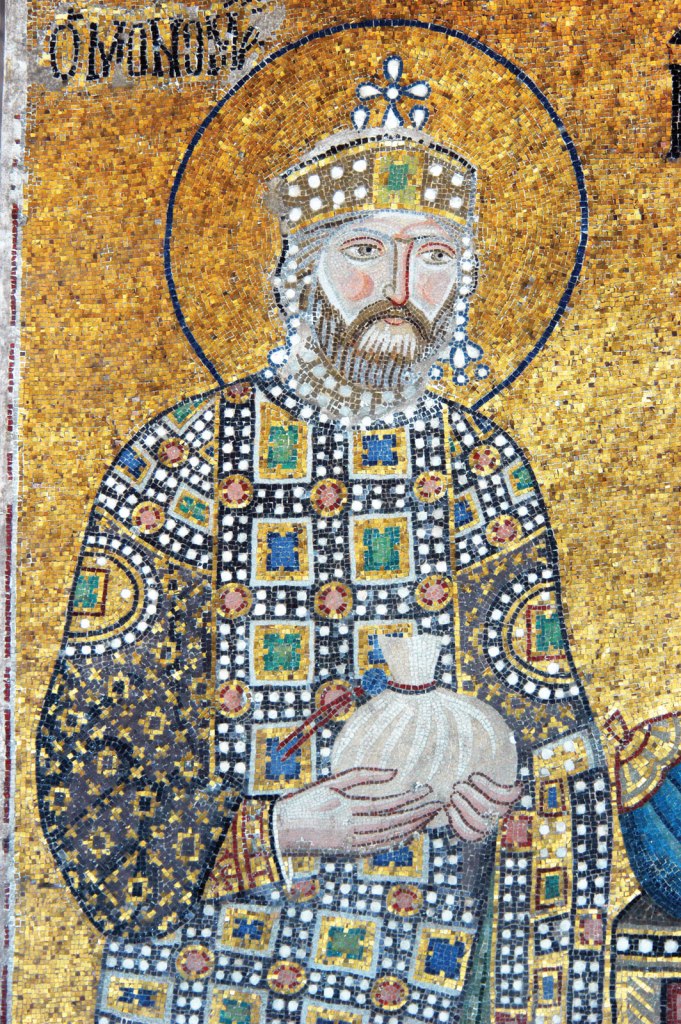
There is a very interesting story in Jonathan Harris’ Constantinople: Capital of Byzantium. It concerns Emperor Constantine IX and his mistress Maria Skleraina. Apparently, he grew up with good looks and was a part of an important Constantinopolitan aristocratic dynasty. One of the great Byzantine women of the late Macedonian age, Zoe, had taking a liking to him; this caused to incite the ire of the reigning Emperor, Michael IV and Constantine was sent packing to a monastery. His stay there was made more tolerable by the fact that he had a mistress. He was not married to her because according to Byzantine law, he was not allowed another wife as he had already married twice before.
Maria Skleraina appeared to be very devoted to Constantine IX and helped him greatly in this troubled time for him. During the time of his imprisonment in the monastery, Constantine’s political rivals were overthrown in a coup. This was one of the greatest breaks in luck for the young man; he was given another chance at political power. According to Harris, Maria was not forgotten by Constantine IX when Zoe chose him as her husband when she managed to seize power away from Emperor Michael. She was brought back with him to Constantinople. Michael Psellos, a biographer of Constantine IX, remarks how Maria was clasped in the imagination of his heart while his relationship with Zoe was more for his eyes.
Apparently Empress Zoe was fine with this. She was in her sixties at this point and considered herself too old to be jealous of Maria. With this apparent blessing of Zoe, Maria managed to retain her position in the Byzantine court. She managed to partake in important rituals and even have a say in how the state was governed. This caught the ire of the Byzantine street mob as well as important religious and political figures of the day, but as usual, the powerful get to skid past the rules and expectations of their society.
Maria’s time with Constantine IX would tragically end with her death in 1044 from chest pains. Constantine IX was apparently greatly stricken with sadness and sought to build a tomb that would represent his love for her. This church was so expensive to build that the emperor had to levy new taxes just to finance the project.
This church was the equivalent of the Byzantine Taj Mahal. That famous structure was built by a Mughal emperor for his empress who had died from the complications of childbirth. The act of building a temple to beloved shows how men have always been trying to impress their peers through their love for a woman.
Works Cited:
Harris, J. (2017). Constantinople: Capital of Byzantium. In Constantinople: Capital of Byzantium. London, UK: Bloomsbury Academic, an imprint of Bloomsbury Publishing Plc.
 Byzantine-Empire.com