


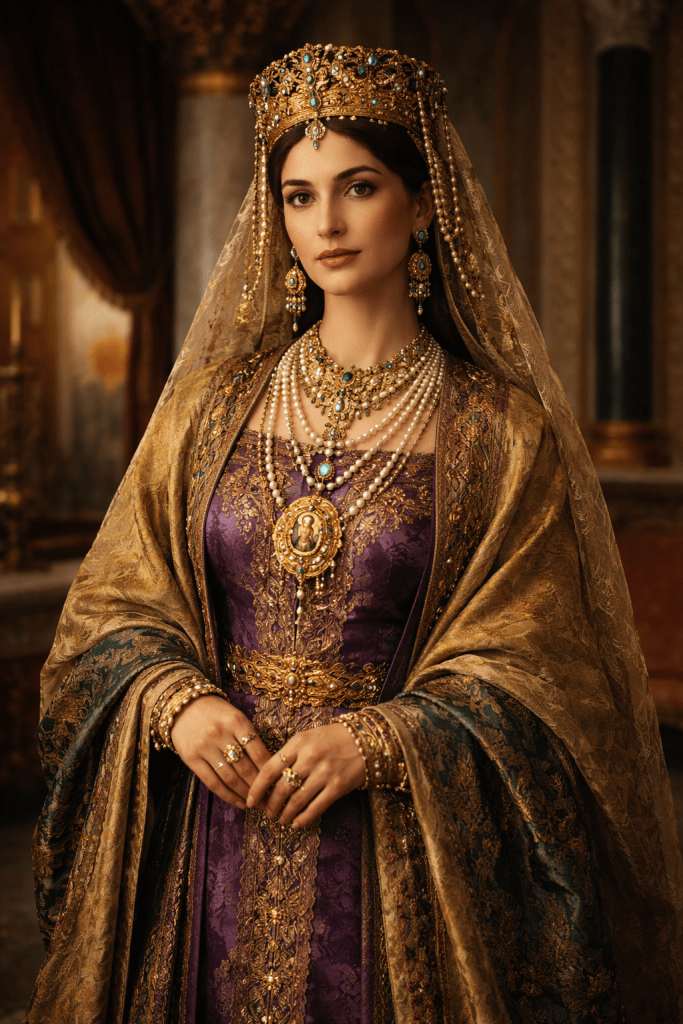
There have been many things that have been written about the status of women before the modern era. There are some that yearn for the days when gender roles were more tightly managed and controlled. Others believe differently, taking the thinking of this modern age in stride. At times there does not seem to be any reconciliation between these two schools of thought. People who are in the middle when it comes to opinions on this issue often see themselves being torn between these two camps, having to pick a side. When it comes to the history of women in the Byzantine Empire, there are many situations where women had it better than women in Western Europe and other situations in which women saw their standing get worse in comparison to the days of Classical antiquity.
The Byzantine Empire or the Eastern Roman Empire as it known by some, was a fundamentally Christian empire. Christianity dominated the social life and the law of people in the empire. Unlike the United States, which was founded on the principles of the separation of church and state, the Byzantine Empire had these two concepts combined into the government. The emperor was seen as the representative of God on Earth and this meant that religion and politics in Byzantium were linked together.
This linking of religion and politics meant that the condition of women was highly linked with the status of women in the bible. One gets a sense from the bible that women are these devious troublemakers that have brought upon man’s many problems. The reasoning was that women were more susceptible to sin than men and this was the result of Eve having tempted Adam with the apple that had been provided by the snake in the garden. This meant that women had to accept their status as means of religious punishment. The idea of sin, which was not present in Roman Empire, was prevalent in the thinking of the Byzantine system. This was different from how women were treated in Roman society; it was still conservative by the standards of the modern era, but Roman women had much more flexibility in their daily lives than would be the case in the Eastern Roman Empire.
This sort of attitude towards women became part of everyday life. The ideal for a woman, was for her to be mostly spending time at home, taking care of children and spinning wool. She was expected to be modest and not pay too much attention to her person. If she was supposed to go outside, she was expected to be veiled. Going to the hippodrome in Constantinople without her husband’s permission was grounds for divorce. Another place that was off limits for women were the many taverns that dotted the city.
There were other places in public life that women were not allowed to be in. They were not allowed to be judges or be bankers. Furthermore, they were not seen as competent to be witnesses to contracts. As one can see, the deck was stacked against women in Byzantium.
However, the Byzantine Empire bucked the trend when it came to how women were treated by giving them some autonomy. Some of this was built into the religion of the empire. In Christianity, the Virgin Mary was a sacred figure and was held in high esteem by the Byzantine population. There were also legal loopholes that gave women some breathing room when it came to their rights. Widows were able to keep their dowry as her property was separate from that of her husband. Women were also able to be parties to contracts and to make wills, even when they were married to their husband. These were rights enjoyed by Byzantine women that were not common in Europe and America until the 19th century.
The ideal of the woman who stayed at home was practiced by the landowning nobility. Women who were in the lower classes tended to be much more visible in public life, especially in commerce. Women played very prominent roles in weaving, spinning, and carding wool. Due to the charitable nature of Christian thought, some monasteries opened hospitals that were staffed by women doctors. Even prostitution, which was a tolerable nuisance in the empire, was not banned in the Christian empire. Constantinople, with its immense size, had a considerable sex trade that would have embarrassed the church authorities.
In the realm of politics, one can see several women being able to be powerful kingmakers and influence the politics of the empire way beyond that would be allowed in other empires. For example, Empress Zoe and Theodora formed a sisterhood of power in the 11th century, with them dominating several male emperors. In the street, women played important roles there as well. In 8th century, while iconoclasm was roiling the Byzantine state, women are described as leading mobs, trying to protect icons from destruction by iconoclasts.
The Byzantine woman had many laws that prevented from enjoying more rights, however, this did not prevent them from having influence in public and private life. The woman’s experience in Byzantium was not monolithic or static, which shows that the situation was more complex than is thought about.
 Byzantine-Empire.com