


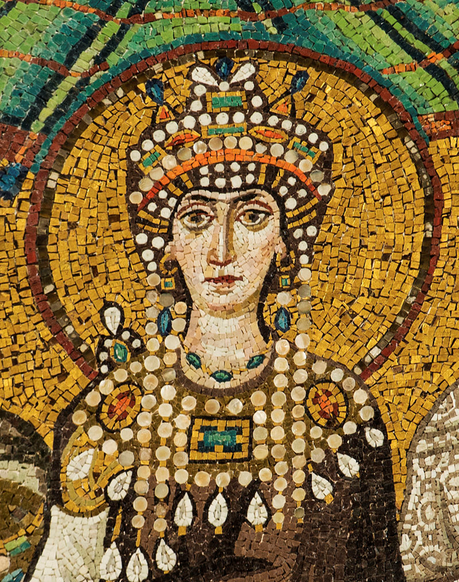
The Byzantine Empire was able to survive for over a thousand years after its foundation by Constantine the Great. In that time, there were many great emperors who reigned over the empire. Their names include Basil II, Alexios Komnenos, Justinian and others. However, the story of the empire is incomplete without the inclusion of women in the greater picture. In particular, there are two women I would like to discuss today. These two women are both named Theodora; they are separated by five hundred years of history, yet they represent the eras in which they lived. Here is the story of two of them and how they represent the status of Byzantine women in their own respective times.
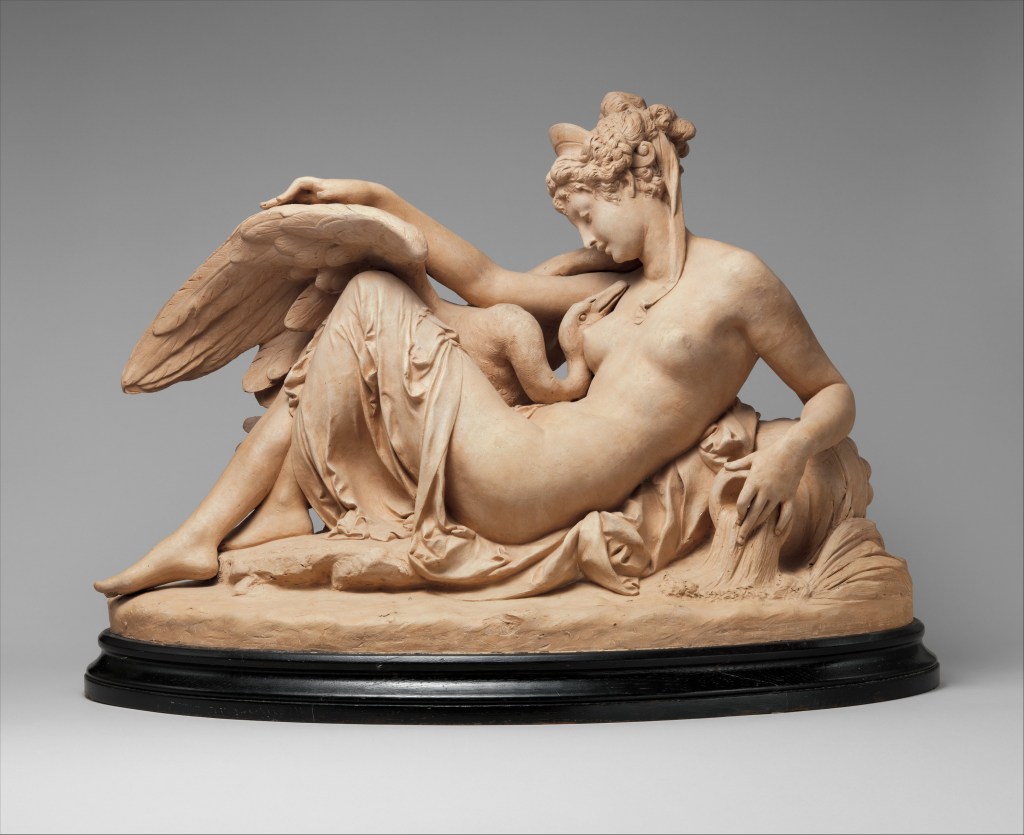
Theodora of the sixth century grew up in an empire that had survived the collapse of the Western half in the fifth century. The eastern empire, due to a combination of good geography, competent emperors and a stronger economy was able to thrive. Theodora’s life began in much more humble beginnings compared to her born in the purple 11th century counterpart. She had neither the privilege of being a merchant’s daughter or the daughter of an emperor. Theodora began her life at the bottom of the social ladder. According to the sixth century author, Procpious, Theodora followed her sister’s example and worked as a prostitute in a brothel that served high class and low-class customers. Later she would become renowned and popular on the stage; She became well-known for her portrayals of Leda and the Swan, a popular mythological story that remained relevant in the Christianized world of the sixth century Roman empire. This is another example of how the Theodora of the sixth century differed from that of her later counterpart. Theodora’s professions of prostitute and actress were considered infamia in the Roman legal tradition. She was excluded from the rights and privileges that afforded to every Roman citizen.
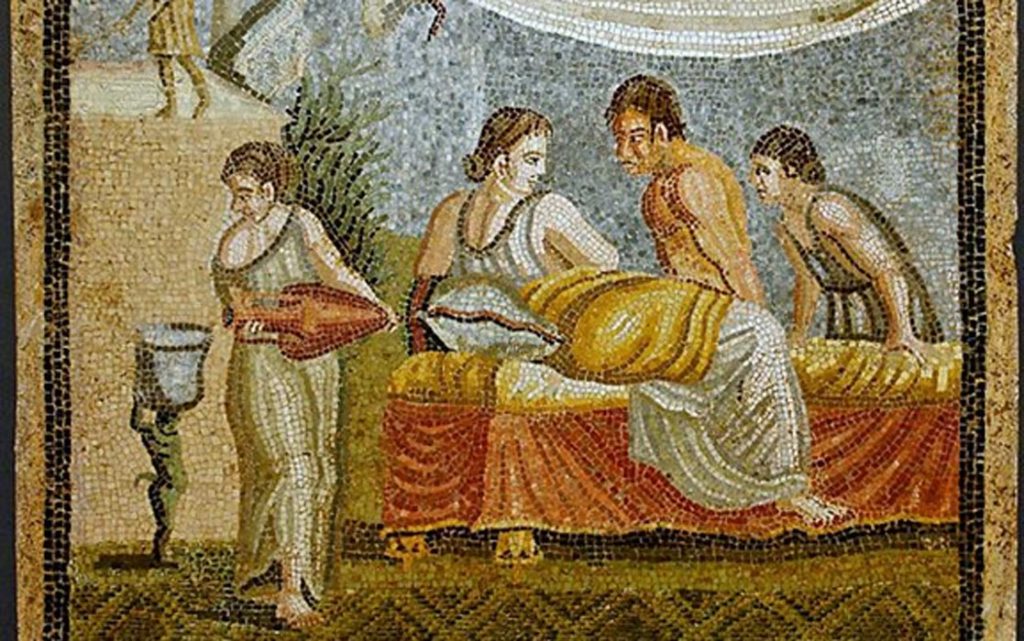
Theodora later became the concubine of a high-ranking official named Hecebolus. This relationship didn’t go well and Theodora ended up being abandoned by him. She later went to Alexandria where she met the Patriarch of the Orthodox church. It was here that Theodora began her spiritual journey, converting to Miaphysite Christianity, a sect of Christianity that holds that Jesus was of one nature, both divine and fully human at the same time.
She eventually met her future husband, Justinian. Due to her infamia status, Justinian couldn’t marry her. Eventually, Justinian’s uncle, Justin, made a law that made it possible for her to enter in a marriage with Justinian.
When the two ascended to the throne, Theodora entered a world that would be more familiar to her 11th century counterpart. The world of the Great Palace of Constantinople, with its myriad riches and many customs became part of Theodora’s life. For a woman in the imperial court, Theodora had a considerable influence on her husband’s policies. The most notable of these were her efforts to get Justinian to not abandon his throne during the Nike riots of 532. Procopius, in his Secret History, depicts Theodora giving a speech, stating that even though women were not expected to speak in a man’s council, the situation as far too grave for her to ignore. She convinced Justinian and others, who had been leaning on the option of fleeing Constantinople, to stay and fight for their rightful throne. Procopius’ portrayal of Theodora seems to imply that Justinian was a bit of a weakling in comparison to his strong-willed wife.
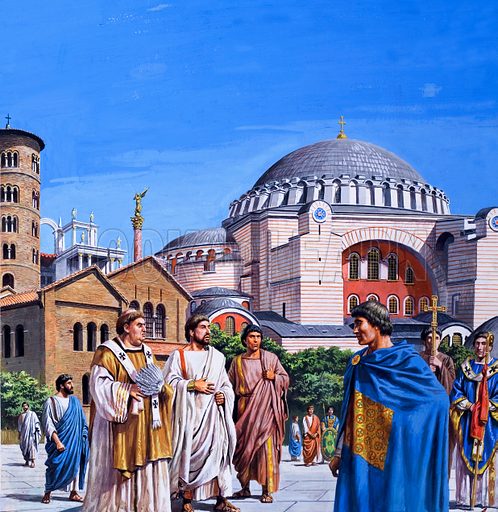
Regardless, Theodora managed to save Justinian’s throne and crushed the rebellion that was happening in the hippodrome. After saving the throne, Theodora and Justinian went about rebuilding the capital, including aqueducts, bridges and more than twenty-five churches, the famous being the Hagia Sophia. She was immersed in politics and built her own system of power, where she would make her influence known in the lives of underprivileged women. She purchased women from prostitution, freeing them and providing for their welfare. Justinian’s legislation during her period as empress includes expanded rights for women in the realm of divorce and property ownership. Overall, it appears that Theodora remembered her roots well and knew how to repay women who were in the same position she was once in. This shows that women’s rights were something that existed in the sixth century Roman Empire; while Justinian may have had grandiose visions of a united empire, he was also concerned with society at home, and with the help of his wife, managed to create a better living arrangement for women in the empire.
Theodora was also highly influential in the realm of religious policy. Her devotion to the Miaphysite faith can be proven by her founding of a monastery. Unlike her Chalcedonian counterpart centuries later, Theodora often contradicted her husband many times on the issue of religious policies. Whenever Miaphysites were being threatened with imprisonment or banishment, she would come to their aid. Even after her passing, her influence on this community and its wider relevance in the religious fabric of the empire would remain strong; Justinian would continue efforts to bring the Chalcedonians and Miapyhysites together in harmony.
Theodora’s life show what a woman could do in the sixth century Roman Empire. Despite lowly origins, she managed to rise to the top and change the lives of her fellow women for the better.
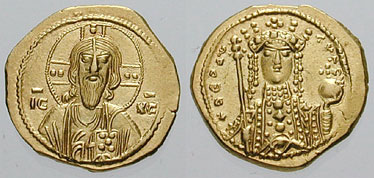
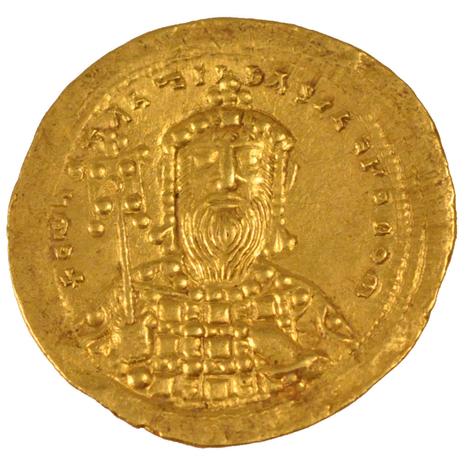
Unlike the Theodora of the sixth century, Theodora Porphyrogenita grew up in an empire that was at its medieval apex. The Byzantines, after suffering losses to the Muslims in the 7th century, were now on the upsurge, going on the offensive and conquering new territories. Her generation was the one that squandered all that Basil II had accomplished. She grew up with every privilege imaginable. Theodora lived a life that was totally different from that of her sixth century. While Theodora of the sixth century married into privilege and was essentially a social climber, the Theodora of the 11th century was born into the top of the social hierarchy. Compared to a life on the streets, Theodora lived her life carefully guarded by the third sex, Eunchs in the women’s quarters (gynaecum) in the Great Palace of Constantinople. These quarters were blocked from the intrusion of men, making this Theodora have a very different childhood yet also similarly gaining an appreciation for religion while also yearning to be able to rule.
Unlike the Theodora of the sixth century, Theodora Porphyrogenita had much more complicated family issues. While Justinian’s wife may have had to contend with laws that made her infamia in comparison to her fellow Romans, Theodora Porphyrogenita had inside knowledge on the treacherousness and deviousness of her own family members. One of the key conflicts in her life was with her sister, Zoe. The two of them conspired against each other. Zoe managed to convince her husband to appoint one of his own men as head of her household to spy on her. Theodora, unlike the Theodora of the sixth century was engaged in several plots to usurp the throne from her sister. She was confined to a monastery in reaction to a conspiracy that was hatched between her and Constantine Diogenes, archon of one of Sirmium, one of the most important cities in the Balkans section of the empire. It was there where she would remain for the next 11 years as Zoe ruled the empire with her serial husbands, Romanos III and Michael IV.
Zoe, after the crowning of the successor to Michael IV, Michael V, found herself too being consigned to a monastery. This caused a revolt in Constantinople, whose generally riotous crowds began demanding the return of the true heir to the Macedonian Dynasty, which at that point had been ruling for 170 years. Michael V was deposed quickly and Theodora, who was accustoming herself to a life of religious contemplation, was dragged out of the monastery and made co-empress of the empire with Zoe. The two of them continued to conspire aganist each other. Theodora of the sixth century definitely had her hand in court intrigue but nothing beats the strange situation in the Eastern Roman Empire in the 11th century where there was one sitting emperor, Constantine IX and three empresses.
After Zoe passed away in 1050, Theodora returned to life of religious contemplation. Unlike her sixth century counterpart, Theodora did not desire to retain her privilege and sought solace in religion. Theodora would herself on the throne once again in 1055, with the passing of Constantine IX. She proclaimed “emperor” by the senate and people despite her advanced age. Theodora, also unlike her sixth century counterpart, ruled directly. There had not been many times in Roman history where a woman ruled in her name. The example of Irene of Athens, the 8th century empress would serve as a warning by the clergy against women ruling. However, unlike Irene, Theodora managed to avoid creating a unsavory reputation. One of the most important things she did during her second reign was to bring the nobility back under control, who had been running rampant, spreading corruption everywhere in the empire after the rule of Basil II. Theodora does not seem to have had any direct legislation dealing with women’s rights in the Empire, though her presence must have been motivation for young women who were desiring the imperial throne. While the Theodora of the sixth century had a fruitful if not childless marriage with Justinian, Theodora Porphyrogenita refused to marry. Even the intervention of the Patriarch of Constantinople, who urged her to marry so that the Macedonian Dynasty would continue would end in failure. She did not want to part of any marriage, no matter how token. When she passed away at the age of 76, the 189 year rule of the Macedonian Dynasty came to an end.
One Theodora weas at the start of dynasty, while the other was at its end. What is history’s verdict on them? They come from different backgrounds. One was born with a silver spoon in the mouth, the other with a wooden spoon. My view is that both women were capable individuals who managed to steer the empire through their respective centuries. The Theodora of the Sixth Century grew up as as infamia while the 11th century one grew up born in the purple. In spite of their differing origins, they both carved out their own path in the Eastern Roman Empire and serve as exemplary examples of women with power in the history of rulers.
 Byzantine-Empire.com