


The city of Constantinople has always been an interest of mine. The city today, even though it has changed its name and has become a much more Muslim city is an incredible melting pot of different cultures and religions. I would so want to have the opportunity to walk through the streets and gaze at so much history. I find the idea that the city that was able to survive through a variety of incredible, trying circumstances to be quite inspiring. The city was like a jewel that everyone coveted and wanted for themselves to conquer and exploit. In the 7th century, when the empire was coming close to collapse, the city of Constantinople became a target. Arabs, Bulgars and Slavs would all attempt to seize the city. These were moments where the empire was at its weakest and could have fallen to the invaders. The invaders would fail however, allowing for the Byzantine Empire to continue thriving for several more centuries to come.
Constantine’s City

The idea of a New Rome has also been very appealing to me. The city of Rome held a special paet in the heart of Roman citizens. it was a city that birthed an empire that continues to influence our world today. During its height, the Roman Empire was home to a great variety of peoples. When the Western Empire fell in 476, its ruins and institutions would leave much a shadow over the peoples of Europe. The legacy of the Roman Empire has always been a crown jewel that people have sought to claim and reinterpret for themselves. Think about all the successor states that claimed a direct link to the Roman Empire. Charlamagne’s empire claimed descent from the Romans. So did the latter Holy Roman Empire. Even the Ottomans, who took control of the Queen of Cities in 1453, considered themselves to be the descendants of a great imperial tradition that started with Emperor Augustus. However, they are based on the idea that the Roman Empire fell in the West. The Roman Empire did not collapse in 476 but continued on for much longer in the East. Constantine the Great and his descendants reestablished the empire with its capital being a city that would come to dominate the mind of the Medieval European.
Constantinople as the cosmopolitan center of a Greek Empire.
I have lived in suburban areas for most of my time on this planet and I have somewhat of an affinity for the diversity that a city provides. Suburbs are boring, antiseptic places that don’t have a lot of culture. They are also places that are filled with different types of people. I would have loved to have lived in a place like Constantinople during the Middle Ages. In the Middle Ages in Europe, the city had a reputation as being a home for all types of people from the citizens of Europe all the way to the Far East. In Roderick Beaton’s excellent book, The Greeks: A Global History, he describes the reputation of the city that one visitor related to the reader in the century after the great emperor, Basil II: “The Greek inhabitants are very rich in gold and precious stones, and they go clothed in garments of silk with gold embroidery, and they ride horses, and look like princes.”(Beaton 288). Constantinople was a puddle of prosperity in a sea of economic decline and stagnation. That to me is a fascinating story to tell. The reasons for this wealth are multi-faceted and complex and I hope to explain it to you.
The Byzantine Empire managed to thrive and survive even after the fall of its Western counterpart. The empire in the East was able to succeed and weather the chaotic political storms of the 5th century due to the fact that the empire was more urbanized, and that the economy was better managed than that in the West. The Western Roman Empire simply did not have enough competent emperors to be able to help the empire grow into a more stable position. Emperors like Anastasius and Justinian were responsible for helping the Eastern Empire reach new heights territorially and economically. This sort of imperial administration was key to making sure that its cities were well-stocked and prosperous, as they contributed a great deal to the economy of the Byzantine Empire. The three great cities in the East, Constantinople, Antioch and Alexandria were jewels in the Imperial crown. A totally different situation was the case in the West, which was less urbanized and less developed than that of the East. Cities like Rome, Londoninium and Trier existed in the West, but they were in a state of decline by the 5th century, depriving the government of important government revenue. The cities in the East were important centers of commerce and religion, giving the Eastern Empire an advantage when it came to keeping its territory together. However, the other two cities of Alexandria and Antioch cannot compare with the wealth of Constantinople.
Constantinople as the successor to Rome in the Middle Ages.
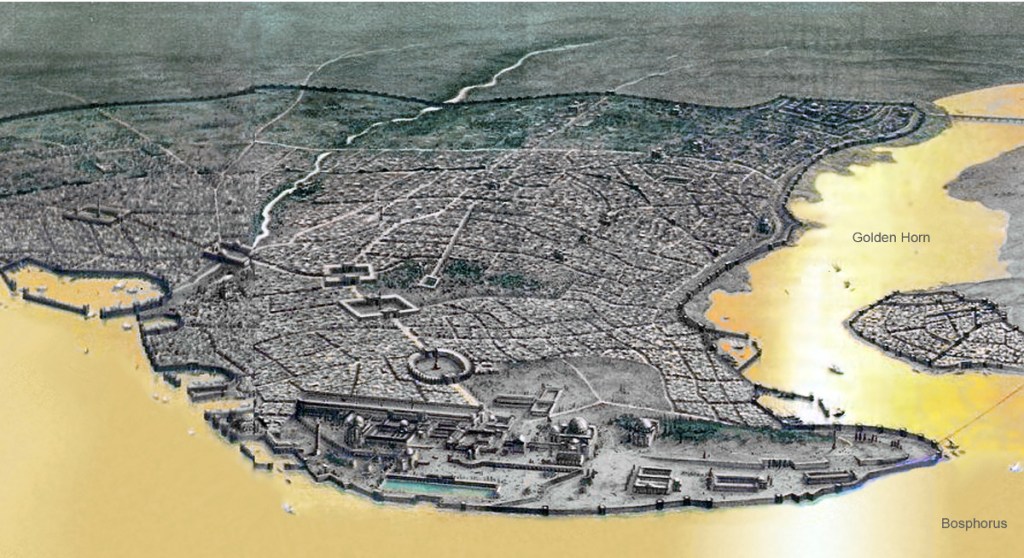
Constantinople was founded as a successor to Rome, and it was able to surpass Rome in many ways. The city was founded on seven hills and was perfectly situated in the center of the Byzantine Empire. It allowed for emperors to respond quickly to threats beyond the Danube and the Rhine. But overall, Constantinople was chosen as the site for the new capital because the Roman state was changing. No longer was the Western half of the Empire the place to be if you were a wealthy senator. It was now in the East that such opportunities for wealth and power was supposed to reside. However, Constantinople’s status as a successor to Rome went beyond Imperial capital; it was a place to be seen and in the aftermath of the Western Empire’s fall, it inhabited a special place in the imagination of Western Europe as well as Eastern Europe in the Middle Ages.
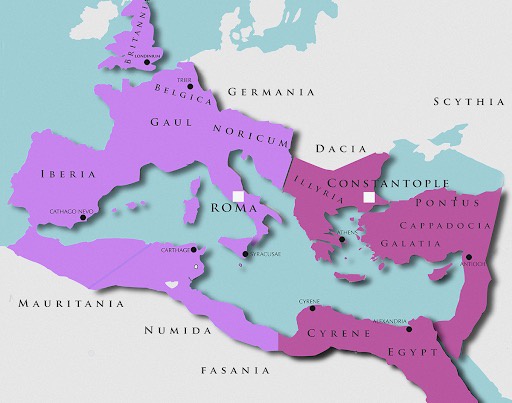
You have to remember that this is in the aftermath of the fall of the Roman Empire. The Roman state was an economy that stretched from England all the way to Syria. It was a titan of economic growth and trade. However, in the aftermath of the fall of the empire, the economies of Western Europe were much smaller. Urbanization had receded and many people now lived in villages. Though many people in the Roman Empire had lived in villages as well, they were connected in a vast economic system that saw trade blossom across the empire and all the way to India. In the Middle Ages, towns were walled and were becoming more self-sufficient. The urban culture that had once characterized Classical Antiquity was now receding into the collective imaginations of a long gone, glorious past. It was as relevant to people’s lives as the ruins in the city of Rome itself. Those ruins were simply repositories of stone to be used for the construction of inferior buildings. People’s views of their lives had become smaller. The life that you lived was largely the village and that was it. If you lived in a town, then your life became larger, but cities were largely trying to be self-sufficient during this time period, allowing for everything that they needed to be made within the city walls. Villages were also self-sufficient with trade being a minor part of how it affected people’s lives. People largely lived off the land and the idea of a city where people were wearing silks and every sort of luxury possible seemed like tall tales to them.
Constantinople in the Imagination of the Medieval European

It is with no mistake that Constantinople inhabited the minds of Europeans in the age of the economic decline and stagnation. If you were living in a village that had very little of the amenities of Constantinople and someone came to you saying that there was this city that contained great silks and roads filled with gold, you would hardly believe him. One visitor to Constantinople, an unknown visitor from the West, describes the polyglot characteristics and wealth of the city: “There are many thousands of people dressed in garments made entirely of silk and also many people of different faiths and speech”(Harris 29). The wealth of the city left quite the impression on the visitor, who was keen on pointing out how diverse the city was and how people were walking around in silks. However, such statements would leave much to building the myth of Constantinople. In the 11th century in particular, the myth grew in the land of the Slavs. Many men from the Slavic regions came to Constantinople to make their fortune. The city was often known by its name, Miklagrath, in the foreign sources. It was a magnificent place filled of wonder and beauty. The Eastern Romans were clearly trying to take advantage of this in their trademark diplomacy. They used the wealth of their city to the best of their abilities. Basil II used the lure of wealth in Constantinople to get the Varganian Guard started. Alexios I of the latter Kommenos dynasty used that wealth to pay off several barbarian invaders.

Why were the sources of Constantinople’s wealth?
There were many factors that allowed for Constantinople to become a prosperous city that would dominate the Western imagination for years to come. According to trademark book, The Byzantine Economy by Angeliki E Laiou and Cecile Morrison, one of the important factors was the fact the Empire was centered in the Mediterranean. The Mediterranean nature of the empire lowered transportation costs and fostered trade between the many lands of the empire (Laiou and Morrison 13). Land transport was always more expensive before the industrial revolution. Even today, water transport is considered to be more conducive towards transporting goods across great stretches of ocean. According to Laiou and Morrison, the sea provided for the provisioning of cities with great amounts of fish and salt (Laiou and Morrison 15). Salt could be produced in great amounts across the empire, providing citizens with vital resources that could be allowed to preserve large quantities of meat in a crisis.
The Byzantine Empire’s Advantage: A dense and big population
However, another factor that made Constantinople wealthy was the human factor. The Eastern Roman Empire had a population in the 11th century that had population densities that were comparable to Greece in the 1961 Census (Laiou and Morrison 16). In the age before widespread mechanized machinery, human labor was important to the maintenance of farmland and other important economic activities. The Eastern Roman Empire had a population of between 21 and 30 million inhabitants in the reign of Justinian before the great plague would reduce population densities. The city of Constantinople would reach 450,000 during the reign of Justinian and it would go through a series of troughs and heights until the 11th Century. During the 11th century, the population of Constantinople was estimated at around 350,000 people. This means that there were more people living in Constantinople during the time of Basil II than were living in many sections of England at the same time. Having such a large population is conducive to the building of markets and an economy. Furthermore, the authors explain that the rise of the nuclear family in comparison to other family groups helped to stimulate growth and investment in the economy. Pressure from the church seemed to have been responsible for this change in how people ordered their families. The Nordic family model of the 11th century in comparison was more kinship-oriented and did not allow for the growth of independent wealth holders.
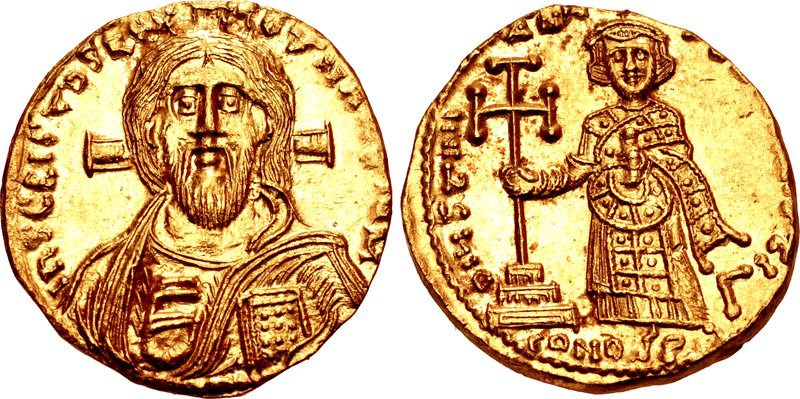
In an age before photographs and other distant means of communication, coinage was an important way for the ideas of the empire to be spread from each corner of Europe. The Eastern Roman Empire was able to maintain a stable monetary economy for well over a millennium, many years before economies in Western Europe were able to do the same thing. Many Roman coins circulated throughout Europe as a form of currency in those territories.
Another element to the wealth of Constantinople and the greater empire was the literacy rate. In today’s society, literacy is recognized as an important skill that has to be mastered at younger age. In comparison with the earlier, classical Roman Empire, the Eastern Roman Empire was located in the regions of the old empire with greater amounts of civilizational development than in the west. For example, saint’s lives seem to indicate that elementary education was available to families of modest means in the countryside during the time of the Eastern Roman Empire (Laiou and Morrison 20). According to Laiou and Morrison, studies done on the topic of literacy in the Eastern Roman Empire indicate a literacy rate that was comparable to 18th Century China and superior to that of Eighteenth Century France. This shows that the Eastern Roman Empire was a more developed society than that of its Western European peers. One can see how this greater development would lead to the concentration of wealth in the capital, where all the goods and services could be enjoyed by the urban elite and middle classes. In comparison, Western Europe was a largely illiterate society, with kings relying on the clergy to help them in governing and dealing with important matters of state.
Another important aspect of the Byzantine economy that made Constantinople so wealthy was its silk production. Silks were originally a high-status item, but they were used in diplomacy as well. These silks were often given to foreign monarchs across Europe. Constantinople was a center of silk production, its factories serving an increasing urban demand for silk as the empire continued to prosper even with the Seijuk invasions of the latter 11th centuries.
Trade: The Foundation of the Byzantine Empire’s urban wealth
Probably one of the main reasons that Constantinople was such a wealthy city was because of its position on the Silk Road. The city was located on the European end of the Silk Road, and this was a vital staging area for merchants who were heading out to civilizations of the East. 25% of the GNP of the Eastern Roman Empire in the twelfth century came from trade (Laiou and Morrison 136). Traders from many parts of the world were present in the city of Constantinople, giving the city an international feeling. In the late 11th century, there would be an increase in the freedom of trade as concessions were given to Pisan and Venetian traders. No longer was Constantinople just a closed trading port, it would have the characteristics of the free trade that is part of the world economy today. This meant that goods and money was flowing into the city from multiple directions, without restrictions. The city exported silk, perfumes, spices, salt, wine, oils and meat. It also exported Nestorian Christianity, which had adherents show up as far as China. According to Laiou and Morrison, before the great upheaval of the 11th century, the spice trade passed through Asia Minor and went right into Constantinople. Overall, the city was an important trading center that would not be challenged by Western Europe for several centuries to come.
Another aspect of Constantinople’s great wealth was the fact that it was an important city for the consumption of goods. The Byzantine aristocracy was an urban one in particular and there was elite demand that stimulated the economy. The urban middle class was also interested in what the aristocracy were buying, and this also stimulated the growth of the commerce and trade in the city.
Constantinople had a well-deserved reputation for its times. The city was a melting pot of many cultures and languages. Though there was still poverty that lingered in the city, Constantinople was a place of dreams and fortunes in the Middle Ages. Through a mixture of location, population and good imperial administration, Constantinople was able to prosper and survive through the many centuries.
Works Cited:
Harris, J. (2017). Constantinople: Capital of Byzantium. Bloomsbury Academic & Professional.
Laiou, A. E., & Morrisson Cécile. (2010). The Byzantine economy. Cambridge University Press.
Beaton, R. (2021). The Greeks: A Global History. Basic Books.
 Byzantine-Empire.com