


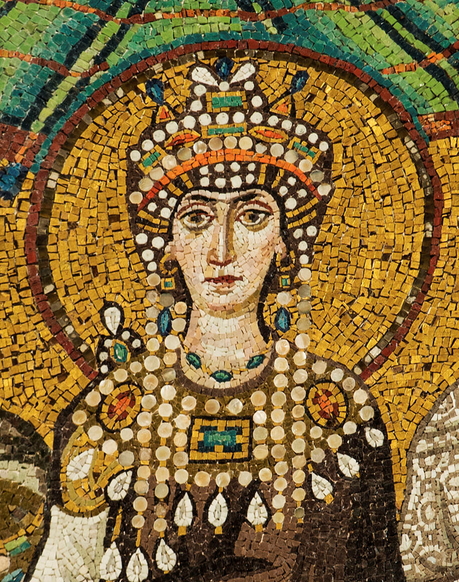
It seems to me that Procopius was the type of insider in politics that I would love to be able to interview. The things that he had seen makes him a great primary source for the sixth century. He was present throughout important events, such as the wars that Justinian waged with his trusty generals Narses and Belisarius. He was also present at the important Nika Riots; he also saw the impact that the plague brought to the Byzantine Empire. However, nothing is as salacious or as interesting as his book, Secret History, which was written in secret and spills the beans on all the important political figure of his time. In the book, Procopius wastes no expense on savaging the rulers of the Byzantine Empire. He criticizes Justinian for a variety of reasons, but he also casts his anger at his wife, Theodora. It is in the Secret History that Procopius unleashes his attacks upon two women of the empire, Theodora, wife of Justinian and Antonia, the wife of Belisarius. I have always thought highly of Procopius, believing that he took the right decision in writing the Secret History, and giving us such salacious details for us readers in the present. However, when it comes to women, it is interesting to see how Procopius frames these two women. Within the philosophical framework of the age, he reveals the biases and the hopes and fears of the aristocracy in the sixth century Byzantine Empire.
The Gynocracy or Procopius’ Obsession with women with Power
One of the main themes that dominates the beginning of the book is of powerful figures being cuckolded by their wives. In this particular case, we are dealing with General Belisarius and his wife Antonina. It is no surprise that Procopius calls the chapter the “Gynocracy” representing how he believes that the government is not being ruled by men but by women. In the Sixth Century Roman Empire, we have a patriarchal society where men are expected to run things. Despite the influence of Christianity, women are still considered to be second-class citizens. Though despite this, women in the later Roman Empire retained rights such as the ability to inherit, own, manage their own property, and sign contracts.
Procopius’ Attack on Antonina
Procopius makes sure to attack the character of Antonina, claiming that she lived a wanton life and showed no restraint. He relates an episode in Antonina’s life, when she was attracted to a man named Theodosios. This man was an adoptive son of Belisarius. Antonina and this man, according to Procopius, were caught in the act by Belisarius, but Belisarius had the wool put over his eyes. He makes it seem like Belisarius has no willingness to defend his masculinity, allowing his wife to dominate him, which according to Procopius. Antonina is so shameless according to Procopius, that she begins to plot against her own son, Photios. In Procopius’ narrative we get a sense of that Antonina is a super villain, whose lust exceeds human abilities.
Procopius’ Attack on Theodora
Empress Theodora doesn’t escape the ire of Procopius either. He describes her relationship with Antonina, and how she tortured Photios in order to garner information out of him. He goes into her background and mentions how her mother made her whore herself on stage. He describes her wanton behavior in a way that puts Antonina to shame. It is stated that never had been a person so enslaved to lust in all its forms (Procopius 42). One of the common themes between Theodora and Antonina is their lust and their eagerness to commit acts of violence. In the Byzantine Empire, women were expected to control their natural urges, as they were the descendants of Eve, therefore being more susceptible to sin. Procopius’ perspective is that of someone who wants to slander who he sees as ruining the proper order of the state.
Procopius’ Attack on Theodora’s running of state
Procopius provides salacious details to the past of Theodora but there is more to his narrative in the Secret History. He describes how Theodora manipulated the fan clubs of Constantinople aganist each other: “She put on that she supported the Blues with all her might and by authorizing them to move against their rival militants…(Procopius 49). The Hippodrome was the beating heart of Constantinople’s social life; manipulating this scene shows a desire for gaining more political power. Theodora, who came from the streets, probably wanted a piece of the action for herself. The Blues and the Greens were legendary sporting teams that formed mobs in the capital that often fought with one another. They would be responsible for the mass rioting that would occur during the Nika Riots in 532. It is not surprising that Procopius calls this section of his book “Justinian and Theodora Unanimously Sow Dissension”.
In another section, “The Demonic Nature of Justinian and Theodora”, Procopius goes back into Theodora’s background and states that she had demonic characteristics: “It is likewise said by some of Theodora’s lovers-this was in the days of her stage career-that some kind of evil spirit materialized among them and drove them from the room where they were planning to spend the night with her”(Procopius 60). The nature of this attack show the importance of religious allusions in Byzantine society and culture. Procopius began his attacks on Theodora by focusing on the secular but could not resist to go into a religious-motivated attack. Procopius’ rhetoric is reminiscent of how Republicans and Democrats tend to relate to one another. The other side is absolutely evil, devoid of reasonable characteristics. It is not surprising that 1500 years ago, the same type of rhetoric was being used. Procopius was clearly set against the Justinian regime so his rhetoric makes complete and total sense. He wants to show his seething anger against Justinian and Theodora and wants to show he wasn’t some cowardly lackey that appealed to all of their whims.
In another section, “The Lifestyle and Crimes of Theodora”, Procopius further describes his problems with the Empress. Unlike Justinian, whose crimes that Procopius states that was rooted in the sort of person he was, Theodora had her mind rooted in inhumanity. She had full power over her actions, and it was never forced upon her (Procopius 68). This shows the difference between Justinian and Theodora in their treatment by Procopius. Procopius seems willing to write off Justinian as a tyrant because that was rooted in his personality. Theodora on other hand, is given no reprieve by Procopius. There is something special about her inhumanity. It’s as if it is demonically inspired. For Procopius, being a god-fearing Christian that he is, he truly believes that there is a conspiracy of demons controlling the government. This sort of state of mind is probably understandable considering the Christian takeover of the Roman state in the 5th and 6th Centuries. By the time that Procopius is writing those words, Christianity had become the dominant religion of the Roman state. These sorts of written conspiracies about the state of mind of their leaders is not surprising. I remember all sorts of statements that written about US Presidents, about how they were devil in the skin of a human, or how they were possessed by demons. It seems that is one continuity with Byzantine and American culture; We both look to religion to find the truths that we seek about our troubled times.
In the “Demonic Nature of Justinian and Theodora”, Procopius describes how both of them were man demons who put on human form. He says that other people have caused harm to the world before, but this pair took it to another level (Procopius 58). He states that Theodora’s demonic nature was preordained, as if the demons of the spirit realm were interacting with Theodora’s mind: “It is said that Theodora then declared that a dream-vision had appeared to her that past night telling her not to worry about money anymore. For she would go to Byzantium, slip into bed with the lord of Demons, and that every method would be used to make her as his wife. As a result, she would be the mistress of all the money in the world. (Procopius 61). Procopius is really obsessed with Theodora’s seductive abilities and willingness to seduce men that he attributes it to demonic possession. The magic that is taking place in Procopius’ narrative really seems to indicate that he is focused on the supernatural reasons for why the Byzantine state is in such bad straits. The Byzantine Empire was a land filled with superstition just like it had been in Roman times; seeing Procopius use such rhetoric in his statements about Theodora is not surprising to me. There is even a passage in Procopius’ narrative where he states that Theodora’s future husband, Justinian, was not the son of any mortal man. This has the feeling of being like something out of Star Wars or some other fantasy type of story. There are demons prowling around the world, waiting to inhabit the bodies of women in order to create willing servants for their agendas. Procopius seems unwilling to ascribe secular reasons for the state’s issues; it seems that he needs go into hyperbole in order to make his point.
Procopius describes how Theodora would was an adept liar just like her husband and was considered someone not to be messed with. He states that Theodora would fabricate trumped up charges against men who had angered her (Procopius 69). He describes how Theodora would pervert the justice system to fit her own whims, handpicking justices, and they would all be competing to see who would be able to satisfy her whims. When it was one of her own cronies who had been arrested, Theodora would make sure that the justice system had its wheels greased so as to benefit her and her faction.
Procopius’ treatment of Theodora in the Secret History
Procopius’ treatment of Theodora in his text shows a man who is writing under stress. He cannot possibly let out such secrets of government leak out onto the public stage. It is the reason that Procopius decides to write such words in such a way. He is desperate to let out some steam about the travails of being a historian in a decaying empire. His narrative is filled with examples of how Theodora and Antonina have ruined the government and the morality of men in it. The hopes of Procopius is that the government could freed from the vile influence of these women and Justinian as well. The author seems like a man who wants the empire to prosper and for the people to do live according to principles of Christianity. For Procopius, women like Antonina and Theodora are part of the reason for the empire’s despair and troubles. They emasculate good men like Belisarius, consort with demonic men like Justinian, and just overall cause problems for the whole state.
Procopius is clearly biased. His mentality is that of a 6th century Roman, who with paganism in the rear-view mirror and Christianity triumphant, wants a state ruled by moral people who live by the teachings that are prevalent throughout the empire. He clearly wanted men to be ruling the state which isn’t too surprising considering the entrenched patriarchy of the 6th Century Roman state. For him, Justinian and Theodora aren’t just bad rulers, they must be the worst. This sentiment seems to be the case with every US President as it seems, creating yet another link between the 6th century Roman Empire and the United States.
The Secret History is a very interesting book to read. It contains tons of salacious tell-all details that I find incredibly bizarre and yet tempting to go through. It is one of those type of narratives one expects to find in those beltway books that get published by people in the former administrations of Presidents. It is a book that reminds us that the more things change, the more things remain the same.
 Byzantine-Empire.com