


Jesus, Yeshua, Joshua, these are the names of one of the globe’s most influential and important man in the history of the religion that bears his name, Christianity. Jesus has been one of the most transformational figures in the history of the globe. When he was born of a Virgin by the grace of god, the air that he breathed was pagan air. The Roman Empire was a pagan empire based on pagan traditions. Jesus existed in a community that was monotheistic, which was called Judaism. They were under control of the Romans for some time. Little did they know that this obscure boy from Judea was going to be a revolutionary. who was going to be a changer of the philosophical system of the empire.
To the Romans, Jesus was nothing more than a long series of false messiahs who was going to overthrow the Roman state. The Sanhedrin put Jesus on trial, had him executed on the cross outside the city of Jerusalem. It was here that the great story of Christianity would begin.
In the years after the passing of Jesus, one has to consider how infrequent the depiction of Jesus was. His symbols, the cross, the fish were all incredibly popular symbols of early Christianity. However, when it came to the man himself, there were some contradictions in the main texts of Christianity, the Gospels. The gospels were written some fifty to sixty years after the crucifixion of Christ. The depictions of Christ may have been different from what he was in real-life. In the traditional gospels, he is depicted as a human as well as the son of the divine being, known as the Judeo-Christian deity. In the accounts of his life, he is depicted as a leader of the downtrodden. He is depicted as a man commiting several miracles that attract the attention of the Sanhedrin, the Jewish authority that regulated the lives of Jews in the province of Judea. They felt threatened by him and sought Roman aid to deal with him. What followed would be one of the greatest stories ever told in the history of holy literature.
Jesus’ in the years after the crucifixion would be depicted on both sides of the religious spectrum as either a charlatan or the savior of mankind. His image was used in graffiti done by pagan romans in order to mock him. However, depictions of Jesus would remain rare even through the Christianization of the empire.
When Constantine the Great converted to Christianity in 320s, Christianity emerged as the major force in the Roman Empire. Even at this point, the depictions of Jesus were still rare.
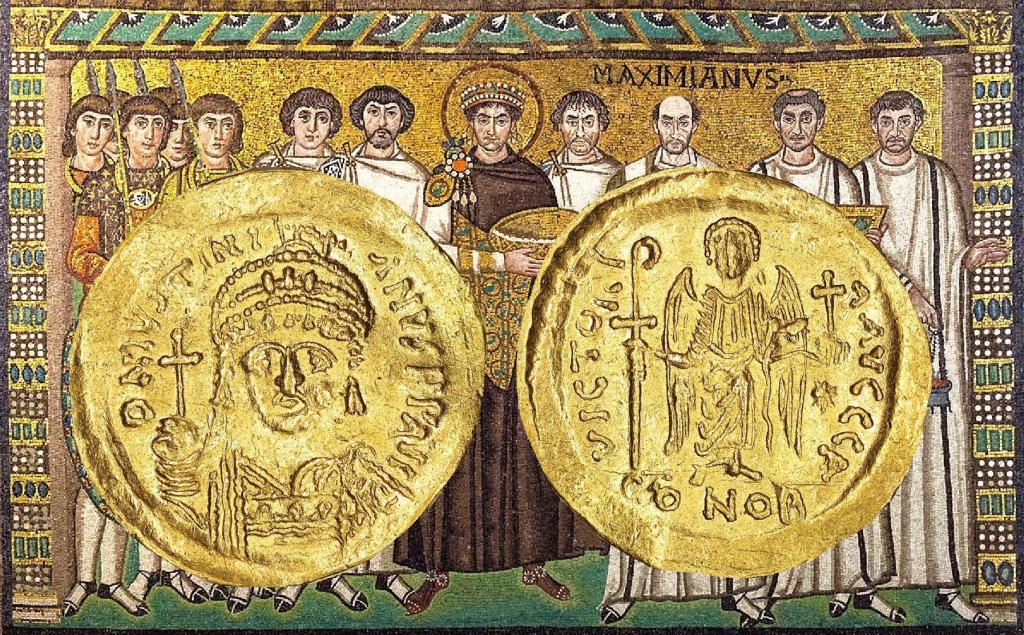
On Roman coins, depictions of the emperor with the sun god, Sol Invictus were common. By the time that the empire’s capital had moved to Constantinople, Roman coins generally had symbols of the Chi-Ro and the emperor. There were still no depictions of Christ even during the early triumph of Christianity.
In the age of Justinian, the statue that he ordered to be built to commerate his victories in Northern Africa were a sign of changing times. On this statue was a figure of Justinian himself with a horse holding on an orb with a cross on it. This shows that Christianity was infused with the Imperial identity of the old Pagan Roman Empire. Such a fusion of Christianity and Imperial Roman militarism was common in the Eastern Roman Empire. However, even during this time, Christ was still not being depicted on coins.
The Seventh Century was a century of missed opportunities for the Eastern Roman Empire. It started with a great war with the Sassanids. It began when the Emperor Maurice was overthrown and executed by the usurper Phocas. The Sassanid Emperor intervened to invade the Roman Empire. He had initial success, with Roman resistance being quite token. When the Sassanid Emperor did receive some resistance, the Byzantines were easily rolled over by the motivated Sassanids. The war went back and forth for several years until the Byzantines would regain the initiative and the reconquer the lands that were taken from them. By the time that the Muslims would swarm the region, the Byzantines, despite their zeal and restoration of Christian sites wrecked by war, were utterly exhausted. The Sassanids, would end up being conquered by the Muslims in span of a few years.
By the time that Heraclius’ descendants were on the throne, the Muslims had conquered a swath of territory from Iran to North Africa. The Eastern Roman Empire would have to consolidate its position and reform their government. By the 690s, the transition from a latin-speaking Imperial state to a Greek speaking rump state was well underway. It was around this time that the first depictions of Christ would be seen on coins.
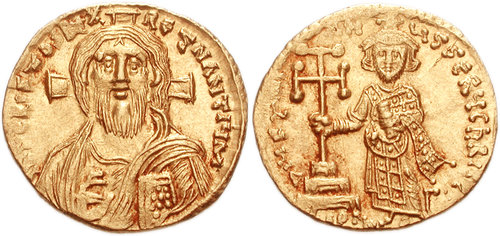
During the reign of Justinian II, the depiction of Christ was first seen. This depiction of Christ shows the man with eyes facing the viewer. He is depicted as having a beard and having a Caucasian appearance. He is in an cat of benediction and holding the gospels near his chest. This image is often described as the Christ Pandokrator ”ruler of all things”. This was to mean that Christ was above all the rulers of the globe. This was quite a change from the Pagan Roman Empire. The many regimes that dominated the Eurasian basin during the time of Christianity’s birth were dominated by the thinking that leaders were gods and should be obeyed. Augustus, while he may have given some respect to the Republic, he was indeed building an autocratic state. The Parthians and the Sassanids were also states that had monarchs as God kings. The shah in Iran was considered to be an absolute monarch. Christianity put the emphasis on Christ not the Caesars as was the case with the emperor’s cult. The emperor would still be represented on Byzantine coins, but Christ would be the central part of the state’s ideology of being god’s kingdom on Earth.
Throughout the years leading up to the fall of the Eastern Roman state in 1453 to the Ottoman Turks, Christ would be a central figure in Byzantine coinage. It was an important moment for the religion. It would set the stage for the depiction of Jesus Christ for centuries to come.
 Byzantine-Empire.com