


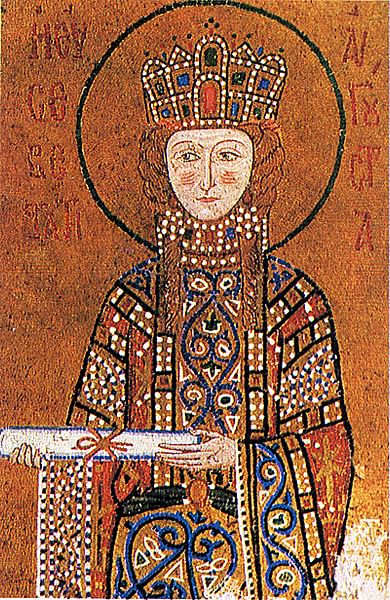
The Roman Empire was a very patriarchal society in comparison to modern society. In general, since the days of the Roman kingdom, there was a system that was put in place that allowed for men to have supremacy over that of women. This continued in the Byzantine era, even with the introduction of Christianity.
In the early Roman kingdom, women were generally considered to be inferior to men and had fewer rights. However, the Romans developed a curious mythology around women during this early phase of their history which would color their views and attitudes of women. Unlike their neighbors in Ancient Greece, Romans seemed to allow for women to have a limited form of citizenship and also to have more autonomy than was allowed in many places in Classical antiquity. This attitude would find itself all way in the early period of Byzantine history, even as Christianity was transforming the way that people thought about themselves and their relationship to the divine. This spiritual transformation also found itself affecting the rights of women in the Byzantine Empire.
The Roman Kingdom and the foundation of Byzantine beliefs
In order to understand the Byzantines and the way that they viewed women, we have to go back to the Roman Kingdom. It is during these times that we see the foundation of Roman culture, which would continue to be communicated through the centuries into the Byzantine age. This is to show that while cultures change, many continuities are found in the cultural attitudes of those cultures.
The Roman Kingdom generally begins with the fleeing of the Trojans after the Greeks began looting and rampaging through their city in the Late Bronze Age. Many of these refugees ended up in Italy and founded a city called Rome. In terms of the historical record as discussed by historians, it’s possible that Rome started out as an Etruscan city that was eventually overthrown by the Romans.
Romulus and Remus, the traditional founders of Rome were not raised in the traditional manner. They were sons of an Italian princess who was raped by a divine creature. Much like the legend of Gilgamesh, they were abandoned in basket and set upon a river. They were raised by wolves and then picked up by Acca Larentia. In some tales, Acca Larentia is referred to as a prostitute. In the Roman mythology, the fact that a woman of such a lowly stature could have such an important role in the founding of the city is a testament to the contradictory views that Romans held about women.
Regardless of how the city began, the Roman Kingdom began roughly in the 8th century BCE. A series of kings came and went, with the city eventually increasing its influence and power. By the time we get to the Roman king, Sextus Tarquinius, the Roman Kingdom had been reigning for over 200 years, yet it only controlled a small portion of the Italian peninsula.
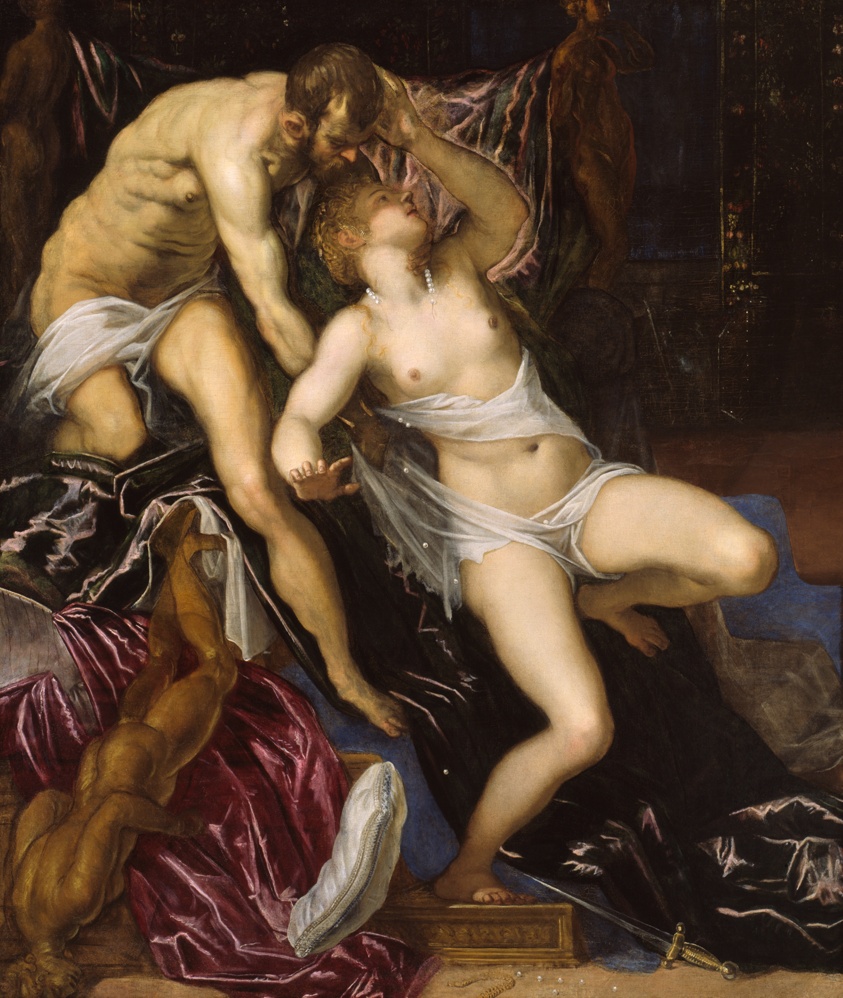
One of the stories that is told that about Sextus Tarquinius talks much about the Romans thought about women in their myths. This story involves the rape of Lucretia, a Roman noblewoman. Apparently, during the siege of the city of Ardea, the king sent his son, Tarquin to meet with a governor of Collatia.
It was there that Taruin and Collatinus were debating the virtue of wives when Collatinus decided to settle the debate. It was during this debate that the virtue of Lucretia was revealed; She was apparently weaving with her maids. With her virtue proven, she is awarded with the palm of victory and Collatinus invites Tarquin to stay.
However, Lucretia’s virtue would come under threat from Tarquin when he would infiltrate her bedroom and offer her the queenship if she would sleep with him or he would take her life and make it seem like she was sleeping with her one of her slaves.
Lucretia stands firm to not to sleep with Tarquin but he ends up raping her, a shocking act of violence by the king’s son.
The woman ends up telling her father and husband and while they are debating what to do, she commits suicide by stabbing herself with a knife. The scene that happened was so powerful that they people decided to take action and overthrow the monarchy.
What does this tell us about the virtues that Romans thought was important in women? It tells us that the old values of pietas, pudicita, and concordia were incredibly important. Spinning your own cloth, maintaining a well-regulated household, and the raising of children was incredibly important to the virtues of Roman women. Lucretia’s actions show that the honor of one’s household was important for every Roman woman in the Kingdom and later the Republic. Though Lucretia was a noble woman, she had, through the act of sacrificing her life, had become an important figure in the movement to overthrow the monarchy and establish a republic. Women had a role to play in the politics of the republic even though it would be largely in the background. She represented the virtues that every Roman woman should have and this was considered vital for the functioning of the Republic. The virtues would be ingrained in the Roman psyche for centuries to come and by the time we get to the period that is relevant to this blog, the Byzantine era, would not have changed that much, even though Christianity transformed the way that Romans looked at women and what the valued in them.
This is not to say that there were no in-between periods of change for the status of Roman women in the Republic and then later Empire. In the late Roman republic, there was a growth of self-assertive women that the Roman emperor Augustus tried to stop. In some ways, he was successful and in others he was not. However, this was largely confined to elite women in the empire, as the lower classes tended to be less strait-laced about their morality compared to the elite classes.
At that time, elite women were generally not interested in Christianity. It was generally the lower-class women who led the charge to the Christianize the Roman Empire.
Ancient Greece and its influence on the Byzantine Empire
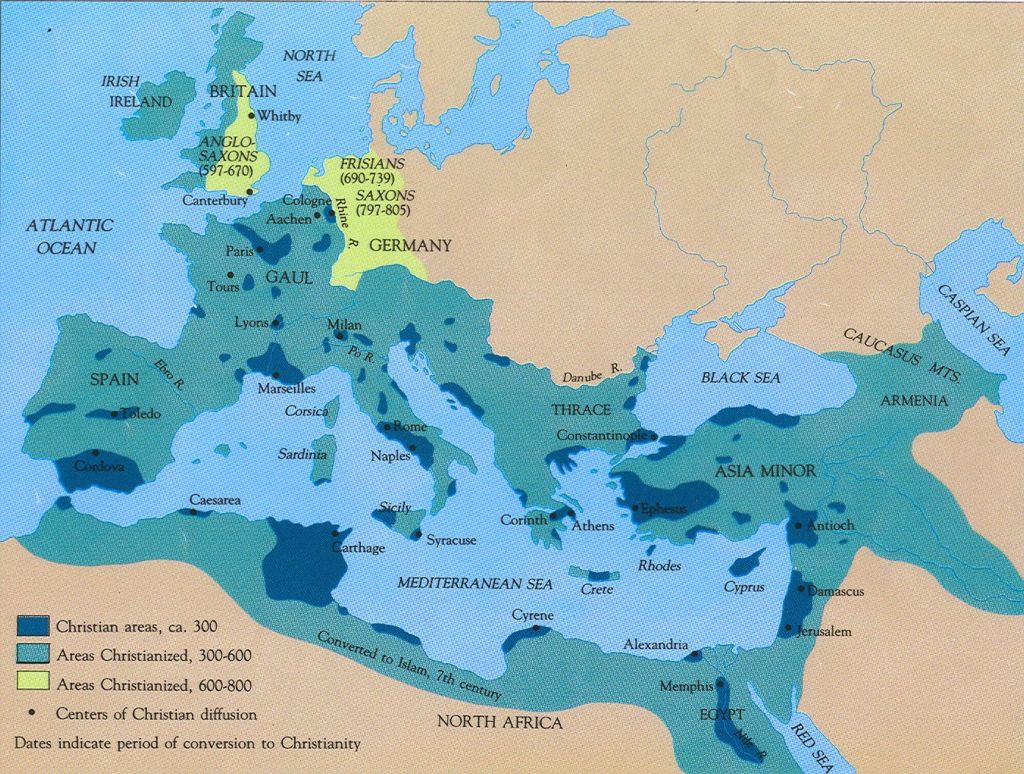
The Roman Empire was a huge empire that was also diverse in its cultures. The Western part of the Roman Empire was Latin speaking and considered to be the ancestral heart of the empire. However, the Greek part of the Empire, the Eastern part was becoming spiritual heart of the empire. Many of Jesus’ disciples made their impact on the empire well known in the East before coming to the West. Cities like Antioch, Thessaloniki and Athens were highly influential in the development of Christian thought. Christianity would come to the West later. The Western Roman Empire would remain pagan longer than that of the East. So, one can see that Christianity colored the Greek East more than that of the West. However, as one can see on this map, Christianity had clearly spread throughout the entire empire, even if those were only in pockets of the Roman Empire.
Importantly, there are some distinctions between the Ancient Greeks and Romans would feed into this strange concoction that would be the Byzantine Empire. In the East, women were expected to be cloistered at home and not interact with men outside the house. In Ancient Rome, they were more liberal in comparison with Ancient Greek sisters. In comparison, women in Ancient Rome were allowed to leave the home and interact more freely with men. Some of this was because of the influence of Etruscan culture which gave women more leeway in their interactions with society.
Byzantine culture and mores would be more influenced by the Ancient Greek model of doing things along with a combination of Ancient Roman customs. As would be seen later in the history of the Empire, we can see the incorporation of a gender segregation. Ancient Greek custom also dictated that women should only be seen in public at certain festivals or at religious temples. Of course, this only really applied strictly to high-born women in Ancient Greek society. Lower class women worked in a variety of jobs that required them to interact with the public. This would remain true in the Byzantine Empire, though the high-class occupation with veiling and living in separate quarters would remain ingrained in the thought of the age.
The Byzantine Empire and Christianity’s impact on women
With the arrival of Christianity, we see that the status of women changed again slowly. In Christianity, unlike in the traditional Greco-Roman paganism, everyone has a soul and needs to be saved from the damnation of the burning fires of hell. In Christianity, we have several stories of important women who would impact the way that women would be treated in the Byzantine Empire.
The first and most important female figure in Christianity is the Virgin Mary. She is the symbol of female virtue that is so prized by the Romans. She is the mother of Jesus and has a birth with no sin attached to it. She is a symbol of the beauty of the immaculate conception.
Mary Madgelene is another female in Christianity that people pay attention to. She is seen in some narratives as a prostitute, but she is more than that. She could be even said to be one of the first disciples of Christ.
With this in mind, after the crucifixion of Christ by the Romans, several women would be involved in the Christianization of the Empire. Most importantly, St. Helena, the mother of Constantine the Great was helpful in getting her son to convert to Christianity and changing the whole course of history.
However, what did this mean for the late Roman woman?
The Roman woman of the 4th and 5th centuries was in a more emancipated position than her sisters in the beginning of the Roman kingdom of the 8th century BCE. Though she was highly restricted, the Roman woman of this time of transition from Paganism from to Christianity was seeing her rights change in not too subtle ways.
The ideals of the Roman Kingdom had been transferred to the Byzantine Empire in many ways. The ideal of the woman weaving her own cloth remained an important ideal that stayed with the Eastern Romans. The man still remained the breadwinner of the household and women were generally not expected to take jobs. They were expected to remain at home with their families and raise their children to be Christians.
Such was the difference between Christianity and the Greco-Roman Paganism that preceded it. In the past, Roman citizens were expected to participate in the religious festivals and the rituals that were part of their religious culture but it didn’t have this proselytizing attitude that Christianity had. It was such a different mentality compared to the Greco-Roman mentality. It is not surprising that women played an active role in spreading the religion across the empire.
One of the big differences between the Greco-Roman paganism and the Christianity of the emerging Eastern Roman Empire is that there was a greater role of women in the church than had been the case before. There are several examples of capable women who played an important role in the elevation of Christianity as the state religion of the Roman Empire.
With the elevation of Christianity to state religion of the Roman Empire, there was a need to update the laws so they would be current with the morality of the times. The Code of Justinian granted several important rights to women and would continue to be an important element of law in the West for centuries to come.
There are a variety of women who played an important role in the Byzantine Empire during this time.
Empress Pulcheria- The Virgin Empress
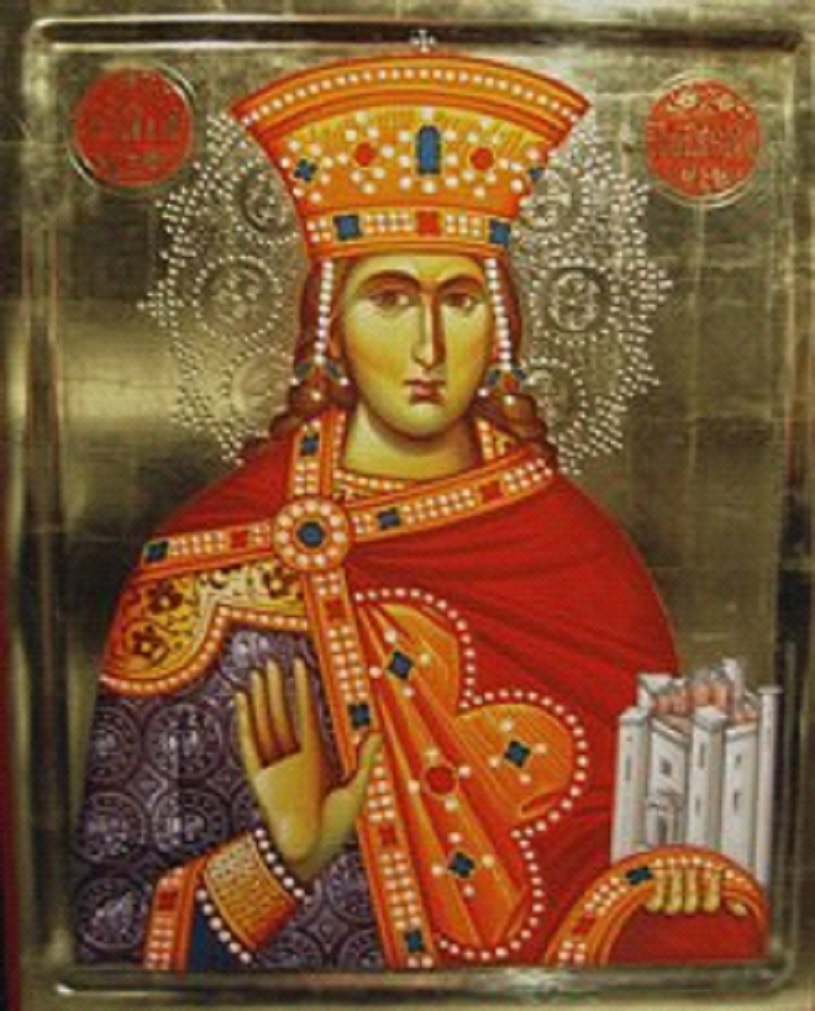
Pulcheria was an early Byzantine Empress, who came at the beginning of the beginning of the disintegration of the Western Roman Empire and the rise of the Byzantines. Pope Leo I praised her piety and willingness to submit herself to one true god.
One of the things that you have to remember about Roman women in this period of the Early Byzantine Empire is that many of them that have left a historical record were very active in the church or the religious proceedings of the age. Pulcheria came of age in a time when Christianity was ascendant and was creating a victorious narrative about itself. This wasn’t the weak-willed apologetic Christianity of the modern age; this was the triumphal Christianity. She was responsible for religious activism against Jews. Previously, synagogues were considered to be private property. However, Jews were being targeted for persecution by the state. Pulcheria contributed to some of this alongside her husband Theodosius II. Women did not play a very big role in religious affairs, at least on the public level in the Roman Republic and Roman Empire. There were the Vestal Virgins, but they were the exception not the rule. Women could participate in religious events and become priestess but their role in influencing the religion were not as prevalent as that would be in Christianity. However, here, we can clearly see women influencing religious policy.
On the flip side, Pulcheria was known for her philanthropy, which was an important aspect of early Christianity. Many structures for the poor were erected in around Constantinople. I cannot think of a single Roman empress in pagan times that did such a thing.
Empress Theodora- The Actress Empress
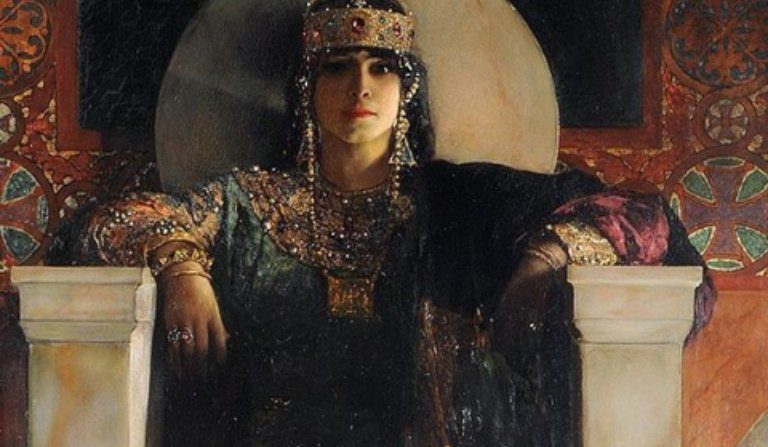
Theodora is an interesting woman to talk about. She came of age when the transition from Pagan to Christianity was largely complete. She grew up in conditions that were similar to that of her future husband, Justinian. When they eloped, the laws were set against them. Justinian had to get his cousin and adoptive father, Justin I to change the laws so that they could be married.
Theodora in many ways is a throwback to some of the Julian-Claudian empresses we have seen. Messalina, Livia, Poppea. These were women of a certain generation that went against the norm of what a woman should behave. They were powerful women of the elite who were highly transgressive in their times.
Theodora in some ways, was like this. She was the Christian Livia in many ways. During the Nike Riots of 532 AD, she was responsible for helping Justinian keep his throne.
In terms of religious activism, Theodora is an example of one of the differences between the Pagan empresses and the Christian empresses of the Byzantine Empire. The pagan empresses were not really known for the charity. Theodora, while she may have been ruthless towards the instigators of the Nike Riot, was also kind person when it came to looking out for her fellow women. She was responsible for helping underprivileged women, especially those who were sold into prostitution. She founded a monastery where women of the world’s oldest profession could repent and learn new skills.
In another area of religious activism, Theodora helped the Miapyhsite community by founding a monastery. In spite of her husband’s determination for a more homogeneous religious community, Theodora was responsible for helping these individuals.
Theodora’s impact on Byzantine history cannot be understated. She is one of the most important figures who set the standard for what a Byzantine empress should behave.
Mary of Egypt- The Prostitute Saint
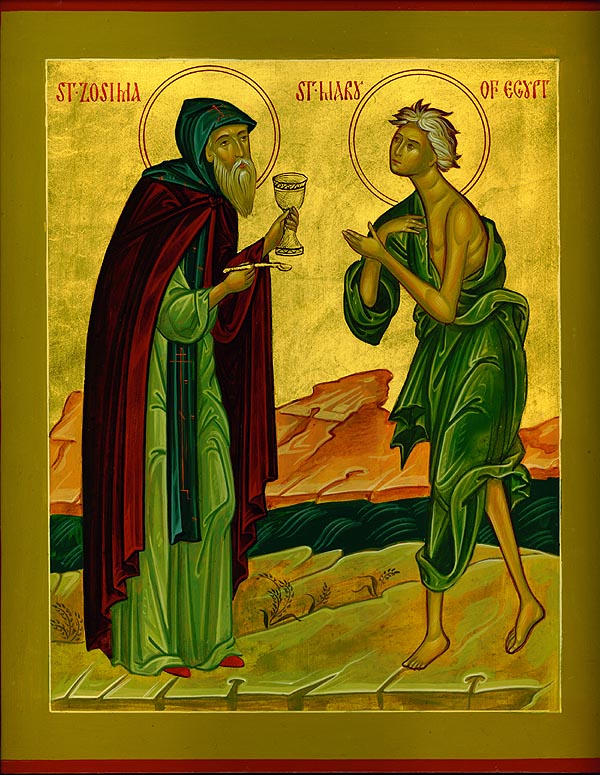
This woman is different from the others in that she did not become an empress, but her story is as important as any other. She was born into an era when Christianity was taking over and Paganism was transitioning from persecutor into that of the persecuted. It is not surprising to me that she deserves a seat at the table of important Byzantine women who changed an empire.
When she was young, she ran away from home and went to the great intellectual city of Alexandria. It was said that she spent alot of time there sleeping with other men and refusing payment for her favors. In the Christian histories, it was said that she wanted to satisfy her lust and would sleep with pilgrims who were coming from all across the empire. It was at this point, supernatural powers prevented her from entering the Church of the Holy Sepulchure and this caused her to feel great remorse for actions.
Mary traveled to the desert, eventually telling her dissloute story to a religious person who wrote it down and brought it our attention in the modern age.
In the Byzantine era, especially in the age of Constantine, women such as Mary would been put in the same place as Mary Magdalene, which is to say that she would have been sidelined and criticized heavily for her behavior. Not all the clergy were like this but there were many who believed heavily in reforming the sexuality of the Roman Empire. However
The Early Byzantine Era- An Age of Transition
As we can clearly see, the Early Byzantine era was one of transition from a pagan culture to a Christian culture. There are many continuities with the early Roman era. The status of women had changed in some ways from the old Roman norms. The days of the Pater Familias having total control over his family had long since become a memory that was only found in codices and scrolls. Christianity had clearly improved the role of women.
Though women were clearly still expected to raise a family and marry at young age, there were many advancements that helped women greatly. Though not liberated in the physical and mundane sense, women had been liberated in the spiritual sense.
To the modern eye, the idea of being spirtually liberated may sound strange but this was truly revolutionary to the Romans in the East. Women were given a role in religion that was not there before. There had been priestess for gods and goddesses before but the narrative surrounding those religions was rather phallocentric and did not give much respect to women. Now, there were tons of narratives about female saints and their contributions to the church. This was quite an upgrade from what had been a male-centered religious experience.
Though some would say that it oppressed women, this clearly not the case. Most of these issues have to deal with sexual morality, which in this day and age is fraught with much controversy. Empress Theodora in many ways helped to improve the lives of women and showed the example of Christian charity. The inclusion of the Saint’s lives in the mainstream culture show that the Byzantine culture was appreciating different values in women. Instead of the stories of women being raped by deities, we had uplifting stories of women rising above the limitations and flaws of their society.
These women would serve as the foundation for the next period of Byzantine history, when the empire would be on the defensive and facing all sort of threats. The 7th Century to 11th Centuries would see the apex of the Medieval Roman mentality and would see the crystallization of women’s rights according to the Christian principles of the Roman Empire.
 Byzantine-Empire.com