


There have been many books written about Roman history that have come out in the past couple of years. Specifically, it seems that there has been a renaissance of books that are geared towards the public that go beyond the scholarly confines of the university. Many of these books are written in a way that are appropriate for anyone outside the ivory tower to read. It is important for the scholars of history to write their books for the public in way that allows for the transmission for narratives and concepts outside the university.
One of those narratives that needs to be transmitted properly to the public are the Roman Gladiatorial Games. This is a narrative that has been distorted greatly over the past couple of decades through misrepresentations in television, books and movies. Some scholars have tried to talk about the games in ways that appeals to the public, but it is not enough. One of the biggest factors that is getting in the way of people learning about the Roman games is lack of popular literature surrounding the topic. When people do end up trying to learn about Roman games, especially the gladiatorial combat, the first thing they gravitate towards to is Ridley Scott’s Gladiator or documentaries on the History Channel. Gladiator (2000) has its own issues, and the History channel documentaries are trying though failing to give viewers a comprehensive and accurate view of the Roman games. However, I come to you today with a book that does talk about the games in a way that is semi-scholarly as well as appealing to the sensibilities of the general public.
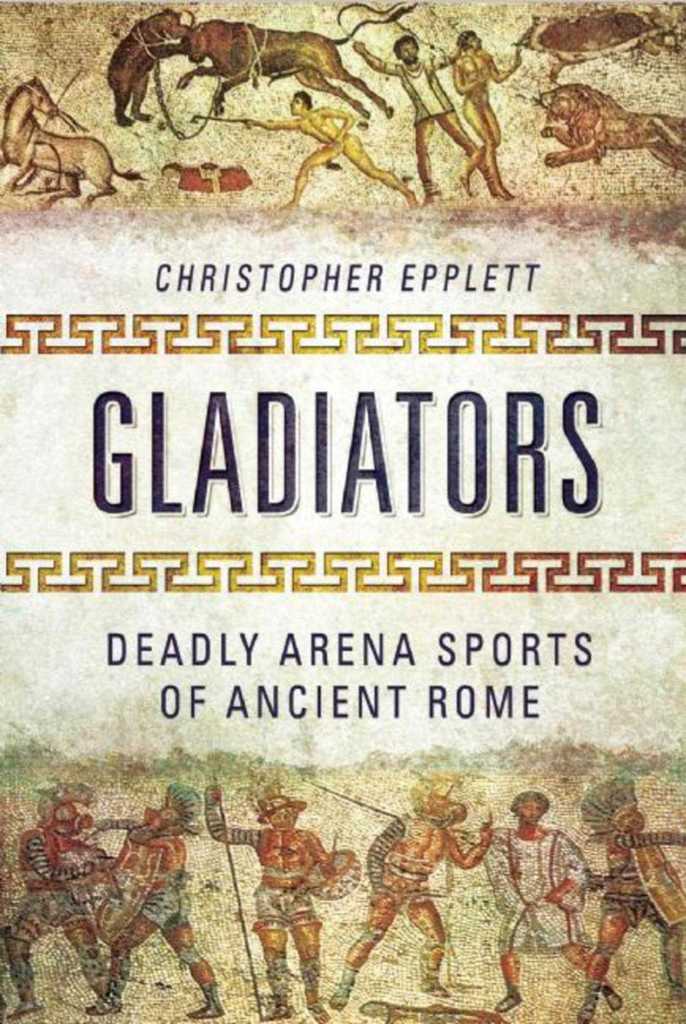
This book is called Gladiators: Deadly Arena Sports of Ancient Rome by Christopher Epplett. The author is a professor of ancient history at the University of Lethbridge in Alberta Canada but most importantly he has been seen in several History Channel documentaries, burnishing his reputation as a scholar who has helped to expand the boundaries of public history.
The book is interesting in many ways. In comparison to other books on the Roman games, his book is semi-scholarly and isn’t bogged down in too many details like other books on the topic. His writing style is straightforward and approachable for a member of the general public. Roman history can be intimidating to people and this book allows for one to get truly invested in the narrative of the Roman games.
Epplett’s book does a tremendous job of balancing the scholarly with the pop history. His book is divided into several sections. The book starts out by talking about the origins of the Roman sport and creates a narrative that goes through the entirety of Roman history. He then smartly goes into the mechanics of the Roman games and what made them work through the lens of economics and politics. All this is done in a way that does not intimidate the reader. I have read many scholarly articles and books and they tend to bombard the reader with many names and historical facts. Epplett is deliberate in keeping it simple while also providing a scholarly feel to the book. This is a commendable achievement.
His book also distinguishes itself from other books in that Epplett focus on the beast hunts of the Roman games. This is a part of the Roman arena that is often overlooked by the pop history and even the scholarly articles. The author provides ample amounts of information that greatly expanded my knowledge of the beast hunts and how they compared to the gladiatorial games.
Epplett’s book is highly approachable and most important in my opinion does not waste its time on moral judgements. Edward Gibbon’s style of moral judgements in history writing has tainted the genre for far too long. It is refreshing to see an author able to talk about the Roman games without going on the moral decadence of the Roman crowd and the society. He simply presents the information to the reader as it is.
This book is one of the outstanding examples of public history in book form. We need more books like this. I highly recommend the book to anyone that is interested in the history of the Roman games. Though some of the more scholarly types may yearn for more meat on the bones in this book, I believe that Epplett’s book is a great compromise between the pop culture types and the scholarly types. Overall, I give this book a rating of 4.5 stars.
 Byzantine-Empire.com