


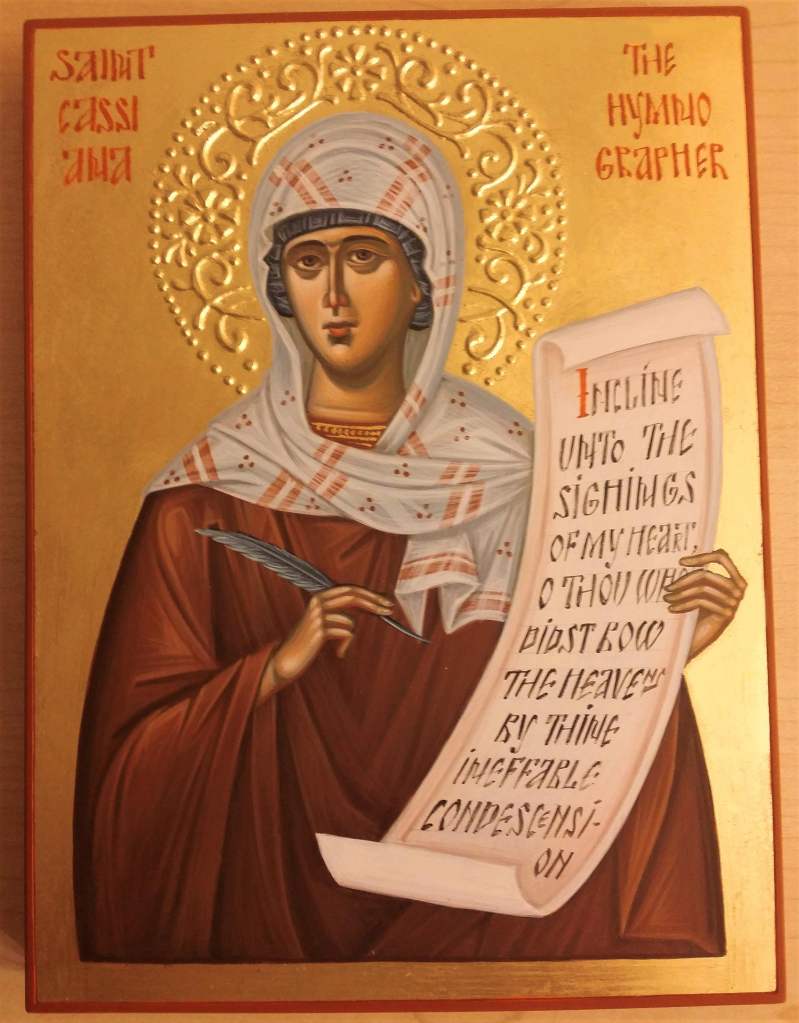
These days are fraught with political correctness and the need to redefine everything through a modern lens. I refuse to do that. The lives of people who lived before us cannot be distilled into a political ideology for today and it shouldn’t be done whatsoever. I understand that history is a powerful tool that can be used for both good and evil. That evil can manifest itself in many ways and sometimes it manifests itself in the way how people twist the past in order to pursue a political agenda. In the area of concern for me, Byzantine history, the most blatant example of this evil of modern presentism is the case of Kassia, the Byzantine composer who lived during the second Iconoclasm period.
Kassia, who was a high-born woman from a distinguished family, would have disliked modern feminism in all its forms. Firstly, she participated in a bride show that was being arranged by the emperor Theophilos and his stepmother, Euphrosyne. These bride shows were meant to showcase the beauty of the participants and allow for the emperor to make his choice of a wife. Kassia would have understood the importance of such a ceremony. Would a modern-day feminist understand this at all?
From the standards of the modern day, a bride show seems woefully out of date and sexist. However, in the times of the 9th century Byzantines, the bride show was an important part of culture and ritual in the Byzantine Empire. This was not an unserious culture that busied itself with fake images and worship of corrupt institutions. The Byzantines were a people, though imperfect, were trying to be the best human beings they could be through their devotion to Christ. Does this mean that everything about them was palatable to the modern eyes? No, it does not. But they at least believed in the divine and were wanting to repair the damage caused by their pagan ancestors ruining the globe through the crucifixion of Christ.
The poor woman did not manage to win the affection of Emperor Theophilos. The reasons for this are probably a mix of fact and fiction. I am guessing that stepmother had something to do with it but here we have a great example of Kassia’s wit and intelligence.
Emperor Theophilos, during the bride show approached Kassia and said: ”Through a woman came forth baser things”. This is a reference to Eve falling to the deception of the snake and causing for humans to be thrown out of paradise. Kassia responded: ”And through a woman came forth the better things”, which referred to the birth of Christ, the salvation of mankind through the Virgin Mary.
Here we can understand the Byzantine mindset which is so alien to the modern feminist viewpoint. Kassia’s retort may be seen by some as a proto-feminist statement. But it is not. Kassia in that age was not referring to the neo-liberal slaves of large corporations who want to be promiscuous and shame anyone who wants to have any virtue at all. Kassia was referring to the strength of the Virgin Mary’s sacrifice to bring Jesus onto this planet. Eve may have made a mistake, but the Virgin Birth made up for it.
Kassia was rejected by Theophilos, who married Theodora, another noblewoman instead. Now, in the modern age, she would have probably written some terrible book about how men are the problem and how the patriarchy is the issue. However, Kassia was thankfully not growing in such an age, which even with its great technology and medicine, is unable to provide people with the spiritual succor that every human being requires.
In the year 843, Kassia emerges from the darkness of the historical record and is credit with founded a monastery near the Constantinian walls. Because of its proximity to the Monastery of Stoudios, it meant that many of her works would survive to the present day.
Kassia’s decision to enter a religious life should be met with praise. She was wealthy and she could have easily decided to take it easy after being rejected for being Empress. Instead, she decided to take the hard decision to found her own monastery and pursue a spiritually pure life.
In the nature of the age, pursuing a path could be dangerous as she was living in an age of iconoclasm. This was the second time that the Byzantine Empire was going through this crisis and Emperor Theophilos was a fierce proponent of such a religious policy. Kassia was an important iconodule during this time. She suffered physical punishments for her views, but she remained steadfast and supported the Orthodox faith.
This is not the sign of a feminist at all, at least a modern version of it. Modern feminists would probably shriek at the prospect of feeling any sort of pain for their beliefs. Kassia was a brave woman, and she was a religious one. If I had to make a guess, she probably would be a Conservative activist not a neo-liberal one.
If one looks at her works, Kassia is hailed as being exceptional and a rare phenomenon among composers of her day. She was definitely an intelligent and intellectual woman but that does not mean that she would have been a feminist. Kassia understood the importance of her Orthodox faith and fought to defend the rights of every Christian to worship icons of the divine and Christ. She did not grow up in age where every woman is forced to become slaves to a large corporation demanding their attention in the capitalist economy.
Kassia is one of those type of women that understood the importance of Christianity in her life. Of course, not every person in those days was as religious as she. Some were what we call ”secular” and would have probably used religion for their own nefarious agendas. However, Kassia was not one of those women.
I am betting that Kassia wouldn’t have even understood what Modern feminism would have even meant to her. She focused on her attention on devotion to God, not to some spurious post-modern ideology.
To those who call her a proto-feminist or even a feminist, you better read up more on Byzantine women. They had more respect for the woman as she is not some damaging utopian view that fails to measure to the realities of the real world. Does this mean that the Byzantines were prefect? Of course, it doesn’t. Kassia probably had moral failings just like us, but she clearly understood what humanity’s role was in god’s plan.
Kassia may have been headstrong, but she would have been the headstrong that I would have liked. She was the kind of intellectual that I would have enjoyed talking to. She wasn’t disparaging of tradition or religion; instead, she actually championed for it at those most crucial times during the second Iconoclasm. This is a person that an intellectual strive to be, persevering over the basest of human emotions to become something great.
 Byzantine-Empire.com