


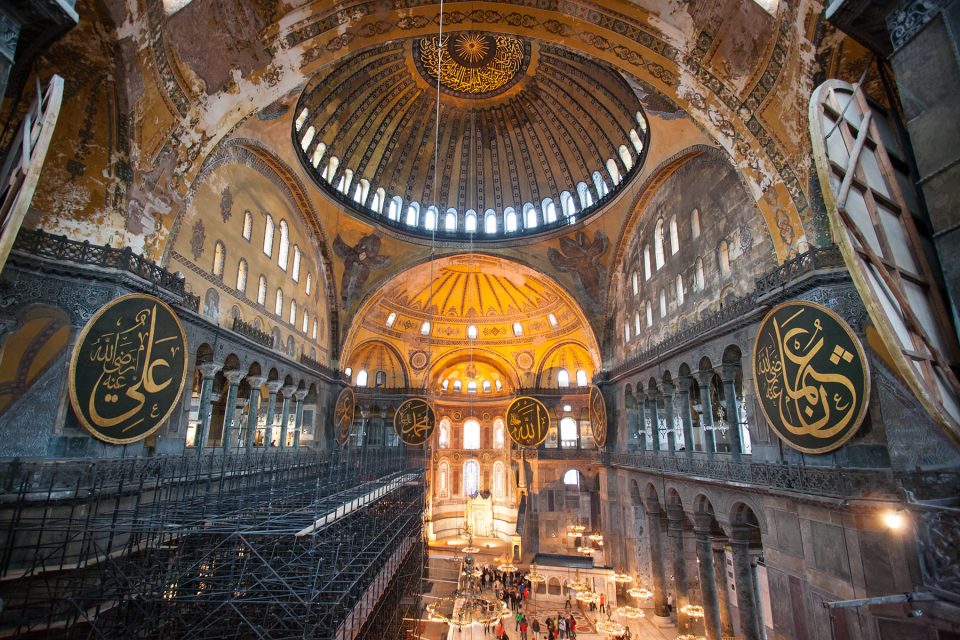
The Hagia Sophia is one of the most beautiful buildings on this planet. It has an incredible dome that is still holding up after all these years. The emperor Justinian knew what he was doing when he ordered the construction of this church. He truly had surpassed King Solomon in the utter audacity and ambition in the design of the Hagia Sophia. His main architect Isidore of Miletus was a brilliant mathematician who brought the Hagia Sophia to fruition. To this day, people from around the world flock to this church or mosque, hoping to get a glimpse of its brilliance.
Today, the building is a grand monument to the great religion of Islam, founded by the prophet of God, Mohammed, who took the peoples of the Arabian deserts out of ignorance and into the bosom of the divine.
The Hagia Sophia has been a building of two worlds. Those two worlds are Christianity and Islam. The people of the book have never been more divided between each other and the Hagia Sophia represents this perfectly.

To the Orthodox Christians, this is a holy building that is dedicated to their mission to spreading Christianity around the globe. It remained the pride of the Byzantines, the latter-day Romans, who sought to create a perfected version of god’s kingdom here on Earth. Throughout the entirety of the Byzantine Empire, there were numerous renovations made on the building, showing that the Byzantines recognized the importance of the church as the center of Orthodox worship. Even the Latin Crusaders, who sacked Constantinople in the Middle Ages, recognized the importance of this building. However, as the empire declined and Islam rose, the purpose of the whole building was altered.
The Rise of the Ottoman Turks
In 1453, the Ottoman Turks, led by the ambitious and stalwart Sultan, Mehmet II, conquered Constantinople and put an end to the 1,000-year rule of the Byzantines. The Ottoman Turks, being Muslim, began transforming the city of Orthodox Christianity into a city of Islam on the edge of Europe.
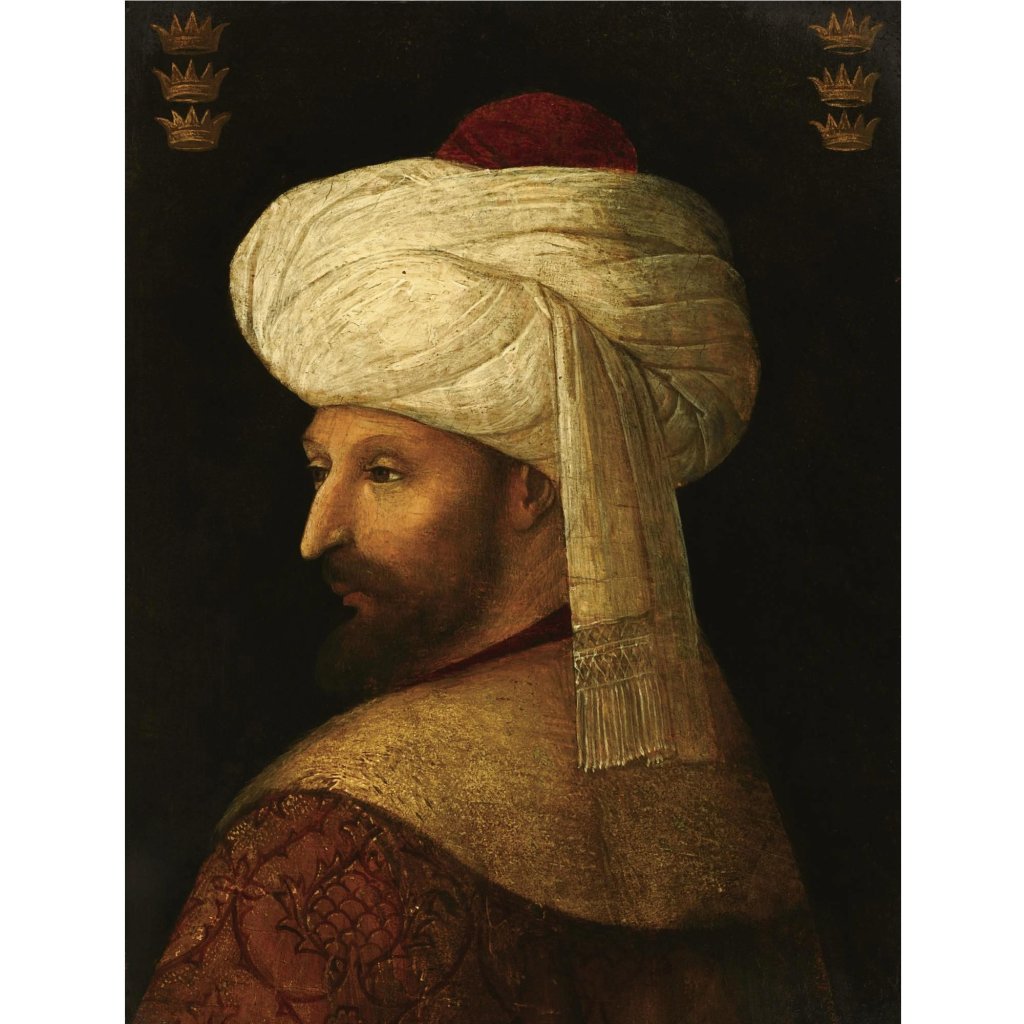
Mehmed II was smart at being able to navigate the varied and diverse religious backgrounds of his subjects. He managed to start a program of religious tolerance across the Ottoman realm. He was the foundation of a century of excellence that characterize the Ottoman leadership until the conclusion of Suleiman the Magnificent’s reign in 1566.
Constantinople remained a diverse city as the Ottomans continued to transform the culture and territories that surrounded it. Many areas in Anatolia would remain Greek and Orthodox for centuries to come. However, change was in the air.
The capital city of Constantinople was being transformed into a Muslim city from the reign of Mehmed II onwards. This meant that many of the remnants of the Greco-Roman past were being demolished or removed from the city. Some artifacts, like the Aqueduct of Valens, built in the 4th Century, remain fixtures of the urban landscape of the city to this day. Other symbols of the glorious Byzantine era, like the Column of Justinian was demolished by the Ottomans.
One of the greatest alterations of the Ottoman era occurred to the great Hagia Sophia. When Mehmed II victoriously entered the great church and performed the Friday prayer and the sermon, the Hagia Sophia was considered to be a Mosque from that point forward.
The influence of the Ottoman triumph would soon be transmitted to the building. The famous architect of the age, Mimar Sinan designed the greatest buildings of the Ottoman era. In Constantinople, his masterful hands were responsible for the Islamization of the Hagia Sophia. Minarets were constructed around the Hagia Sophia, another significant sign of the Islamization of the church. They are generally in Islam supposed to project the Muslim call to prayer, but they serve as powerful symbols of the power and influence of Islam.

The minarets were only one part of the Islamization of the Hagia Sophia. Many mosaics and images of Christ, Roman Emperors and their families were covered up with plaster.
Despite the Islamization of the Hagia Sophia, the building was constantly being renovated by the Ottomans on several occasions throughout the centuries. Christian artifacts were respected and maintained, all the while establishing the supremacy of the Muslim religion in the Ottoman state.
Throughout the reign of the Sultans, the Mosque would be a beacon for the ideals of Islam, particularly the ideals of Sadaqah, which is voluntary charity in Islam.
Ataturk and the Rise of Secular Turkey

By the 19th century, the Ottoman Empire was known as the sick man of Europe. Many sultans starting with Selim III tried to reform the Empire. However, the Ottoman Empire was facing revolts on all fronts and there was a rise of nationalism sweeping the empire with multiple peoples of all kinds, from Armenians to Greeks, demanding the ability to govern in their own way.
By the time that the Ottoman Sultanate was abolished, and the new Turkish Republic was emerging out of the ashes of the old state in 1922, the Hagia Sophia would again intersect with religion and politics. Mustafa Kemal Ataturk, the hero of the Turkish secularists, began a wholesale campaign to transform the Turkish people into secular, rational-thinking people.
One of Ataturk’s most important decisions was to change the status of the Hagia Sophia into a museum. The Hagia Sophia is a microcosm of the changes of Turkey. Ataturk’s great victory over the Greeks in the Turkish-Greek War of 1919 to 1923 was a crowning achievement of the secularists who sought to lift up the Turkish people to new heights of glory. They believed that the Ottoman sultans had ruined the state of the Turkish people with an overbearing religous state that was causing much misery and stagnation.
Over the next couple of decades, Ataturk and his successors pursued the reforms of the Turkish society. Headscarves were banned, women were given equal rights and ability to vote and religion in society was discouraged by the authorities.
The Hagia Sophia’s transformation into a museum was one of the great achievements of the secular age in Turkey. It allowed for many researchers and archivists to visit the site and make discoveries that enhanced our understanding of the Byzantine and Ottoman periods. It was during this period that Hagia Sophia was serving as a bridge between two worlds, both Christian and Muslim.
The Turkish experiment in secularism did not go without a hitch. There were several coups and issues with Kurdish nationalism in the southern part of the country. However, by the 1990s, it seemed that Turkey was the model Islamic state that would be ”acceptable” to Europeans. It looked like Turkey was going to enter the European Union. The Hagia Sophia would have had the same status as that of the Tower of London, or the Eiffel Tower, a landmark that would be used for the purposes of tourism in a secular age, dominated by the Europeans.
However, history does not adhere to a linear line. Many Westerners and Kemalists, the secularists of Turkey were mistaken to believe that the religious faction disappeared and were not important anymore. Indeed, in the West, there are many strains of political thought that were seen as not being viable anymore in society. However, as time has shown, they are continuing to have support amongst the society.
Islam strikes back: The Hagia Sophia and Erodgan’s Turkey

Enter Recep Tayyip Erdoğan. This man is one of the most interesting politicians that I ever seen. He literally defied expectations and became one of the most powerful men in the country through sheer determination.
Erdogan in the early part of his career seemed to be a typical Turkish politician who happened to be on the right. His main party, the AKP was not even that Islamist. However, things would begin to change in the previous decade with the rise of Erdogan to the prime minster post and then the presidency.
Many secularists were opposed to the AKP and their slow process of Islamization. Protests broke out and there were attempts to reverse the process in order to return the country back to the times of Kemalism.
He had overseen the revival of the Ottoman tradition that had been abandoned by the Kemalists. For example, when he greeted the Palestinian president, Mahmoud Abbas in 2015, this was done with Ottoman pomp and circumstances.

Under Erdogan, Turkey has become something of Islamic media powerhouse, churning out series after series extolling the glorious history of Muslims around the globe. This is in stark contrast to Turkish cinema of the past, which tended to be critical of Islam and focused on the secular lives of its citizens. Series like Magnificent Century glorified the leaders of the Ottoman state, creating the image of a past where Muslims were on the march everywhere across the globe.
Many Kemalists were in shock at the fact that Erdogan was bringing back Islam into the public sphere after Ataturk had tried so hard to turn Turkey into a secular state.
Though it seems at times that the secularists still have a lot of support in Turkish society, the Islamization of Turkey continues apace. There is no greater example of this than the conversion of the Hagia Sophia into a Mosque.
On July 10, 2020, a Turkish court annulled the Kemalist era decree that turned the Hagia Sophia into a museum. The Hagia Sophia was transformed back into a Mosque. Erdogan in that same month led prayers in the Mosque. The Hagia Sophia had come full circle to the Ottoman days.
The Hagia Sophia has seen three eras, Christian, Muslim and secular. This site of religious worship is intersected through multiple religious and political traditions.
In this day and age, it appears that the Hagia Sophia serving as a bridge between Christianity and Islam is no longer politically tenable.
Whose History is it? Is it Muslim or Christian?
In my opinion, Ataturk was misguided to change the status of the church to that of a museum. His country had Islam as the official religion even though it was a secular state, and he should have respected that. He may have been guided by some ideal of transnational religious tolerance, which may be high-minded, is incredibly naive and is ignorant of the realities of human relations.
Ataturk was interested in building a secular state so that Turkey could compete with the West on a more even footing. In a way, he and successors have succeeded at that goal. Turkey is a country with some 80 million inhabitants. It has a vibrant economy and a strong military. The people are mostly secular but have learned to respect Islam. They are determined to see Turkey as the leader of the Muslim realm.
The Christians should still have been allowed to visit the Hagia Sophia but after some 500 years of ownership, it was clear that the Muslims had clearly Islamized the site. This is not to say that the Christian aspects of the Hagia Sophia should have been ignored but that the ownership of the site clearly belonged to the Muslims.
The Byzantine Empire had long since passed into the annals of history by the time we get to 1930s. Ataturk was motivated by a backlash against Islam in his government and a willingness to reproach with the West. That decision was highly misguided and needed to be corrected. Erdogan made the right choice.
The Hagia Sophia’s rich history remains intact, and I expect that the Muslims will continue to be great custodians of this great architectural wonder.
 Byzantine-Empire.com