


The Universal Empire of the Classical Romans
The Roman Empire during the age of Augustus was a different beast all together compared to any other organization on the planet at the time. It’s closest rival, the Han Empire, was comparable in size and population. However, it did not share a very important aspect, which was the empire’s commitment to integrating its subjects into a greater Roman culture. The Han Empire was more homogenous in its population than that of the Roman Empire and its nearest rivals, the Xiongu Confederation, were not seen as potential subjects of the emperor. While they did trade with them and arrange marriages, the Han Chinese always viewed them with a certain degree of contempt and did not seek to integrate them into the social order. Not so with the Romans.
The Roman Empire was truly multicultural and multiethnic. It was multilingual as well, with a variety of dialects and languages being spoken across the empire. The ideology of the Roman Empire during this time was to spread the empire’s borders to every corner of the globe. They had been on a conquering spree, spreading influence from England to Armenia and had been absorbing all kinds of people into the empire. The Romans, who originally had been just a small city state on the banks of Tiber, were now ruling a massive empire that included a bunch of people who were different from them. The Roman Empire was a great project, one that the globe would not see until the rise of America in 18th century. It was a multicultural project. Some of it was by force and some of it was by assimilation.
One of the fascinating aspects of the Roman state was its ability to incorporate a vast variety of peoples from all other the rest of the Mediterranean and Northern Europe. The Romans were heavily inspired by the Ancient Greeks. When they conquered Greece, they managed to incorporate many of their ideals and concepts into their empire. Many upper class Romans, in contrast with their ancestors of the past, began to emulate Greek culture and wanted their sons to be taught it. This meant that the Roman Empire was really the vanguard of Greco-Roman culture.
The Greco-Roman culture spread throughout the entirety of the Roman world as well its imperial territories. From England all the way to Armenia, you can find traces of the influence of Rome’s universal empire being represented. To this day, the Roman Empire has left an incredible legacy that is being found by a variety of archeologists. You can find the influence of Rome in Wales as well as in the farthest reaches of Armenia.
This sort of reach of Roman culture also melded well with the local traditions. The Romans were smart in coopting the local elites into their empire. These elites often retained some of their local traditions, but they became full-fledged Romans who supported the system. The people of these regions, while they may have been conquered, were incorporated into a large trading network that reached across the oceans. This meant a leveling of political power across the empire.
This does not mean that the Roman Empire did not have to deal with rebellions among said groups. These rebellions happened often but were often crushed with much brutality. However, the Romanization of the Empire continued, with Roman culture and influence spreading to many parts of the Mediterranean.
This led to a situation in the 2nd Century AD, where Roman emperors increasingly came from other areas of the Empire vs previously all emperors had come from Italy. Emperors like Trajan and Hadrian came from Spain and this was harbinger of the diversification that was occurring in the levels of the elite. During the crisis of the Third Century, many emperors did not come from Italy at all but were emerging from all over the empire, beyond the confines of the colonized core of Latin colonies in the Mediterranean. This shows that the Roman Empire was integrating its ideology into the elites of every region that it conquered.
Generally speaking, the Romans believed themselves to be divinely appointed by the deity, Jupiter, to rule the whole world. The Roman religion by its very nature was not acquainted with the importance of humility in their approach to the growing empire. They were truly in the belief that the empire demanded that people were subservient to a new global order that had Romans at the top and everyone else at various levels of this hierarchy.
The Middle Kingdom of the Macedonian Dynasty
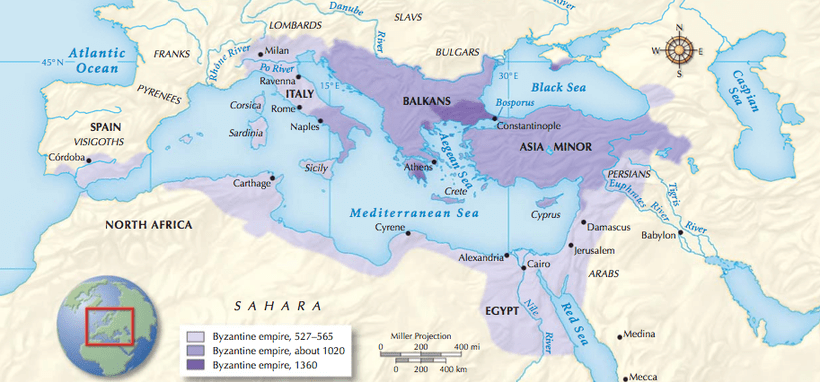
One of the greatest dynasties of the Byzantine era, the Macedonians, is a great example of how priorities had changed in this erea.
During the early Byzantine period, particularly during the age of the Justinian and Heraclius, the idea of a universal empire continued with the rise of Christianity. It became the prerogative of every Emperor to look out for the welfare of Christians and to spread the faith to every corner of the globe. This is one of the reasons that the Byzantines initiated the reconquests of the 6th Century.
However, as the Muslim conquests took hold in the 7th century, the Byzantine Empire was shaken to its core. The state no longer had the resources to pursue its agenda of universal empire. That idea of universal empire was now transferred to the Muslims, who were in the processing in adapting Muhummad’s law to a great variety of people.
The Byzantine Empire on the other hand became more of a kingdom that was filled with people who generally spoke the same language and were the same ethnicity. There was some diversity in the Empire, with there being Armenians who played an important role in the Empire’s military. There were also the famous Vikings who served as the Emperor’s bodyguards starting in the 980s.
However, the Byzantines were different in that their empire was less about being a universal empire that everyone would aspire to live in but a Middle Kingdom that was trying to prefect God’s kingdom on Earth before the return of Christ. Christianity was important to the early Byzantines, but it was still colored by the fact that the emperors were in charge of a powerful, Mediterranean-oriented empire. The imperial ideology of the Byzantines at that time still dictated that an Emperor was supposed to be expanding the empire as well as protecting the rights and interests of Christians. However, the Byzantines became an empire that was more focused on issues closer to home.
The Byzantine Empire during this period after the Muslim Conquests focused its attention on prefect god’s kingdom on the planet. That meant the empire was more about soft power than about hard power as it had been under the Classical Romans. The Byzantines during the period of renewal during the 9th century were using their soft power to project the power of their religion to all corners of Eastern Europe. One of the most important achievements of the Byzantines during this period was the Christianization of the Rus by the Eastern Romans. While the Byzantines were no longer trying to be the universal empire of Augustus, they could still try to expand the influence of Christianity to other pagans.
Even though that the Byzantines would try to conquer other peoples in the late 10th and 11th centuries, this experience would not go on for very long due to the fact that the Romans were about to come into contact with the Seijuk Turks who would demolish any sense of remaining imperial feelings among the Eastern Romans.
The universal empire of the Romans would be replicated several times without great success. Charlamagne attempted it only to have his kingdom being broken apart by squabbling sons. Napoleon was the next great attempt, but his empire could not resist the combined forces of several coalitions set against him. Over the course of the 20th Century, Fascist empires and Communist Empires attempted to create universal empires based on ideology, appealing to the average man. However, all these universal empires failed due to war or standard exhaustion.
It remains to be seen what the next universal empire of Europe will be but one can be sure that it will go through the same cyclical nature as that of the previous imperial regimes.
 Byzantine-Empire.com