


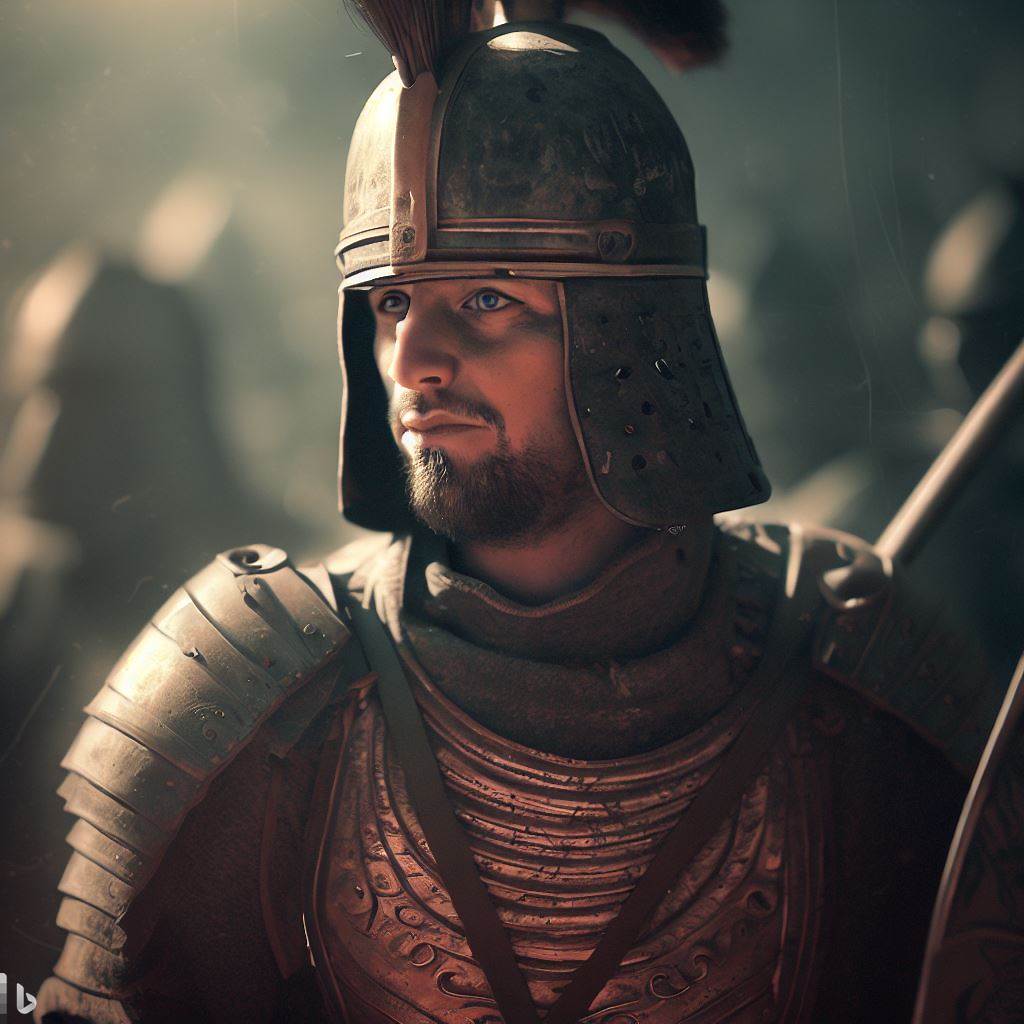
The Roman Empire was one of the most enduring Empires in history. However, it had many issues, one of which being that the transition of power was not smooth. While the transition from Augustus to Tiberius was somewhat smooth, there was a lack of consistency with this afterwards. Caligula ended up being slain by members of the Senatorial Elite and members of the elite Praetorian Guard and Claudius ended up in power. The Roman Empire would go through several crisises during the Pax Romana, but the situation wouldn’t be as dire until the Crisis of the Third Century. During this time frame, there were many Emperors, many of whom were called Barrack Emperors. Many of these Emperors were either assassinated or deposed by their own soldiers. The Senate, the reserve of the old Roman Aristocracy became less and less important. Emperors like Diocletian and Aurelian managed to put the state back together. However, the damage had been done to the Roman state. It was no longer able to call upon the resources that were needed in order to invigorate the state.
As Constantine the Great moved the capital to Constantinople and the cultural shift began towards the Greek East, the Roman State also began changing. The Augustan style of leadership, the principate, was no longer as important to the Roman state as it once had been. Instead, it got replaced by the Dominate, a much more authoritarian system compared to what was created by Augustus. When Constantine the Great became sole emperor in the 320s by defeating his rival Licinius in battle, the Roman Empire was truly an empire that was autocratic. Constantine’s moving of the capital to the city of Constantinople and the formation of the Byzantine Senate was an important stepping stone that allowed for the continuation of the myth that the Republic had been restored and that the Roman state was still answerable to the citizens of the Empire.
In the beginning of the new Christian regime centered in Constantinople, the Constantinian government only managed to continue for some thirty years until 363. There were a series of emperors afterwards who formed their own dynasties and they generally managed to have more secure successions than the succeeding dynasties. The main issue was the Germanization of Roman society. While how much of Roman society had abandoned its Greco-Roman roots is up to debate, it is without question that the Germanic tribes had a significant impact on the way that Roman society conducted itself. Many of these Germanic Tribes, whose influence in Roman society could be traced to the days of Julius Caesar, were becoming more prominent in Roman culture. This influence could be felt heavily in the Roman military.
The Roman Army during the time of Constantine and the Theodosian Emperors was still a force to be reckoned with but its glory days were past. Many Germans began replacing Romans and Gauls in the military and many officers began rising to the top of the imperial bureaucracy. One of these officers, named Aspar, would be prominent in the Eastern Roman Army.
Aspar was responsible for being kingmaker during those fifty years as a member of the Eastern Roman military, leading to the Germanic faction in the Eastern Roman Empire to have considerable influence. However, in the 470s, the ruling Emperor, Emperor Leo I concocted a conspiracy and had him assassinated. Had Aspar or his descendants had been in power for longer, it is quite possible that the Eastern Roman Empire would have experienced the same crisis of confidence that led to the fall of the Western Roman Empire in the mid 5th Century.
The Germanic influence on the Eastern Roman military would decline yet they would still feature prominently in the armies of Belisarius. However, the period of Emperors from Leo I to Maurice would generally feature stable succession to the throne of the Byzantine Empire. However, with the rise of the usurper, Phocas, everything would change and alter the fortunes of the Empire for the rest of the Millenium.
The Emperor Maurice was a latter day version of Marcus Aurelius in many ways. His reign was generally filled with many military campaigns both on the Danube and the in the East with the Sassanid Empire. He has wrote a book on military strategy known as the Stragikeon, which was one of the best books on combined arms that would be seen until the era of World War II. However, as one of the preeminent historians would say about him and his issues with the armies, was that he was a better judge of policy than of men. This is one of the great failings of Maurice as Emperor.
Emperor Maurice spent many years campaigning on the Danube, trying to stave off the invasions of the Avars. These groups of peoples were invading the empire and causing much havoc to the people living within the boundaries of the Byzantine realm. Maurice attempted to turn the tide but much like other emperors, like Severus Alexander, he did not know about the dissatisfaction in the military that would lead to a crisis. The military eventually overthrew and raised another military officer, Phocas to power. Maurice and his family attempted to escape Constantinople, but Phocas and his men captured them and eventually had them slaughtered as a symbol of the beginning of his rule.
With the fall of Maurice and the rise of Phocas, we would see a new rise in instability in the Byzantine Empire. Why was this occurring at this particular moment? Other empires like the Sassanid Empire and the Sui Empire had the same issues. They would often have rival claimants to the throne or conniving army generals. However, the Byzantine Empire was uniquely unstable. It did not have the concept of primogeniture like other states had and this would prove to be a very troubling aspect for the state. Anyone could end up on the throne with merit or enough might to shove everyone else out of the way. The Byzantine Empire did not have the structures in place to ensure orderly succession.
Heraclius and his dynasty would put an end to Phocas’ subversion of the imperial order yet he would be facing an existential crisis with the Persians invading the Empire as well as the latter Muslim invasions. Revolts, which typically were kept at the peripheral level in the Byzantine Empire, were erupting all over the place. Reforms were made by Heraclius and his successors to reform the administrative structure of the Empire into a series of themes which were semi-autonomous regions of the empire that were dependent upon themselves for the recruitment of troops.
The Byzantine Empire remained a centralized empire, but it was not the same empire as during the early Dominate era. The Roman state between the time of the Severan Emperors and the reign of the Constantinian Emperors was transformed into a state more resembling the Han Empire. However, due to the Muslim conquests, the Byzantine state underwent a long process of feudalization. While the Byzantine state did not truly become feudal in the sense of a government type with a King answering to his vassals like in the early days of Capetian Dynasty in France, it was clearly not as autocratic as say the state was in the days of Justinian.
In comparison with France or England during this period, the Byzantine state faced many more revolts and civil wars than those states. The French and English systems were based on primogeniture, meaning that the oldest son inherited the throne. The Holy Roman Empire had a complex system of elections that were integrated into the system of the Empire. It was one of the strengths of the system that allowed for the smooth transition of power through the deliberation between the nobility. The Byzantine Empire did not have any these institutions to hold the Empire together. While it may had a more centralized government, the centralized nature of that government meant that any time an Emperor was overthrown, it meant that the government would face many issues with establishing control, with many rival claimants to the throne. This is not to say that countries like England and France did not have issues with succession; England underwent the bloody War of the Roses in the 15th Century between House Lancastrian and the Yorks. However, England was overall less centralized than the Byzantine state. The Byzantine State up until it fell in 1453 was a state that was centered around the Emperor.
Centralization brought many benefits. Those benefits included the ability to collect taxes, raise armies and just have more bureaucracy to manage the population. However, without a clearly defined succession, this meant that the position lacked the ability to provide for orderly transitions between rulers. Heraclius would represent a change that would result in the Byzantine state becoming less autocratic and more decentralized like the feudal states of Europe.
Heraclius and his descendants had managed to devolve the state into the thematic system by the time of Justinian II in the 690s. The state was still highly centralized but it now relied more on local commanders taking charge of the recruitment of soldiers. However, in spite of this, the Byzantine state would start plunging into the twenty-years anarchy. Emperor after Emperor would take the throne and this would almost lead to a catastrophic loss in the Umayyad siege of Constantinople in 717 AD.
After Emperor Leo III managed to sustain the situation and allow for the construction of a new Byzantine state, the Byzantine state would see less instability. However, the iconoclasm crisis that occurred in the 8th and 9th centuries proved to be trying times for the Byzantine state. This is one of the reasons that the Byzantine state would remain rather brittle up until the emergence of the Macedonian dynasty in the late 9th century.
By the time that we get to the Macedonians, the Byzantine state is starting to reach its zenith in power. Civil wars continue to break out, especially during the reign of Basil II but they are not damaging enough to cripple the state. This is one of the reasons that the Roman state during this time got so powerful and able to resist invasions. The Rus and their arch-rival, the Bulgarian state were able to invade Byzantine territory many times but they were always pushed back by the Byzantine state.
Basil II’s reign is the pinnacle of the Byzantine state and this is in spite of it being unstable and having many civil wars, it was still able to triumph over the Muslims and the Bulgarians. One of the most important reforms that Basil II was making was to put more power put in the hands of the Emperor rather than the land-owning aristocracy.
After the Basil II’s passing in 1025, all these reforms were undone by his successors. The land-owning aristocracy regained power and the common people began losing their influence on the politics of the Byzantine Empire. The land-owning aristocracy, who for their credit had been responsible for shoring up the state from the constant invasions of the Muslims and Rus, were now becoming part of the problem and causing many issues for the central authorities in Constantinople.
These issues, that had not really resolved by the time of the Battle of Manzikert, became even worse as almost every significant nobleman sought to seize the throne after the defeat of Romanos IV at that significant battle. Within a couple of years, almost the entirety of the Asia Minor was in the hands of the Seijuk Turks. Had the squabbling noblemen of the Byzantine state had stopped fighting among themselves, this catastrophic situation would have not have occurred at all. In spite of the disaster at Manizkert, the Byzantine state was still strong and could call upon its resources to repel the invaders. Unfortunately, the unstable nature of the Byzantine throne meant that the Empire was easily taken advantage of by the cunning enemies that surrounded it.
The Kommenian Dynasty would be the truly first attempt in the history of the Eastern Roman Empire to have a succession plan in place. Unfortunately, as soon as Emperor Manuel I passed away in 1180AD, the empire began breaking down again. The aristocracy began clawing back their privileges and started to using the emperors as puppets. It is not surprising that the situation was so horrible that by the time that we get to the Fourth Crusade, that the Byzantine Empire was literally up for sale and the Crusaders wanted a piece of it for themselves.
By the time that we get to the concluding years of the Byzantine Empire, it is quite clear that the Empire was becoming ever more unstable, even as its territory began to shrink in size as the Ottomans grew more and more powerful in Anatolia and then crossed over into Europe. During the Palaiologian rule of the Empire, numerous civil wars kept breaking out during the 14th century. Even though the Palaiogians managed to resolve the succession issue, the empire was far too weak to be able to sustain itself in the face of the Ottoman and also Serbian advance. This was the culmination of many years of failed policies that resulted in the fall of the Empire in 1453 to the Ottoman Turks.
The instablity of the Byzantine state was not competely unsual to pre-modern states. It is not surprising that there was a series of civil wars in the Eastern Roman Empire several times throughout the many centuries of its long history. The problem with the Byzantine state had alot to do with the lack of a stable succession, the centralization of the state and the constant struggle between the emperor and the aristocracy. In spite of these many problems, it is amazing that the state was able to survive for as long as it did. That is one of the great achievements of the Eastern Romans.
 Byzantine-Empire.com