


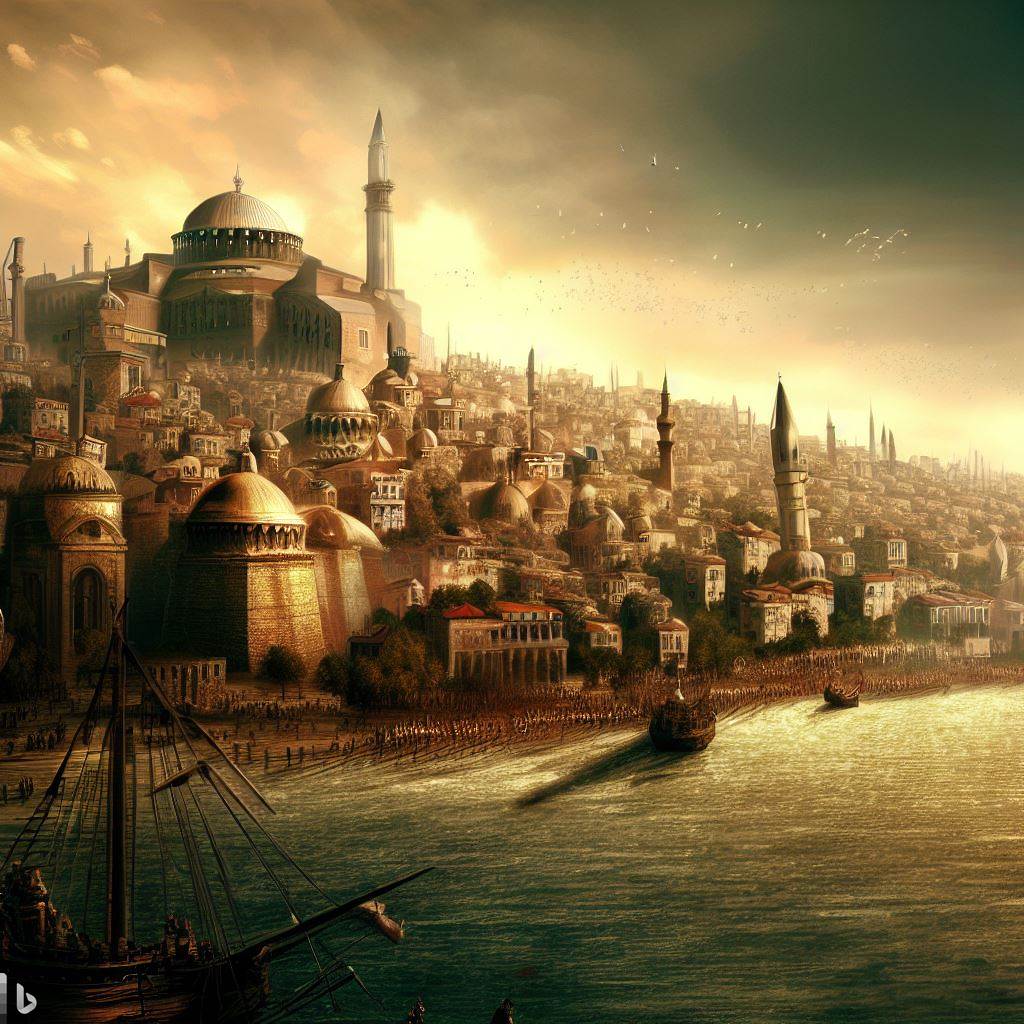
The city of Constantinople holds so many secrets that are waiting to be unveiled by historians. It is a city of many cultures all intersecting with one another, creating a fusion of tastes, religion and tradition. It is such a huge influence on the culture of the world, that many books have been written about its history and importance to the legacy of classical antiquity.
According to many historians, the Byzantine capital of Constantinople reached its demographic height during the reign of Justinian. More specifically, the height of the population of Constantinople in 540 AD corresponds to the victory of the General Belisarius over the Vandalic Kingdom in Africa. Right before the plague of Justinian, the capital of the Eastern Roman Empire or the Byzantine Empire was a place of wonder as well as great violence and poverty.
Much like many ancient cities and cities in the third world today, the city of Constantinople in the time of Justinian right before the plague was a place of contrasts between Rich and poor. Now, this isn’t to say that cities in what is called the Global North tend to not have these same characteristics, its more about the extremes than whether this social stratification impacts society. Empress Theodora was part of the social milieu of the lower classes. Justinian and his uncle Justin also came from the lower classes and migrated to Constantinople in order to make their fortunes and get out of the grinding poverty that generally characterized the life of Danubian and Thracian peasants in the Eastern Roman Empire. Justinian’s peasant life is an important part of the story of the new Christian city. The urban growth of Constantinople shares many of the characteristics of urban growth in third world countries. There is a push from the rural areas towards the urban, as people seek to make their fortunes in the new urban opportunities of the cities of the Eastern Roman Empire.
When Justinian and his uncle managed to get to Constantinople, they would have been amazed at the wealth that the city that had managed to acquire since the days that Constantine had managed to declare it to be the new capital of the Roman Empire. The city was a trading hub in a way that Rome aspired to be but was never able to truly achieve. Because of Constantinople’s amazing position on the Bosporus and the Black Sea, the city had a tradition of commerce that allowed for it to have a significant presence on the Silk Road. This meant that wealth was just pouring into the city because of its optimal location.
There was also another major factor that was playing into Constantinople’s favor. It was a city that was increasingly become the center of the Roman government, replacing the old standby, Rome. Considering that Constantine offered grain and land to prospective senators in the city, it is not surprise that the city was incredibly attractive location for the middling elites of the Roman Empire to make their fortunes. It started a rush for the positions that not yet been monopolized by old families that had been in control for generations.
Constantinople was a city of great wealth and contrasts and to people like Justinian, it would have made a great impression on men such as him.
With this city being the New Rome, there was a whole new narrative that drove the life of the city. That was the narrative of the revolutionary religion of Christianity. That religion helped to revolutionize the whole social relations of the Roman Empire. However, the city of Constantine was still beset by the same human frailties as the old pagan city.
Constantinople was a teeming metropolis of hundreds of thousands. But a question remains? How many people lived in the city during the reigns of Justin and Justinian?
According to Google, when you research the words: ”Population of Constantinople in 500 AD?” it gives you a result that 400,000 to 500,000 people lived in the great city of Constantinople in the reigns of Emperor Anastasius before the plague of the 540s.
For comparison, the city of Rome is generally estimated to have had a population of 450,000 during its height. Of course, there are other estimates for the population of the city. Some of them range from 450,000 to 1,000,000. Constantinople and Rome were generally speaking the same size in area compared to each other.
With this in mind, it is to be expected that the population of Constantinople will be around the peak of its Pagan brother, Rome. This means that the population of Constantinople during the time of Justinian, before the plague was probably 450,000 to 500,000.
Constantinople would go through ebbs and flows of population growth and decline many times in its history. The Queen of Cities as Constantinople was called, would not again achieve these peaks of greatness until the 11th Century and then again in the 17th century under the reigns of the Ottoman Turks.
The city of Constantinople in 500 AD would constitute one of the largest cities on the planet. The only cities in the Eastern Roman Empire that came close to matching it would the city of Antioch and Alexandria.
Internationally, the only cities that are comparable in size to that of Constantinople are the Chinese capital city of Luoyang and the Sassanid Ctesiphon.
The population of Constantinople at this time clearly eclipsed that of the old Roman capital and represented a huge shift in the fortunes between the Western and Eastern Roman Empires. While the Western Roman Empire was undergoing a process of deurbanization, the Eastern Romans were experiencing a period of urban growth.
Though the city would eventually be hit by the Plague of Justinian, Constantinople proved to be incredibly resilient and would continue to be beacon of Greco-Roman civilization for many centuries to come, even through all the political changes and cultural changes. It is important to note that Constantinople was already the Queen of Cities in the 500s. It would continue to retain that title in the years to come.
 Byzantine-Empire.com