


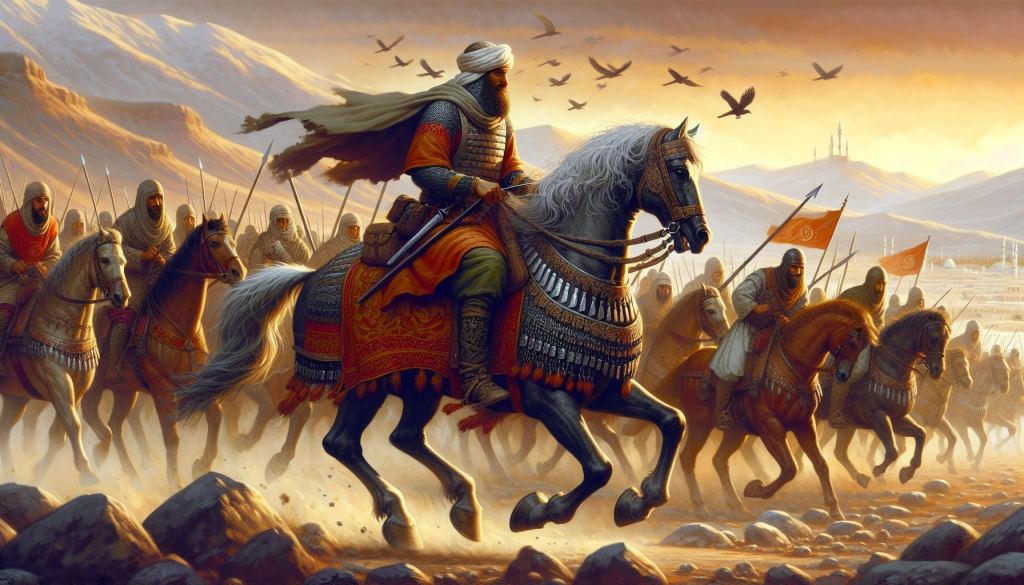
The armies of Khalid Bin Al-Walid swept from the deserts of Arabia and brought the Byzantine Empire to its knees. His fellow Muslim generals who also participate in the conquest of the Zoroastrian empire of the Sassanids. The entire history of the world was altered by the actions of highly skilled generals and cunning administrators in the Arab heartland who managed to marshal the newly united armies of Islam to spread the religion across the globe.
The conquests after Muhammad are truly one of the greatest military achievements in the history of mankind, but to this day, it is still not really understood by Christians or even secular thinkers.
The conquests by the Muslims is often seen as a symbol of Islam’s violent nature by some. However, the Islamic conquests were driven by a need to expand outside of a reigion that was not able sustain a growing population that was also hungry for new territories and filled with energy and hope as they were now devout to the religion of Islam. This wasn’t just a conquest, it is was a migration that saw Arabs become masters of new regions that had been just decades earlier had been only regions where traders would explore.
The Muslim World, generally speaking, has been seen as separate realm from how the Western world tends to categorize history. The inner life of the Caliphate and its social transformations are ignored by mostly everyone except history enthusiasts and historians. The Haji is one of those incredibly important events that defines the spiritual life of the people of the planet and yet it put into its own box, its news coverage being mostly an obligation to fulfill quotas rather any real observations of Muslims.
However, the three Caliphates of Islam were some of the most successful empires at expanding territory that humanity has ever seen. In comparison with the Roman Kingdom and its transformation into the Roman Republic, the Caliphates managed to conquer the whole of North Africa within a century of Muhummad’s passing into the spiritual realm. While the Caliphates would not be able to conquer all of Europe, they did manage to control a huge section of the Earth’s surface. Within the Caliphate, there was enough peace and prosperity to begin the process of Islamization. While people have believed that the people of the Middle East have been Muslim since the time of the conquests, the process of Islamization took centuries and by the 11th century and the 1st Crusade, Muslims had truly become the dominant religion in the area.
Specifically, the Caliphate’s success with attacking the Byzantine Empire is bit more complex than exhaustion as the reason for its comparable conquest of Sassanid Empire. I believe that the secret to the Rashidun Caliphate’s success is in being able to exploit the religious tensions in Byzantine Empire. While the Sassanids were a multi-religious empire like much like the Byzantine Empire, those tensions were not as big as they were in the Byzantine Empire. While some The successor to the Romans was an empire that was truly convulsing with religious conflict.
In the Pagan Roman Empire, the most violent conflicts that occurred between religious groups was that between the multireligious Romans and the Jews. These wars would result in Jerusalem being sacked many times and Hadrian would then build a city in his name over the ruins of religious center after a particularly violent revolt that challenged his vision of a Greco-Roman Commonwealth.
However, this was only the beginning of religious conflicts in the lands of the Roman Empire.
The Byzantine Empire and religious tensions
With Christianity taking up the mantle as religion of state patronage and imperial might, the religious conflicts that had largely been kept to the fringes of the Roman Empire. However, it was during the time of the Byzantines (Eastern Romans) that religious conflicts became even more of an issue for the government.
After Christianity became the state religion under Emperor Theodosius, the religious tensions were still increasing. While the Pagan element in the Roman Empire would still remain a potent section of Roman society, it would increasingly be the Christians fighting the Christians for domination of society.
The heresy of Arianism would generate many issues for the Nicene church after Constantine’s Councils. In the Western Empire, many of the Germanic tribes who were migrating across the Rhine and Danube and settling in the Western Roman Empire were adherents to Arianism which would be in opposition to the Orthodox Christians in the Eastern Empire.
Arianism, however, was still largely an external rival to Orthodox Christianity. It did not have many adherents in the East and was largely the domain of mainly Barbarian tribes that were transitioning their societies away from being warrior cultures to taking over the ruins of the Western Roman Empire.
The Eastern Roman Empire in the next century before the rise of Justinian would continue to consolidate its society and military. However, religious issues would remain a big issue. There were many religious tensions between various Christians and the remaining Pagans. However, the empire’s biggest conflicts would between the Monophysite Christians and the Orthodox Christians.
Emperor Anastasius was a highly effective emperor who I have stated on this blog as one of the greatest of all Byzantine Emperors after Constantine. However, he was a true careerist type. He went up through the offices of government just as many generations of Romans had done and he was highly successful and had a long life that allowed for him to become emperor at an advanced age. He was a true bureaucrat but he was a politically-minded and religious man as suits a Byzantine man of his station at this time. He was a devout Monophysite, much like Theodora, wife of Justinian would in the next century. Unlike many politicians in the modern age, Anastasius was a man who believed in his religion and was willing to stand up for beliefs in that his age were causing great convulsions in the capital city of Constantinople and throughout the empire.
However, in spite of such issues, Emperor Anastasius was able to navigate through these issues and be an effective emperor. He was able to not be overly dogmatic about his Monophysite views. While he was not a man who was changing his views wherever the wind was blowing, Anastasius was pragmatic and was about the stability of the Empire instead of his own ego. When it came to picking his successor, he wisely chose someone from the Peasant classes, Justin, as he shown great ability and accomplishment, regardless of his Orthodox views or his class. As such, while the empire had many issues not resolved on the religious area, especially with the continuing practice of Pagan philosophy at the Neo-Platonic academy in Athens, the Empire seemed to continue without a serious civil war that may have emerged had Anastasius made a decision to change Christianity in the Empire closer to his own views.
However, Justin and his more famous cousin, Justinian, had pushed the empire to the limit of Imperial expansion. Anastasius careful approach to politics, both external and internal, may have allowed for the Empire to maintain more religious cohesion. While there were rebellions by multiple groups in area of Syria, these rebellions were accompanied by damage to the Imperial system. Jewish revolts were generally suppressed by the Empire and were not allowed to get out of control. Additionally, the Jewish community was not nearly as radical as it had been in the reigns of Emperors such as Nero or Hadrian. While resentment towards Christians was continuing amongst the Jews, the situation was somewhat manageable, though the tensions would sometimes erupt into urban riots without becoming a huge struggle.
The Uspuration of Emperor Phocas
The usurpation of a Emperor Phocas would greatly impact how the Byzantine state would continue to evolve. With Emperors of Justin II and Tiberius trying to hold the Empire together, the failures of Maurice and his ability to prevent the empire’s army from revolting in the early 7th Century, is probably one of the most important events that greatly weakened the empire and allowed for many religious issues to become much more polarizing and violent than it had been before. With chaos spreading across the empire after the rise of the usurper Phocas and the Sassanid Emperor Khosrow II’s war against him, the structures in place that kept the tensions just bubbling along the surface of Byzantine culture began to emerge.
Emperor Phocas was a rather ineffective ruler who had many in the aristocracy who were outraged at how he had treated the previous Emperor Maurice and began plotting against him. Heraclius the Elder and his son began building up their power in Carthage and sailed to Constantinople to attack Phocas. They were successful and Heraclius managed to have Phocas executed in response to an insult he made to him about the prospects of Heraclius’ rule being as tyrannical as his.
With Phocas out of the picture, Heraclius came to the helm and came to realize that the struggle against the Sassanids was going to be much more difficult than he thought. The Sassanid Army was rampaging through the Byzantine provinces of Syria and had managed to conquer Jerusalem with the help of the great Jewish revolt against Heraclius.
The Great Jewish Revolt was similar to the Jewish revolt against Hadrian except this time it was against Christians not the Pagan Romans.
The Jews managed to help the Sassanid’s capture the city and the Sassanids then made advances into Egypt and took it in the name of the Sassanid Shah.
With all this occurring, Heraclius and his empire was teetering on the brink of being taken by the Sassanids. Heraclius even considered trying to move the capital back to where he and his father had begun their rebellion against the usurper Phocas. However, much like Emperor Justinian had a couple decades earlier, he was going to stay and battle the Sassanids.
Heraclius managed to pool his forces together and managed to win back control of Syria as well as Egypt. He managed to launch a campaign against the Sassanids and beat them at the Battle of Nineveh in 627 AD.
However, Heraclius would not able to celebrate his victory for long and would end up having to see much of his empire fall into the hands of the Muslim Empire, the Rashidun Caliphate.
The Sassanids invasion of the Eastern provinces in the Byzantine Empire
In the land of the Zoroastrians, the situation was even worse. The Sassanid Empire, which had just a couple years before had managed to conquer all of the Byzantine Empire and return the borders of the Sassanid Empire to the former glory era of the Achaemenid Empire when they were at the doorsteps of Europe.
However, with the victory of Heraclius over the Sassanids, the Empire was facing many issues suddenly, revealing the the true weakness of the Sassanid realm. Unlike the Roman Empire, the Sassanids had a government system that was heavily dependent on its Bronze age mentality. Much like the Ancient Egyptians, the Sassanids put much emphasis on their Kings (Shahs) being these great men who could lead entire nations to victory.
However, the Sassanid Empire was always built on somewhat shaky grounds as the empire, while being more imperial in its ambitions than the Parthians, were not able to have an empire that was able to have smooth succession from one Shah to another. The Romans had many issues with succession; however, they still had the ideal of the Roman Republic. Even in the reign of Leo II, people still believed in the Republic, even so many years after Augustus. However, the Sassanid Shah had to contend with many competing nobles who were always one plot away from engaging in treacherous activity to have him overthrown with one of their candidates. The position of Shah was more unstable than that of the Roman Emperor. The Shah of the Sassanid Empire who had been responsible for launching the titanic war to conquer the Byzantine Empire, Khosrow II had been removed by his son and his rule was ineffectual with various rulers who were passing through the throne until Muslims came knocking on their borders.
This chaos was causing great chaos to the Sassanid Empire.
While the Romans were able to survive the multiple attempts by barbarian tribes to settle and conquer the empire. The Roman state, while it may never have been able to attain the immense dominion it had over its part of the globe in the time of Augustus to Marcus Aurelius, the Empire was able to maintain its structures for much longer than most empires. When one looks at the longevity of empires, the Roman Empire stands up as one of longest living empires.
The Sassanids would also be an empire that would survive for many centuries but as with all things, sometimes a generation of leaders are just unable to meet up to the task of getting their act together and being able to run the country. However, the Sassanid incompetence in the 7th Century came just at the moment when the Islamic Empire would spread across the Middle East and North Africa.
The Byzantines were able to survive because of geography. In comparison, the Sassanid’s had one major issue that interfering with using their great fortifications in the mountains in the Western section of the empire.
The Sassanid capital was at the City of Cstephion on the Euphrates River. It had the unfortunate status of being a capital which had been sacked multiple times. The Pagan Roman Empire, while not being able to conquer the Parthian and Sassanid Empires, was able to sack Cstephion on multiple occasions.
Why the Muslims managed to conquer so much of the Byzantine Empire
The Muslims managed to unite after Muhmmad’s quick conversion of the many tribes in the Arabian region. After he passed away after giving his farewell sermon, the new Muslim religion began quickly conquering the two rival empires nearby.
The two empires, Byzantine (Eastern Roman) and the Sassanids had been manipulating the Arab tribes in the region in order to support their empire’s interests. However, the Muslims had a different relationship with these great powers. They were no longer going to allow themselves to be pushovers in this ancient great game.
Within months of the passing of leadership from Mohammad to Abu Bakr in the Sunni tradition. While the Shia would have their own disagreements over who was the true heir to Mohmmmad’s empire, it was clear that Abu Bakr was the one who was spearheading the transformation of the Islamic Caliphate into an empire that would change history.
The Muslims were highly motivated and wanted to spread their religion.
People have a tendency to underestimate this important aspect of the Muslim conquests. While scholars may talk alot about that the two great empires of the Byzantine and Sassanids were exhausted by war, there is also a very important aspect to how people are motivated to engage in warfare. In Classical Warfare, it was very important to have morale in your armies. Many ancient battles were won simply because the other army was unable to maintain cohesion.
The Rashidun Army, when one looks at it with a modern set of eyes, seems to be contrary to the way how Westerners tend to think of Arab armies. Their memories seem to be of how incompetent Arab armies are in the modern era. This also connects with the Spanish Armies during the age of exploration being able to overthrow the Aztec Empires and Inca Empires. These great empires of the Stone Age were swept away by men who rode horses and were wearing steel armor. While many in the West tend to argue about whether the natives should have been left alone by the Western Europeans, the general idea is that people in ”marginal” areas of the globe are simply not powerful enough to go up against the established empires.
This idea is extended to the Rashidun Caliphate as many people in the West tend to look at Islam as being a ”primitive” religion, ignoring of course the glory ages of Islam after the conquests. Because of such a perspective, many armchair historians are surprised at how the Rashidun Caliphate was able to be so successful at its conquests.
In spite of Islam seemingly coming out of a primitive place, the Rashidun Caliphate was not in the position of Montezuma’s Aztec Empire. It was aware of its importance to the two superpowers that were nearby and had skilled and competent commanders who were able to marshal some incredibly motivated and energetic soldiers.
The Conquests allowed for Islamization
When the Muslims took the city of Jerusalem in 640s, the Jews of the city were quite happy to see them. The Byzantine Empire was giving the Jews a very difficult time in the region. The Pagan Romans had issues with them and Hadrian responded with violent action against the Jews in the revolt that occurred in the later ages of his reign. However, the Byzantines had a uniquely intolerant attitude to the Jews. Roman Civilization starting from Constantine’s reign was becoming more and more intolerant of any deviations from how people were thinking about Christianity. This meant that the toleration about ideas that went contrary to the trinity and the deification of Christ were generally speaking not acceptable by the Christian culture of the Romans.
The Jews and the Christians were fighting amongst each other more and the state became more Orthodox in its manner towards how it dealt with the Jews. Many streets battles were erupting in the capital city with even a famous charioteer who responsible for attacks on Jews in the early 500s. Porphyrius the Charioteer was such a man; he grew up in the golden age of the Byzantine chariot races.
The animosity between the Jews and the Christians was one of the main reasons why the Sassanids had the success that they had in Syria when they were marching their armies through the chaotic Byzantine Empire.
When the Muslims came into Jerusalem with their armies, it is not surprising that many important Jews were assisting the Arabs with building up their government. As a result, the Muslims were able to integrate their Caliphate quite easily into these highly Christian lands and began the process of Islamization. While the Byzantines would attempt to strike back under the reign of Emperor Heraclius’ son, Constans II. They would have some success with regaining control in Egypt but the Muslims would quickly regain control in Egypt. After that point, Christians would not have any real influence on Egypt until the 19th Century under the British Empire; However, this influence was more about controlling the Ottoman Empire than Christianizing the area.
What is important here is that Muslims weren’t just able to conquer but what were able to maintain their conquests and eventually turn entire areas of Christian areas into those were swearing allegiance to Islam.
Unlike Alexander’s conquests, these conquests would be actually add many new adherents to the religion of Islam. This is why the Byzantines were not really going to realistically recapture these areas after Heraclius. After Heraclius and going into the era of Byzantine revivals in the 900s and 1000s, the Byzantines were not going to be able to reconquer these lands for the empire. By the time that Basil II was conquering Bulgaria in the East, the lands that had once been in the possession of the Roman Empire for many years were pretty much at this point all under the control of the Muslims.
The Muslim Conquests in Context of History
In this day and age, it seems that conflict seems to more about making money and keeping the conflict going than actually accomplishing anything. The Muslim conquest in this sense really did change the course of history. Unlike in today’s age, there was sense of cultures shifting and alliances moving around. The Byzantine and Sassanid Empires were still clinging onto Classical Antiquity. What the speed of the conquests show is that decay institutions tend to be overtaken by vigorous and youthful ones. Indeed, Islam had showed that its adherents were able to combine youthful vigor with an appreciation for caution as well as strategy. That is what makes these conquests such a great topic for study as well learning about our own age and how we should approach issues that in our many cultures.
 Byzantine-Empire.com