


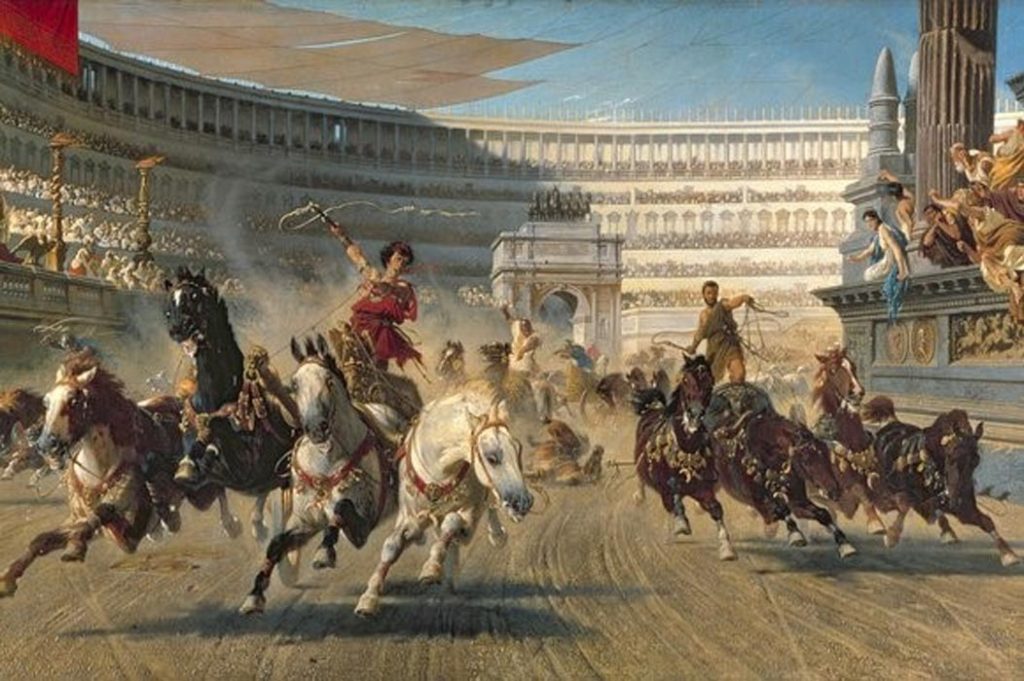
The Roman Games and the American Imagination
The Roman games have been of great interest to historians for many years. Unlike other aspects of Roman culture, the games seem to resonate heavily with the American public, mainly because their own latter ages after the Early Republic seem to be heavily revolving around sports and the industries that surround it. The Roman Games are a mirror to how to see ourselves.
The Byzantine Empire, as I have stated before as is generally not seen in the same caliber as that of the Roman Empire. Generally, books will say some things about Justinian and Belisarius. Theodora also gets a mention but nobody else gets any attention unless its a very specific class that focuses on Early Medieval History or the Byzantine Empire.
However, when I come across many stories that reveal how incredibly interesting this Empire is, I want to just tell people about what they are missing by not researching this empire.
The Roman Game Traditions and Christianity
Porphyrius is an interesting guy who represents a culture that is changing. The Roman Pagan culture was huge on the maintenance and conduction of rituals. However, Christianity began to change that heavily with the emperors starting ban Gladiatorial Games and the also very popular beast hunts that were playing alongside those gladiator games. People were hungry for entertainment and Christian ethics were taking that away. Porphyrius and other entertainers who were celebrities were important men who helped Christians get through this particularly confusing age. They were echoes of past glories that once left roars on the walls of the arenas across the Roman Empire.
It is important to remember that Byzantine Empire in the time of Justinian was an Empire that was transitioning away from Paganism even though Christianity was the victor in the empire. There were still many parts of Paganism that were still present in the Eastern Roman Empire. The Empress Theodora for example, began her life in the city as an actress acting in salacious entertainment that reenacted Greek myths. Unlike in today’s classics, these renditions were made for an audience that would have had their recent ancestors been engaging in Paganism. Theodora was giving the audience what they were aching for and were wanting to get away from the stifling aspects of Orthodox Christianity, without needing to change their religion to another. It was a pressure valve in a sense and allowed for Christians to indulge without having to abandon their support for Christianity.
Porphyrius was instrumental in the Byzantine Empire’s ability for it to give Christians an ability to not just indulge in the Pagan entertainments of their ancestors but also to engage with the emperor, to make their voices clear to their ruler so they could understand what going on in the city of Constantinople and by extension, the rest of the Empire.
Porphyrius’ contribution to the Eastern Empire’s cultural scene is not entirely known as many sources have been able to come to us in the modern age. However, we do have an important monument to his great achievements as one of the Christian Empire’s greatest athletes. These monuments were seen at the Hippodrome by archaeologists.
These transcriptions celebrate his amazing accomplishments as a charioteer and make it clear that he was a celebrity, probably one of only ones that would see in the West until the reemergence of sports as a popular form of entertainment in the 19th Century, with the rise of what some call the Mass Society.
Christianity of course would replace these secular entertainments with more a focus on spirituality, such as Passion Plays and art becoming more interested in Christ and the story of the disciples than about secular art. Secular entertainments would still make echoes around the corners of Christendom in the forms of music, tournaments and dance.
Why is Porphyrius so important?
While he may not have been a man who gave us all of his secrets, Porphyrius’ contribution to the area of sports is well-known to us Byzantinists. He helps to move history away from Emperors and Generals and into something that modern Americans understand, the sports star and celebrity. Such men appeal to the middle American much more than the pagan philosophers who were teaching as Christian became the religion of choice for pretty much all citizens except some who believed in the importance of the Pagan religions.
There is a tendency to believe that Gladiatorial games were all that Romans enjoyed in entertainment. Of course, the gladiators get all glory, but many entertainers made careers as chariot riders and beast hunters. Porphyrius shows that the Byzantines were not just Romans who shook off all their Pagan entertainments and were just endlessly worrying about piety and Christ and his allies.
In many ways, the Byzantine culture of Justinian may seem alien to modern American tastes. To Americans in the early Republic, it would seem that the Christians of Justinian’s era were hypocrites. However, Porphyrius’ great exploits show that the Byzantines navigating through this complex time of religious transition. Some, such as the pagan philosophers who were carrying out the legacy of Aristotle, Plato and Socrates were not allowed to continue by the Christians. However, there was a moment that charioteer would shine at their brightest in centuries since the glory of the Circus Maximus in Rome.
 Byzantine-Empire.com