


With Civilization VII quickly approaching its gameplay being seen by gamers, it seems befitting I would take a look at how the Byzantines have been portrayed in the series, particularly in the earlier incarnations of the game, when the game was beginning to increase in complexity and expand beyond the original cast of civilizations and leaders.
The Civilization Video games are some of the most popular video series that has endured for so many years. Unlike many video series such as Halo or Sonic, Civilization has remained rather consistent in its success, which each entry becoming more mainstream than the other installments of the game. Civilization VI represents the most successful in the franchise, as its sales are testament to its ability to adapt and change to the video gaming landscape. The earlier games were much more niche and I think that this niche was very popular among a certain segment of gamers. This is the same trend that was happening with RTS games. Dune 2, which basically built the genre in the most significant way since the Atari 2600 game, Utopia.

Civilization V would represent probably the largest change in the gameplay since the beginning of the series in the early 1990s. With the change of the gameplay towards maps being represented as hexes rather than squares, the game become more gamey and less about trying to represent human history in its broad strokes. It became more of a digital equivalent of playing chess without many of the additional complexities that make Computer games special. While some may say that Civilization games have always had this bias towards being more of a video game than a simulation, I would say that Civilization has always been a middle-brow game. While it tries to entertain and isn’t a very serious game like some wargames that heavily focus on issues such as logistics and how societies change according to entertainment.
Civilization games have always been veering in two directions. One direction goes towards caricature, similar to how the SimCity games were depicting interest groups, especially in SimCity 3000, where interest groups were seen in these very overt and exaggerated ways that were humorous.
Civilization has been somewhat similar to SimCity but its trends has been less towards humor in some of its titles. SimCity has almost always been about emphasizing the more ridiculous aspects of American city planning. Civilization has had trends that go in multiple areas.
When one looks at the original Civilization game that came out in the early 1990s, it is clear that they wanted the game to be more serious than humorous. While one considers some of the graphics and how the great Indian independence leader, Gandhi is seen in the game, there is some unintentional humor in the game.
When we get to Civilization II, we see the Elvis Presley images that made the game so memorable amongst so many gamers. However, this was a sign that the game was becoming less serious and so there was changes in Civilization III, which remains my favorite entry in the series. The reason I say this is because I believe that it is the apex of the classic era of the series, before the series went away into a more mainstream approach that was appealing to bigger audiences. With Civilization III, the game was attempting to becoming more mainstream without compromising its more niche origins. At this time, 4X games such as Civilization and Master of Orion were still very much not on the radar of most gamers.
In Civilization III, we have some mixture of realism with stylization.
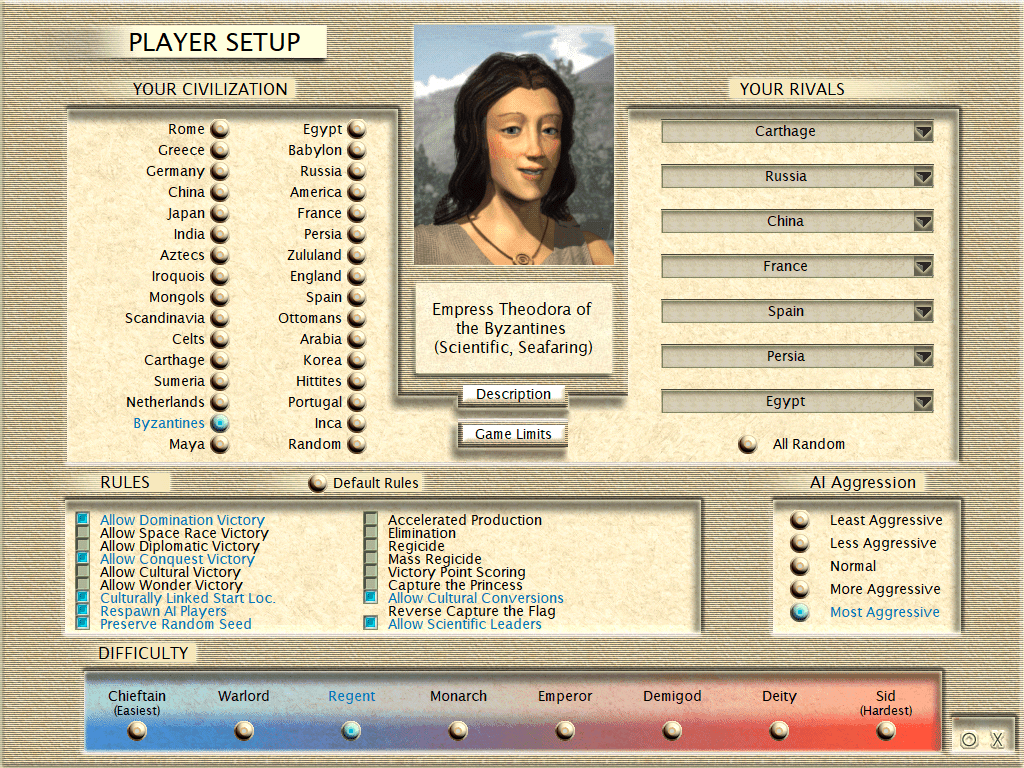
With the appearance of the Byzantine Empire in the Conquests expansion, it was clear the popularity of the Empire was on the rise in video games. In Civilization III: Conquests, the Byzantines are represented by the Empress Theodora. In the game, their abilities are Scientific and Seafaring.
Scientific makes quite a bit of sense for the Byzantines as they were one of the most important civilizations when it came to keeping the Western Canon alive and transmitting it during the Renaissance.
Seafaring also makes alot of sense as the Byzantines were the preeminent sea power in the Mediterranean until the 11th Century would see sea power start shifting in favor of the Merchant Republics of Venice and other merchant republics that would start exploiting the economy of the Byzantine Empire in order to get economic advantages in the whole of the Mediterranean Sea.
Before the Civilization games began making the civilizations have more variations between them, these special abilities the only thing that made them special other than the leaders and the city names.
Empress Theodora
In my opinion, why Empress Theodora was an important aspect of Justinian’s reign, she wasn’t ruler. She also did not affect the latter aspects of his reign due to passing away due to what historians believe to be a form of cancer in her breast in the 550s. Justinian may have heeded her advice during the Nike Riots, but she was not in charge of sending Belisarius to North Africa or Italy. Justinian would be the leader in Civilization IV. However, Theodora would return in Civilization V and then in Civilization VI, Basil II would be the leader, which represents a trend in that people are remembering his stature and importance in the Byzantine Empire.
Civilization 3 gives great respect to the Byzantines.
Overall, Civilization 3 may not have the fancy graphics, however, it does it make for it having a reasonable amount of simplicity as well as having a degree of complexity. This game was right at the sweet point for Civilization. It was in that transition from being a more niche game to becoming more mainstream. I think that the Civilization series has been incredibly successful as series but something in its vision has been sacrificed for it to be more mainstream in its appeal to customers. In Civilization VII, the Byzantines should try to try to stay away from stereotypes and try to really embrace the Eastern Romans as their own unique culture that made so many contributions to the Western Canon and civilization.
 Byzantine-Empire.com