


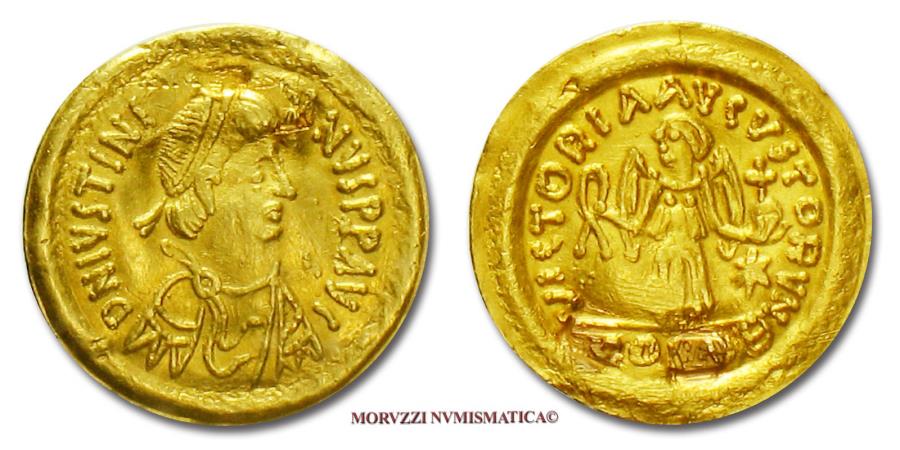
In the country of Bulgaria, beautiful gold coins have been found in an ancient village. Archaeologists managed to retrieve five Eastern Roman Tremissis in a 10th Century house in the Debnevo a historical village that is in Northern Bulgaria. According to the archaeologists in the country, they have a working hypothesis that the coins were kept in this house more than just use as currency. It was a way to remember an Empire that once ruled the Mediterranean. This is a very interesting speculation about the usage of the coins in the Bulgarian state at the time. The coins also reveal something else that is very important to emphasize when talking about the history of the Byzantines; The Roman warrior spirit and imperial messaging was still present even in the sixth Century, when Christianity had basically become the most powerful religion in the Empire.
According to the details on this article, the tremissis coins have images of Emperor Justinian on them. Of greater interest is that on the side which is the opposite side of the coin is an image of Victory with inscriptions proclaiming Justinian as Augustus, a man worthy to the legacy of the founding emperor of the Roman state.
The title of Augustus is one of those persistent Roman concepts that continued almost without interruption until after the reign of Heraclius, which then revived the ideal of monarchy which had been hidden by the Romans since the days of the Kings of Rome.
To the Bulgarians in the 10th Century, who were also building an empire that would challenge the resurgent Byzantine Empire under the Macedonian Emperors, having a coin with the inscription proclaiming Justinian as Augustus would be a great way to honor their history and interactions with the Romans. Even though the Bulgarians were not the same peoples as the Thracians who once proudly served in the Roman army, curiosity was important in allowing the coins to remain in their possession and not be melted down as so often happened with so many Roman coins.
The title of Augustus and the persistence of the usage of the Solidus in European currency shows the staying power of the Roman state even after it was not dominating the Mediterranean in the same way as before. This was an empire that had a presence in the minds of the Medieval man.
Articles such as this show that the relationship between Ancient Rome and Medieval Europe was not one of a break with Classical Antiquity but one that showed that there was a great continuity between the eras. Instead of relying on books that tell us about the evils of the Dark Ages and praise the Classical era, maybe historians should try to look at what brings these two eras together instead of criticizing it.
These coins are an important link with our past and it was quite responsible for these Bulgarians to take care of these coins for the pure act of intellectual curiosity. They allowed other generations to enjoy their presence and learn more about their past even as the Roman accomplishments began to be move into the realm of stories rather than a tangible history within a society that was still making those stories to express themselves to their rivals and allies.
In the Middle Ages, many Roman monuments were stripped of marble and other materials to make way for other structures. In some ways, this makes logical sense, the people in Medieval Italy were not beholden to an idea of keeping structures around for sentimental reasons. However, the discovery of such coins in Bulgaria shows that some still had a respect for the past, even those of an empire that was occupying their homes.
 Byzantine-Empire.com