


The image of Jesus Christ holding the gospels on Byzantine coins is a common theme in the numismatic history of the empire. The Byzantine Empire endured for over a millennium and there was much change as well as continuity in the coins produced by the state in Constantinople. One of the most enduring images on Byzantine coinage was the image of Jesus Christ.
However, the image of Christ was not seen on Byzantine coins until the reign of Justinian II.
Here is Jesus Christ on a coin some 3 centuries later in the reign of Emperor Constantine IX.

In previous centuries, the emperor was generally seen in profile with images of the Goddess Nike on the other side. The goddess represented the victory of the Roman state.
As the Eastern Roman Empire began developing its identity separate from that of the Western Romans, the coinage began to change. The emperors began to be seen holding a spear which laid on their shoulder as they were looking straight at person holding the coin.
For some time, this was the standard look of the Byzantine Coin. Other variations included the emperor holding the orb of the Earth with a cross on it.
By the time we get to Constantine IX’s Age, the ideas of Christianity have largely settled upon what was to become Eastern Orthodoxy, splitting away from the Catholic Church which was increasingly under the influence of the Carolingian and later the Holy Roman Empire. The conflicts of Iconoclasm were now in the past. We see here is an Empire that has emerged from conflict to become a beacon of the Orthodox Christian Civilization.
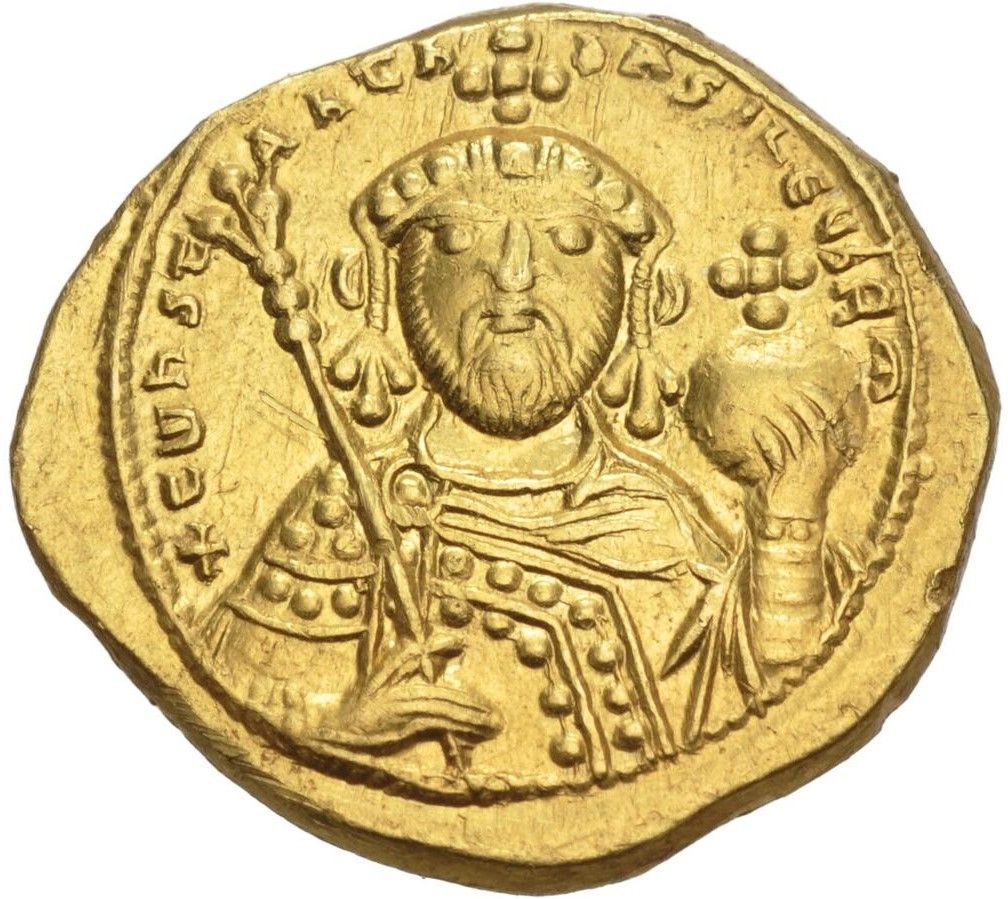
Many elements from the previous ages still remains on Byzantine coins. Here we can see that the emperor is still holding the orb with the cross on top. The artistry is still stylistic and not realistic as the earlier Roman coins were. However, you can clearly make out what is written on the coin. In Medieval Greek, a statement is made that will explain the moral universe of the Medieval man in both Western and Eastern Churches: Jesus Christ, Reigning King.
Such a statement about Christ is a reference to how Christ was above the material world which Kings were in. It was no longer about Emperors attempting to become demi-gods and having temples built in their honor. It was now that Christ had sacrificed himself for the salvation of man. In spite of his errors, man had free will to choose salvation or to remain in the darkness of the underworld, namely the lands of Satan.
It is this message that we should be trying to communicate to our fellow humans every Easter.
The Byzantines need knew it and integrated well into an empire. They were not saints, but no human is. However, they understood the mission of man. Subservience to the higher morals of the divine is what civilization should strive to emulate. The secular world is just that; it is the world of money. However, the integration of the divine with the human world shows how the Byzantines viewed the nature of their age.
 Byzantine-Empire.com