


The City of Athens is one of the great world cities. While for many years it was a small village or town depending on the era, it was a still a place that was in the hearts of many westerners. However, in spite of those sentiments, Athens was a far cry from when it was visited by the Emperor Hadrian. Athens by the time of the Greek War of Independence was a small town which had seen better days but it was a focal point of several battles for the Greek’s people’s struggle.
The Early Hellenic under King Otto
Athens in the years after the Ottonian ascension, became then biggest city in Greece. The city was also home in its early years to many philhellenes who were responsible for helping the Greeks with the struggle for liberation as well as with the building of their institutions.
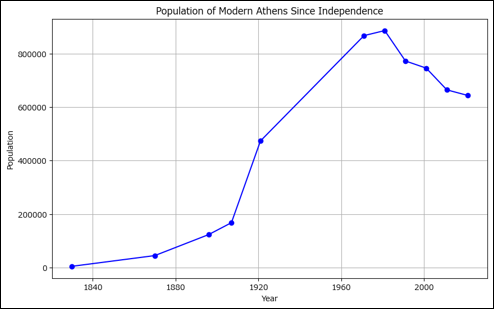
The capital would grow quickly as one can see on both charts.
However, in the 19th Century, the growth of the capital was in a Kingdom that was still largely attempting to create a new Greeks state with all the Greeks not just those in Attica, Thessaly and the Peloponnese. The Capital would soon rise to new heights and truly retake its place as of the one of the great cities in Europe.
The Return of Athens to the Throne of Cities
When the Population transfers of the 1920s occurred between the Turkish Republic and Greece, the population of Athens would surge to above 500,000 people in comparison to it being under 200,000 on the eve of the Great War.
The suburbanization of the Athens City Area
Athens would peak just after the return of the Hellenic Republic in the 1970s. It was a sprawling city of well over 800,000 people. However, the years of quick growth were over and Athens began to deflate as Greeks began to stake their claim to a life outside the metropolis.
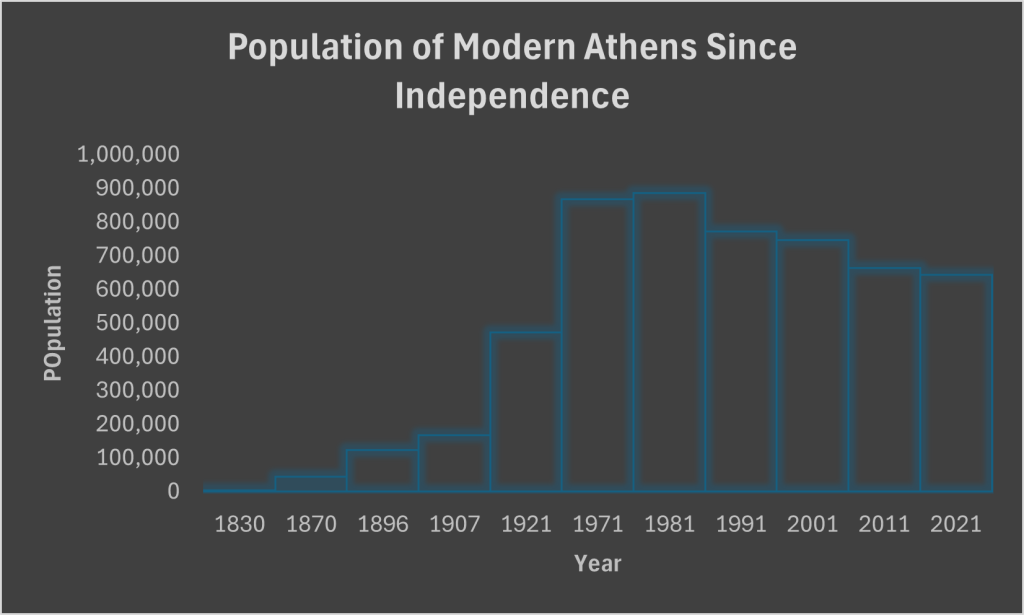
As you can clearly see, the suburbanization of Athens has been occurring since the 1980s. The migration out of Athens was quickest in the 1980s but it was a steady decline as the suburbanization went on in Greece. The process has continued through the economic crisis that was going on in Greece in that time and has seen the city continue to hemorrhage.
Athens is still the beating heart of Greece. However, it is clear that Greece is going through the same suburbanization process that America saw in the 1950s. American cities suffered greatly in that period from the 1950s to the 1980s. How Greece prospers in this century will depend partly on how cities manage this change.
 Byzantine-Empire.com