


The Byzantine Empire began as a mighty and powerful empire with millions under the rule of the Christian Emperors. By its end, only 50,000 people lived in Constantinople as Mehmed II was besieging with a huge army of some 50,000 to 100,000 men. How did this change occur and what was the trend of population growth in the empire?
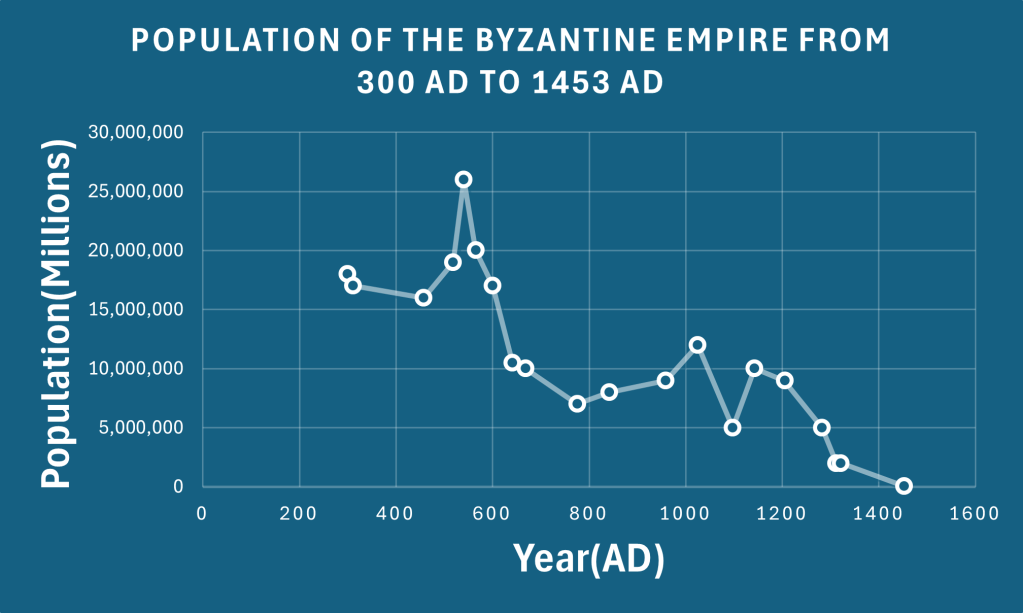
The Early Empire: The population of the Byzantines until Heraclius
The Byzantine Empire began with the increasing cultural divisions between the Eastern and Western halfs of the Roman Empire. The West was increasingly becoming more detached from the economic system of the East and became a laggard in the Empire.
In 311 AD, the Roman Empire in the East had a population of around 18,000,000 people.
As the Western Roman Empire fell, the Byzantines became custodians of the Greco-Roman tradition and culture.
Under a series of competent rulers, the Byzantine Empire up until 540 AD had grown to 26,000,000 people.
The plague of Justinian would take its toll on the empire and the various invasions by Avars and other groups would reduce the population to around 17,000,000 people around the time of Emperor Maurice.
The Prophet Muhammad would unite the people of Arabian Peninsula around 630 AD and his descendants, caliphs as they were known, began expanding the Rashidun Caliphate.
By 641 AD, the empire had lost Jerusalem and many important areas in Syria and Egypt to the Caliphate. The population in the remaining areas under its control was roughly 10,500,000 people.
The Entrenchment and the Recovery of Byzantines under the Macedonians
The empire would increasingly come under pressure from the Muslims. The Empire’s population fell from 10,500,000 to 7,000,000 by 775 AD.
After the reign of Leo III and Constantine V, the population begins to increase again. By the end of the Second Iconoclasm in the Byzantine Empire, the population rose to 8,000,000 people.
By the time of Constantine VII, the empire was in the midst of the Macedonian Renaissance and the population rose to around 9,000,000 people.
For greater context here, we must understand the Byzantine Empire consisted of Greece, Anatolia and some parts of Southern Italy. The empire’s boundaries had shrunk and it mostly within the span of these three areas. What this means is that the Byzantine Empire was less spread out than it had been in Justinian’s age. However, it was more integrated in that time than in Justinian’s age, which meant the Byzantine Empire was more stable and had to deal with less conflict with various groups internally. The only issue was dealing with the external threats.
By the passing of Basil II in 1025 AD, the empire reached 12,000,000 people. This was the peak of the empire in the High Middle Ages.
The Byzantine Population from the Battle of Manzikert to the Fall of Constantinople
After the Battle of Manzikert, the Byzantine Empire would suffer a rerun of Islamic invasions just like it had in the 7th Century. Anatolia, which had been Greek speaking for millennium would begin the process of Turkification as the Seljuk Turks moved in after the victory of Seljuk forces at Manzikert. It was during this period that the First Crusade would be called and Latins from Western and other parts of Europe would move to the engage in an armed pilgrimage to the Holy Land and protect Christians. The Byzantine Empire at the onset of the First Crusade in 1097 AD had fallen to a low of around 5,000,000 people.
By the passing of Emperor John II in 1143, the Byzantines had recovered many parts of Anatolia with the rebuilding of the Byzantine Army and the Crusades. The population rose to around 10,000,000 people.
By the Fourth Crusade, the cracks began show once again in the empire. The Bulgarians revolted and created the 2nd Bulgarian Empire and the Balkans would serve as the place where the Serbian Empire would grow to challenge the hegemony of the Byzantines. The population of the Byzantine Empire by the time of the sacking of the city of Constantinople was around 9,000,000 people.
By the time that the Empire of Nicaea had retaken Constantinople, the city was a shadow of its former glory. The population of the Byzantine Empire in 1282 AD was around 5,000,000 people.
The Ottomans began rising in Anatolia under the first Ottoman Sultan Osman I and his successors. They began methodically taking land away from the Byzantine Empire. By the year 1320 AD, the Byzantine Empire had around 2,000,000 people.
After a serious of civil wars in the 1340s and then on, throughout the 14th Century, the Byzantine Empire shrunk to a city state with remnants scattered across the Eastern Mediterranean.
By the time of the conquest of Constantinople by the Ottoman Sultan, Mehmed II, the Byzantine Empire was largely confined to the city of Constantinople and only had around 50,000 people.
The Byzantine Empire’s population is one of those trends that shows an empire resilient to survive. In spite of the great calamities, the empire showed itself able to adapt to many trying situations.
The source of the information in this article and the chart come from Warren T. Treadgold’s A History of the Byzantine State and Society.
 Byzantine-Empire.com