


The Byzantine Empire was among one of the greatest empires in history. One of the reasons why the empire was so successful at imprinting its memory upon the world was because of the great city of Constantinople. It was a city in the right geography and continued the traditions of a strong polis which gave the city a reputation across Europe.
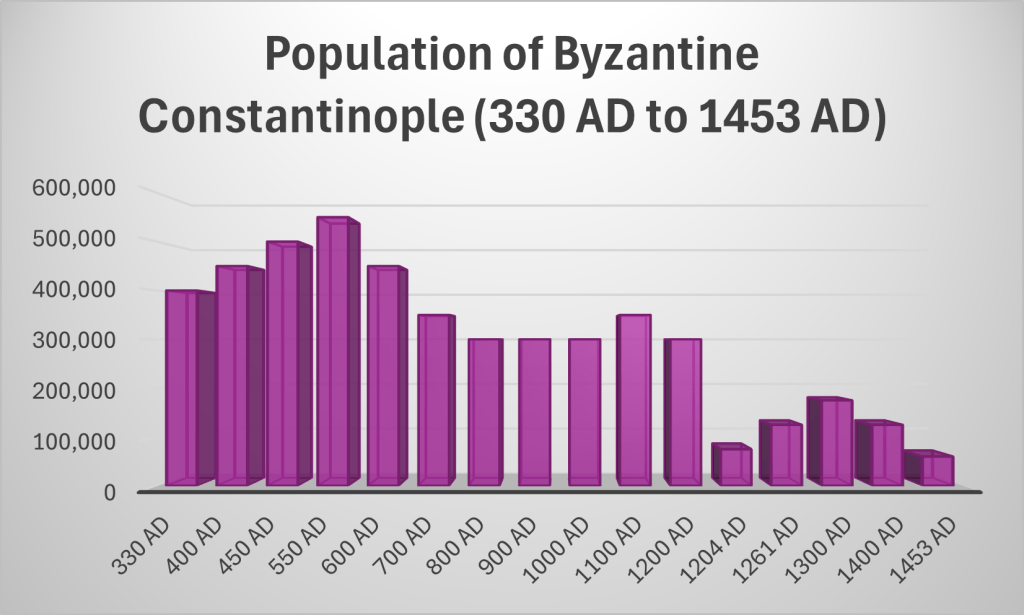
The city of Byzantium, when remade in the image of Emperor Constantine had a population of around 300,000 to 400,000 Roman citizens. The senatorial class had just begun moving to the city and many statues across the Roman world were being transported there including Ancient Egyptian obelisks. Constantinople would serve as the capital of the Byzantine Empire until Constantine XI. The city, which already had a big reputation in Ancient Greek history, was going to become even more important.
Constantinople in The Age of Justinian
It is in the Age of Justinian we get the full apex of the “Ancient” Byzantine system. It was in the city that the full blossoming of the fusion of Christian and Pagan ideas would come together.
However, the plague of Justinian would reveal how fragile that system really was. While Justinian managed to still beat Totila in Italy and maintain the empire’s borders, his successor Justin II would not be able to stop the Lombards from crossing into Italy and taking many territories. Rome would remain for a couple more centuries, but the Byzantines would not be able to continue to have hegemony in Italy.
The Decline of Byzantine Constantinople
The Arab Invasions and the spread of Islam would hit the Easterns Romans quite harshly. The population, already declining due to the Plague of Justinian and the ruralization of areas being ravaged by Avars and other migrating clans.

Constantinople’s population would mirror the fall in the empire’s own population as a whole after the 7th Century. Once the supplies from Egypt were cut, the ration could no longer be given to the citizens. Tax revenue began drying up and the city began declining from its Justinian peaks.
Leo III and his successor Constantine V would begin the process of rebuilding the city’s prosperity and population in the 8th Century.
By the time we get to reign of Emperor Basil II, the capital had grown back to a semblance of what it once was under Emperor Justinian though under new political realities.
The population in the mid 11th Century was around 300,000 to 350,000 people.
While the crisis that erupted after the capture of Emperor Romanos IV at the Battle of Manzikert by the Seljuk Turks was damaging to the Empire, there was continued economic growth in the Asia Minor as well as in Greece.
By the end of Emperor Manuel I’s reign, Constantinople had a population of around 350,000 to 400,000 people.
The West Surpasses the East: Constantinople after the Fourth Crusade to Conquest of Constantinople by Mehmed II
By the time that the Byzantines retook the city of Constantinople in 1261 AD, the city had been mismanaged by the Latin Emperors. The Byzantines attempted to repopulate the city and there was some semblance of economic growth returning but by 1300 AD, it began to decline again in the face of the rise of the Ottoman Sultan.
The estimates for the population of the city at this time vary and are represent a state that is more comparable to the Serbian Empire than one that once ruled from Northern England to Armenia. The 14th Century was a time of regional powers in the Balkans vying for control and mastery in the new political realities of that age.
The city probably only around 50,000 people by the time that the Ottoman Sultan Mehmed II conquered it in 1453 AD.
It would take Islamic rule before Constantinople would reach and then surpass the Justinianic peak in the mid 6th Century.
 Byzantine-Empire.com