


The Byzantine Army went through many changes in its composition and tactics through its history. A mostly defensive army, this institution proved to be vital to the defense of the Christian Romans.
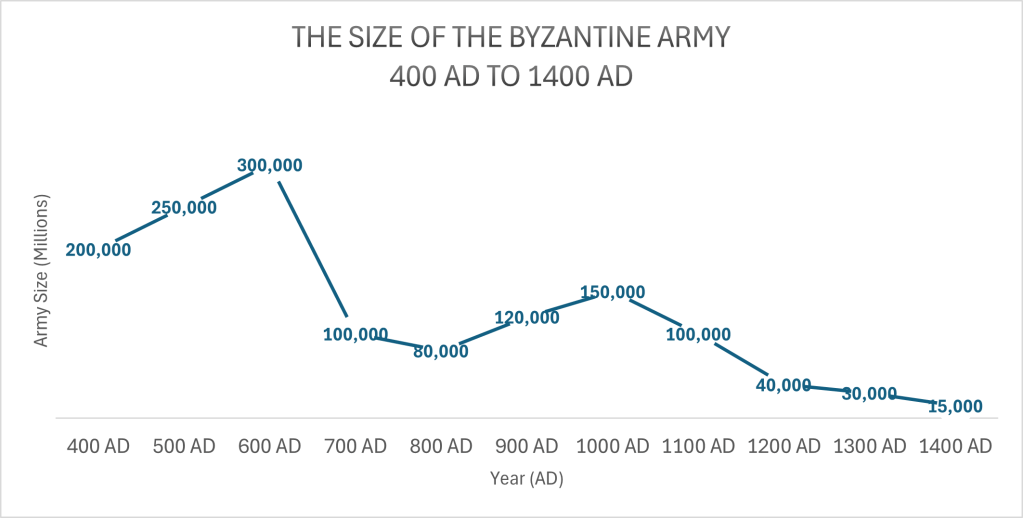
The Eastern Roman Empire would continue the army’s traditional strength up until the Islamic conquests. Then a slow rebuilding process would begin in the 9th Century going to about 1000 AD under Emperor Basil II. After the Battle of Manzikert, the Byzantine Empire would undergo a process of reforms in administration. It would become less centralized in the civilian affairs. In comparison, the army would become centralized around the emperor rather than the theme system of the past 400 years.
After 1204 and the Fourth Crusade, the Byzantine Army becomes less organized except for a brief revival led by the Empire of Nicaea.
The Byzantine Army in the 14th and 15th Centuries was a shadow of its former glory; it was a militia relying on the reputation of being a once fearsome army capable of taking on opponents and defending its interests.
What the chart shows is the remarkable longevity of the Byzantine state and its ability to adapt to many different situations. The army was an institution that had this adaptation inherent in its very structure.
In spite of losses at Yarmouk in 636 or at the Battle of Manzikert in 1071. The Byzantines showed themselves able to bounce back many times and there is no greater way to show that than in its soldiers and its successes at maintaining the imperial order in the Queen of Cities.
 Byzantine-Empire.com