The Byzantine Empire, or the Eastern Roman Empire was a state that punched way above its weight. It was a state that began as an administrative way to keep the empire together. It later faced many challenges but managed to survive multiple times in various ways. The Eastern Empire managed to expand and contract through many trials, and it was a remarkable empire of endurance.

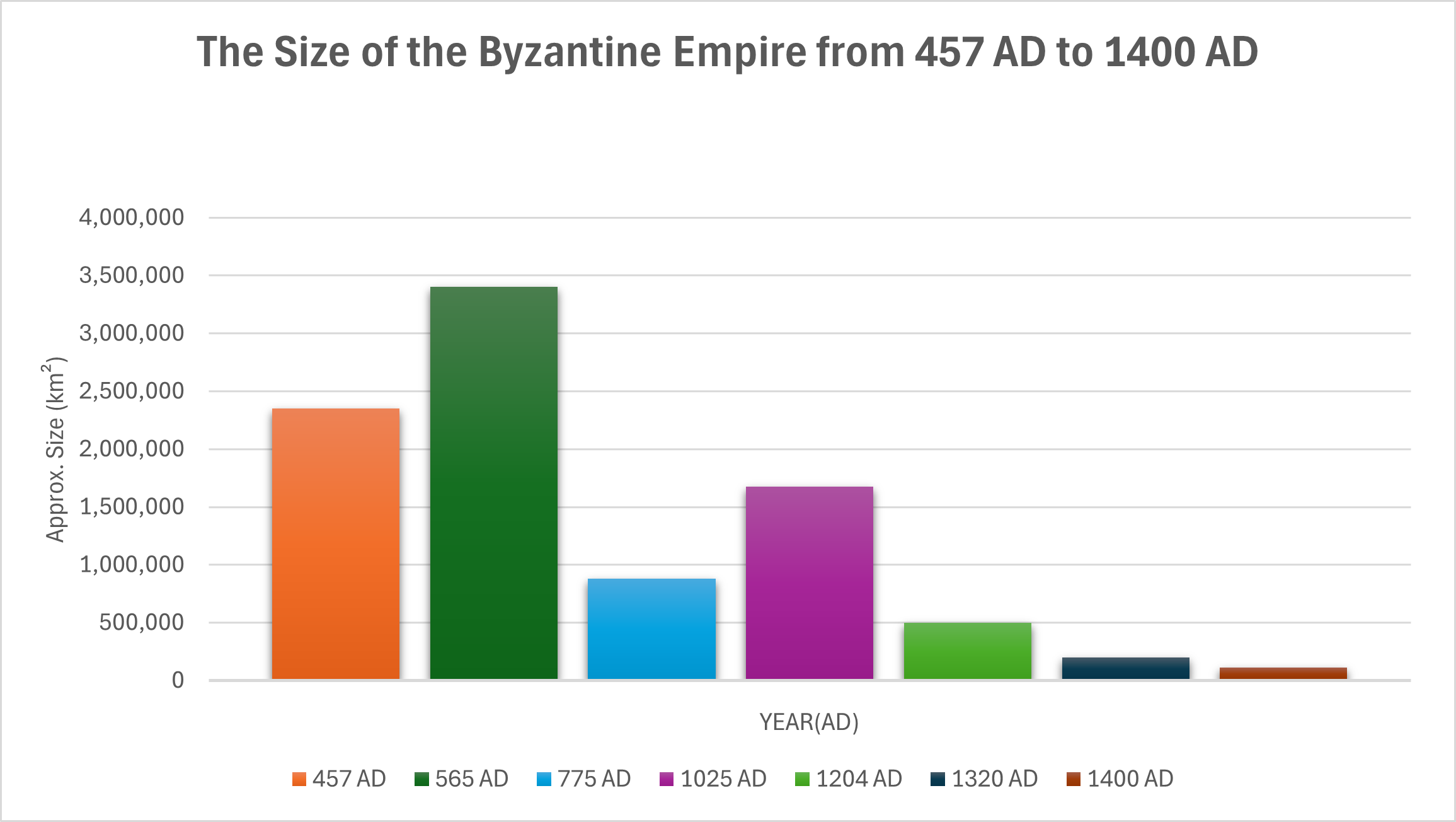
As you can see in the chart above, the Byzantine Empire after Emperor Basil II really began its decline as a state that had dominance of the Mediterranean. While the Kommenians had managed to recapture some of the empire from the Seljuk Turks, the empire became very dependent on Venetians and Genoans for the economy. As such, the economy began being run by people outside the empire.
The recovery of the empire in 1261 was not enough to stem the movement of power to the Kingdom of France and the captial of Paris. The Byzantine Empire, once the most powerful state in Europe barring the 8th Century apex of Charlemagne’s empire, was now being overtaken by the Ottomans.
However what does the chart teach us?
It shows the longevity of the Eastern Roman Empire. Even 500 years later, the government centered at the capital founded by Emperor Constantine was still able to project power and trade with the globe. Charlemagne’s empire burned brightly for a time but it would transition into multiple kingdoms before Hugh Capet and his dynasty would set France onto the path of becoming the crucible of Feudal Europe in the High Middle Ages.
The Byzantine Empire’s longevity has only really two competitors, the New Kingdom of Ancient Egypt and Japan. Such longevity and the twists and turns of its territorial contraction and expansion are unique in the history of empires and nations.
When one considers how the memory of Ancient Rome lived on in the words “Augusta” and “Romans” in the Byzantine Empire, the survival of such an empire is remarkable.
The reason why the legacy of Rome remains is not just because of the monks or the translation movement of the Abbasid Caliphate but because of the enduring spirit of the Eastern Empire.
 Byzantine-Empire.com