


There are many reasons for why civilizations manage to survive and thrive. Some survive due to geographical reasons, others economical. The one main thing is that they have something that the other civilizations did not have. These advantages can prove vital in a time of crisis, especially when one considers that in the pre-globalized world, where civilizations are at the mercy of natural forces that could prove to be quite damaging to their infrastructure and populations. How did the Eastern Roman Empire survive while the Western Empire did not?
This has been a very interesting question for me to ponder about. The Byzantine or more appropriately the Eastern Roman Empire was able to survive for many centuries after the Western Empire fell apart. Its survival is quite remarkable, considering the many crises that would occur in its long history. It’s actually quite a popular topic to be asking on the internet, if one takes a look here. This question asks how the Eastern Empire was able to survive and then be able to take Rome from the barbarians all the same time. According to one poster on the question site Quora, one theme that comes up again and again is geography. Geography is a very important aspect of how civilizations thrive. Take a look at the Inca Empire for example. This Pre-Columbian civilization’s holdings are largely located on the west side of the Andes, which as a mountain range proves to be an important defensive position. This is one of the reasons that the Incan Empire is very long but narrow in its territorial holdings. Geography once again proves to be pivotal in this regard.
Many civilizations have rose and fell due to their geography. Time and time again, the empire was able to claw its way back from the brink and be able to prosper. The Eastern Empire had many advantages that the Western Empire simply did not have. When one thinks about it, one realizes that the Western Empire was simply too large to be properly defended by the military. These advantages for the Eastern Empire were beneficial to Western Europe. The survival of the Eastern Roman Empire allowed for much classical literature and science to be retained until the blossoming of the Renaissance in the 16th century. The important question to ask here is this: How was the Eastern Empire able to survive but the Western Empire did not? There are several reasons for this.
1, The Eastern Empire had better leaders.
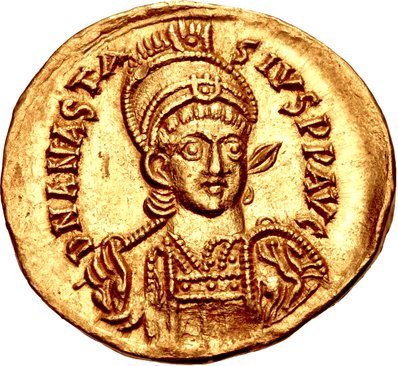
The names of the Western Empire do not communicate much in the way of confidence. Honorius, Valentinian III, and several others. The other emperor that I can think of that actually could have been able to bring the empire back together is Majorian, though he was undermined by several usurpers and rebellious generals. The Western Empire simply lacked competent leaders who weren’t merely puppets for the generals. The efforts to restore the Western Empire were simply unsuccessful. In comparison, the Eastern Empire largely had competent leaders. One of my favorite leaders of the Eastern Empire was the Emperor Anastasius. He was responsible for rooting out corruption and left the empire with a sizable surplus in the treasury. There were a series of revolts during his reign, but these did not disrupt the economy to the extent that it would have had it happened in the Western empire. The Western Empire simply lacked visionary leaders like Justinian. The Western emperors were simply too beholden to their generals, especially their barbarian auxiliaries.
2. The Capital City
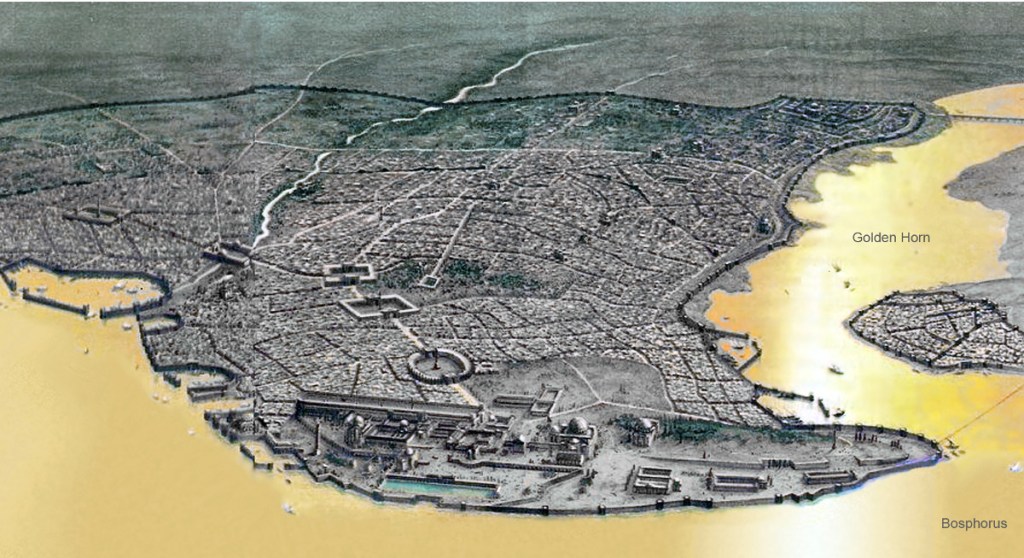
The importance of Constantinople to the empire’s survival cannot be overstated. In comparision with Ravenna in the West, the city of Constantinople was a much larger urban center. It was the capital of the unified empire after all. According to some estimates, Constantinople had a population of 450,000 by the time Justinian came on the throne. Ravenna could hardly compare with such a huge population; Also, the city of Rome was in a state of decay, and no longer had the pull that it once had.
Another part of what allowed for the city to contribute to the survival of the Eastern Empire was its formidable fortifications and its strategic position. Constantinople benefited from being located on a peninsula. This peninsula was surrounded on three sides by the Black Sea and Bosporus. The only vulnerable side was the land side, heading from the east. An army could only besiege the city from one direction and that would be from the west. Any empire that was seeking to take over the city would have to contend with a considerable navy. Time and time again, we see invaders able to surround the city but are not able to take it due to not having a skilled and large navy. This fact that the city was surrounded on three sides by water meant that the city could rely on supplies from the seas. In order to properly besiege Constantinople, one would have to cut off those supplies coming from the sea. This is where having a considerable navy is important.
The walls of the city were considerable and would remain so until the time that cannons would be used by the Turks in their siege in 1453. Even then, the cannons were only part of a huge invasion force that was surrounding the city. The cannons were sometimes not even strong enough to damage the walls. There were double walls that gave the city extra layers of protection. Ravenna simply did not have this advantage.
3. The Eastern Roman Empire had a more urban culture
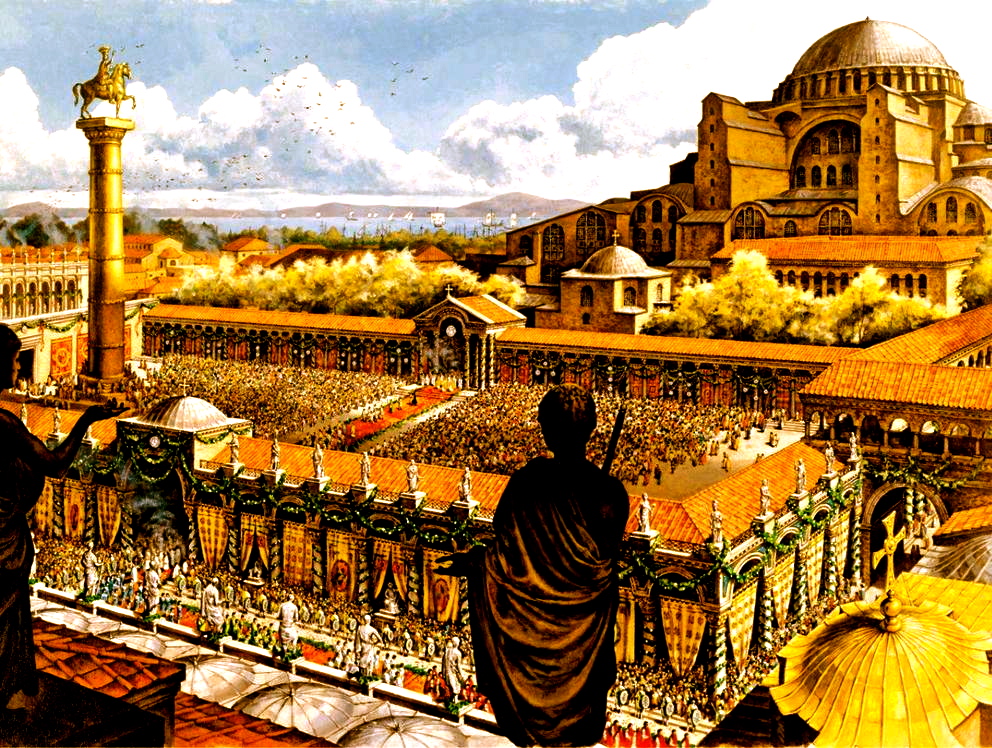
Simply put, the Eastern empire had a more established urban civilization compared to the west. The Western Empire, though it was the heartland of the empire, remained relatively undeveloped outside of a few cities like Rome, Londoninum and Lyon. Many of the provinces in the West did not have much in the way of urbanization. This is probably one of the reasons that the Romans did not try to conquer Germania the same way that they conquered Gaul; the Gaulish tribes had a more developed urban culture than the rural Germanic tribes. Despite this, the urban rate in the Western Empire was simply not that high. These provinces, before their conquest by the Romans were places that were inhabited by largely tribal people. They did not develop an urban civilization in the same way that the Greeks, Egyptians or Palmyrians did in the East. The Eastern Empire had longer periods of urbanization. It was also the location of several important big cities compared to the West. The Western Empire had Rome, but the Eastern Empire had cities such as Antioch, Alexandria and of course the rising star, Constantinople. Whatever cities existed in the West were small in comparison. Also, the trade network that had been so beneficial to the growth of cities was disrupted in the Crisis of the Third Century. This meant that cities in the West were undergoing a deurbanization process and were starting to wall their cities with stone walls. The Eastern Empire on the other hand had a thriving urban culture in comparison to the West. This thriving urban culture would prove very important with tax revenue, which the Western Empire was struggling to get.
4. Reliance on foreign mercenaries.

There is a theory in Roman histography about the barbarization of the Roman military. Scholars debate the validity of this theory but both East and West utilized foreign mercenaries in the time honored Roman tradition. However, the Western Empire was simply too reliant on them. According to an answer on Quora, one person states that the Western Empire remained effective as a military power but politically, the empire was falling apart. This makes sense as the emperor Majorian had a chance of being able to restore the Western Empire and won several major battles. The Army still remained competent and able to deal with rivals that were threatening the Empire. However, it was not enough to deal with the political instablity that damaging the empire.
5. Greater tax revenue = bribing your enemies.

One of the advantages of having a more urbanized culture was that the empire was better able to bribe barbarian invaders. This would prove to be very useful when dealing with the barbarian invasions of the Huns and Germanic tribes. The Western Roman Empire simply did not have tax revenues to utilize to bribe the barbarian tribes. Instead, it had to spend time fighting those tribes, which led to the state having less of an ability to maintain political stability. This also meant that the barbarian auxiliaries were prone to revolt, looking for whatever general would be able to pay them the most. This meant that the military would be weakened, further making it easier for the empire’s enemies to be able to probe the frontiers and sack important cities and fortifications. The Eastern Empire on the other hand, generally had full coffers until Justinian’s campaigns.
6. Geography
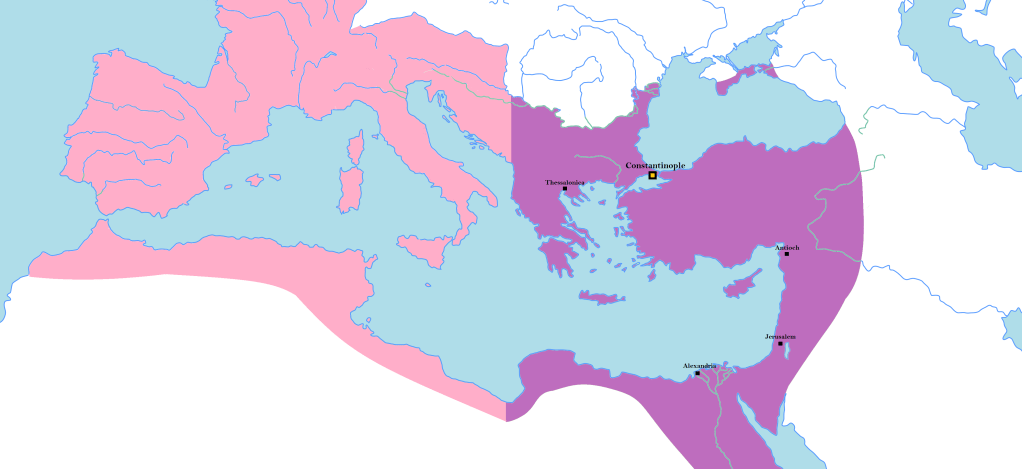
While I have talked about the geography of the city of Constantinople, there is more to the empire’s geography than just the position of the capital city. For example, for historical comparison, the United States is blessed with its geography, being surrounded on both sides by large oceans Take a look at a map of the Roman Empire in 400 ad. It is split into two divisions, both East and West for administrative expediency. These two administrative divisions surround sections of the Mediterranean, which is an excellent place for a navy. However, notice how the Western Roman Empire has much more land to defend than that of the Eastern Roman Empire. The island of Britannia was a strain on resources and the empire had been crumbling politically, making it tough to utilize the natural defenses of the Rhine and Danube. In comparison, the Eastern Empire had the breadbasket region, Egypt that was surrounded on multiple sides by desert. This meant that one of the most important regions of the empire could be defended more easily. There are also the regions of the Levant that are next to deserts. This meant that the Eastern Empire could spend more time trying to defend the Danubian frontier from the invading Germanic tribes and the Euphrates frontier from the Sassanids. The Eastern Roman Empire simply did not have to defend as much as the Western Roman Empire did. With the desert regions to the south and to the west, the empire was better positioned to not have to deal with invading armies. Of course, in the 7th century, things would prove somewhat different in this regard but at the moment in the 5th and 6th centuries, the Eastern Roman Empire was simply more secure.
This is not all exhaustive list, but these are the most important reasons for why the Eastern Empire was able to thrive while the Western Empire was falling apart. In my personal opinion, the most important reason is geography. While leaders are important, and urbanization did play a role, geography is very important. The position of Constantinople had its position chosen by Constantine for this very reason. It was easier to defend than Rome. It was also closer to the Eastern frontiers that would allow for the Eastern Army to respond to threats. The Western Empire simply did not have the same defensive advantages as Constantinople. The breadbasket, Egypt was also located in part of the empire that would not face many threats. What type of threats would it face? The only places that the enemy could threaten the province would be from upriver from the Nile or across the Sinai Peninsula. The Western Roman Empire had many places that were exposed and left open to attack by several forces such as the Huns and the Germanic tribes.
Overall, there are many reasons for why the Western Roman Empire fell but these are the main reasons why the Eastern Empire was able to thrive and survive. The Eastern Roman Empire was simply more urbanized, had better leaders and overall was in a better position geographically to deal with threats. This is not to say the Western Empire did not have any advantages. It had the Rhine as a defensible position as well as the Danube on the Eastern side of the Empire. It had control of the Western part of the Mediterranean. However, the political instability of the Western Empire left it unable to utilize those advantages. The Eastern Roman Empire was had more advantages playing for it, which led it to being more successful and being able to survive.
 Byzantine-Empire.com