


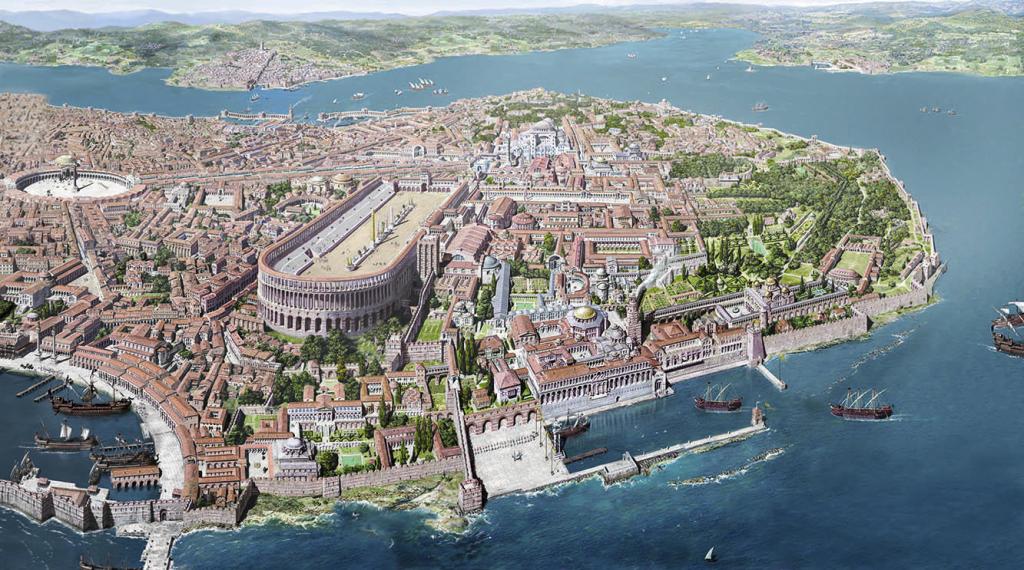
There are many things that I find interesting about the Eastern Roman Empire. One of those things is that it represents a transition from a pagan world view to one that is based on Christianity. The Roman Empire, which had ruled the entire Mediterranean world during the 1st to 5th centuries had now shrunk to a much smaller state, centered around Greece, the Balkans and Anatolia. There clearly had been a change in fortunes for the Roman state. However, at the very same time, the people who lived in that state still considered their state to be a Roman state. It was not Byzantine, but it was Roman Empire. When Theodosius I spilt the empire into two halves, what survived in the East was not a successor state but a continuation of the Roman Empire. However, historians have decided since the 16th century to use the term Byzantine in order to describe the state that arose from this political change. What was once an administrative change, was now seen a break from the Roman Empire itself. The Byzantine Empire represented something that was different from the usual Greco-Roman culture. But why is that? Why use that name instead of the Eastern Roman Empire?
The name Byzantine was used by a German historian in his book and it was used in other historian’s works as well. It was not until the 19th century that the term Byzantine would be widely used in scholarship. One of the major reasons for this is that difference between the Roman character of the state and the Greek character of the state. In Non-English histography, there was a larger usage of the Greek terms over the Roman terms. In English histography however, there was continued usage of Roman names for the state. What did those differences mean? The Roman character of the state was defined by the usage of the Latin language and certain cultural characteristics. The Roman mindset led to the creation of a powerful, militaristic republic that sought to keep power out of the hands of one man. The Greek mindset, at least from the perspective of historians of the 18th century onwards, is that of a monarchial rule by aristocrats who are worshipped like they are gods. The Romans were not familiar with the style of leadership one would find in the Greek East. There was something unique about it to that part of the world. The Romans themselves, at least those who lived in the heartland of the empire, tended to disparage this part of their Greco-Roman heritage. Look at the way in which the Romans continued to call their empire, a republic, even after the emperor had become the singular element of power in the government.
But when do we start using the terms Byzantine for the Eastern Romans? When are the Eastern Romans no longer really connected to the legacy of Western Rome in the same way? For some, the division begins as soon as Constantine decided to make Constantinople the capital of the empire. This represented a shift in power, away from the Latin West and towards the Greek East. It represented a new dawn for the empire and how it was not going to be same political system anymore. We should also pay attention to how the emperors were become explicit with their usage of power and symbolism. Homages to the Roman Republic were still important, but they were not as important as once before. To me, I think that Constantine’s choice of Constantinople was an important step but it was still not the defining line that represented a difference from the old Roman order. There was still the symbolism and structures of the Roman Latin West in the government system. Despite the emergence of Christianity, there was still usage of Pagan symbols on coins, especially on coins which were created for the celebration of Constantine’s decision to move the capital. I think that that you can make the argument that 330 AD is good dividing line between the Pagan empire and the Christian Empire. However, in terms of revealing when we should use the term Byzantine, I do not believe that this is right moment to do so. The Empire was still Roman in character, and this means that I would not use the term Byzantine to describe the Roman Empire at that point.
Then what about 395 AD? This is the moment when the Roman Empire was split into two halves. One emperor ruled in the West and the other ruled in the East at Constantinople. I generally consider this to the moment when I start locating the divergence for the two halves of the Roman state. The Eastern state was going into a whole another direction, separate from that of the Latin West. The Latin West would fall apart due to a variety of issues but one of the most important of these was its vulnerability geographically. However, do I start calling this state Byzantine? I can understand the arguments for it. The Roman state remained unified under Constantine, even though it had been previously divided by Diocletian into four other parts to be ruled by four emperors. However, with the division of the Roman state under Emperor Theosdosius, this represented a totally new reality for the Romans. They were living in two states, that were on differing paths. However, I would still not call the state of affairs in the Eastern Roman Empire at this time to be Byzantine. The Eastern Roman Empire continued to use Latin in its official government documents, and it remained the dominant language of the army. The structure of the government still remained classically Roman.
What about when the ascension of Emperor Justin II in 565AD after Justinian? To me, one can make the argument that Justinian’s reign repersented the end of something. He was one of the last emperors to use Latin in his speech and only spoke rudimentary Greek. His reign repersented the first apex of the Eastern Roman Empire, if only when it was still classically Roman. The empire still had dominance of the Mediterranean Sea. The empire was still bringing grain shipments from Egypt to feed the populace in Constantinople. The empire was still mostly being governed in Latin rather than Greek as it would become later. In my opinion, you can still call this the Eastern Roman Empire.
The conquest of Egypt by the Arabs in 641 AD, to me represents an important fissure that I think provides the best opportunity to talk about there being a change in the mentality of the state from that of a Roman mindset to one that was more based in East. When Emperor Heraclius took control of the state in 610 AD, the empire was still recognizably Roman. By time his son took power in 641, the state of affairs had changed completely. The empire had now shrunk in size and was smaller, no longer control lands from England to Syria, but having a scattered realm with holdings in Italy, Greece, Anatolia, and for a time, North Africa. With the loss of Egypt, grain shipments to the capital of Constantinople, meaning that the city would shrink in the years to come. At this point, one can reasonably call the Eastern Roman Empire, Byzantine.
To me, there are several important things to consider when using the term Byzantine for the post 641AD state. It represents a successor state to the Roman Empire not a continuation. Of course, there will those who argue that the post 641 AD state is a continuation and I think that they may be right. Here’s why. We must consider that the city of Constantinople was not captured by the Arabs, representing a continuity with the old Roman order. Second, the empire did not lose control of two of its core regions, Greece and Anatolia. However, I just do not see these as being enough for the empire to be considered to be represented as a continuation. The empire’s main region, the lands of Anatolia were reorganized into themes, which were semi-independent holdings that were responsible for their own security. This represents a shift away from the provincial model that dominated during the time of the earlier emperors. Furthermore, the loss of the wealthiest regions of the Levant and Egypt meant a reorientation of the entire empire’s economy. Now it was Anatolia that was the powerhouse of the economy not those regions. The army would also have to be reorganized into something that would differ quite alot from the late Roman Army. The Empire had changed, despite the continuity into something that I would a call a Greek commonwealth over that of the Roman Empire. I still believe that the Roman Empire lived on in the spirits of the people who live in it but the reality was quite different. It was a different state all together, one that was Christian and Greek in its character.
Then does that mean the Empire of Basil II is not Roman then? In my personal opinion, I consider the deromanization process to take a long time. When it starts in the 7th century, there was still the consideration that the empire was a Republic and many of the old offices of the Republic were still being used. However, in the 9th Century, you start to see those old titles and offices being abolished. The Byzantine Senate is also less important than it used to be, becoming what Wikipedia calls a class of dignitaries rather than an institution. The empire in the 11th century had recognizable Roman traits but it wasn’t Roman, not in the way the empire had been during the reign of Justinian.
There will be those who state that the Eastern Roman Empire continued up all the way up to 1453. These arguments can be debated again and again. But the thing is that historians need to way categorize things. Without it, we would just be lost and unable to think about these issues clearly. This is one of the reasons that historians do not consider Ancient Greece into one long line of republics, tyrannies and oligarchies. There needs to be a way to categorize Roman history into something more manageable. I believe that calling the Eastern Roman Empire, Byzantine, is a reasonable thing to do. However, I am willing to understand why people want to use the term Eastern Roman instead of it. There are nationalistic reasons for it; some Greeks believe that they are heirs to the Roman Empire and think that the term Byzantine is a term that gets in the way of them being taken seriously as the heirs. There are histography reasons for it as well. Some historians consider the Eastern Roman Empire to be a state that continued all the way up to 1453. Whatever the reason, there are valid desires to have the state called the Eastern Roman Empire instead of the Byzantine Empire.
However, in spite of that, the reason that I use the term Byzantine is because it I think it helps to represent the change in the empire from one that was Latin-speaking to one that was more monarchical and Greek-speaking in its language and government.

