


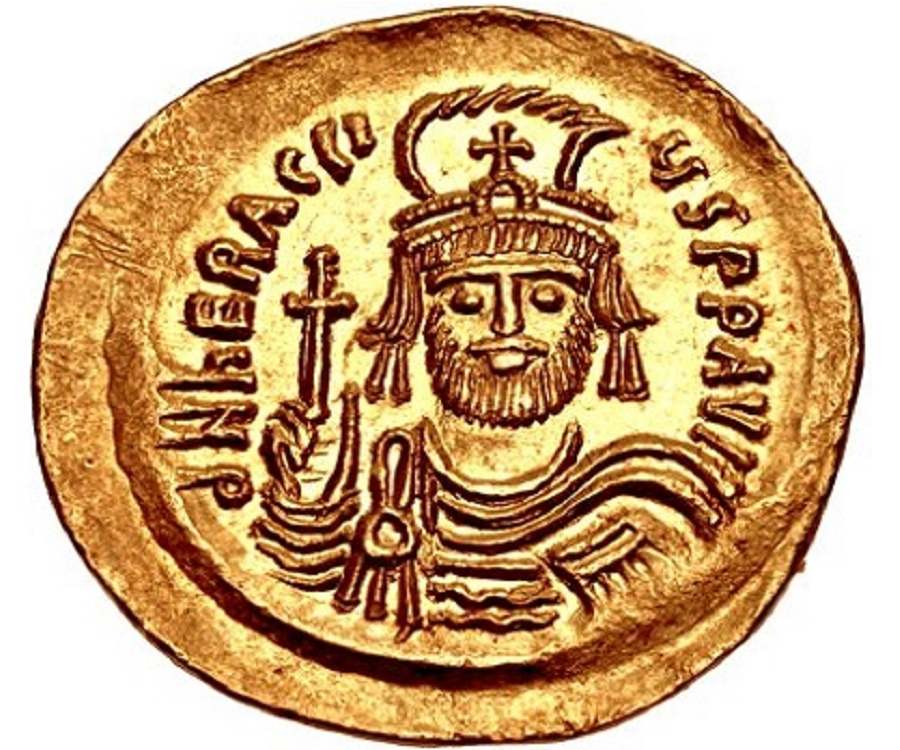
The Byzantine Empire was very chaotic. It had many civil wars compared to its Islamic and Catholic neighbors. It was an unusually urban empire that almost fell victim multiple times to its squabbling nobles.
There is a paradox here.
The empire had a huge coinage system. It also had a professional military.
The chart below showcases the many civil wars the Byzantines had in 1000 years of Emperors ruling from Constantinople.
How common were Civil Wars in the Byzantine Empire?
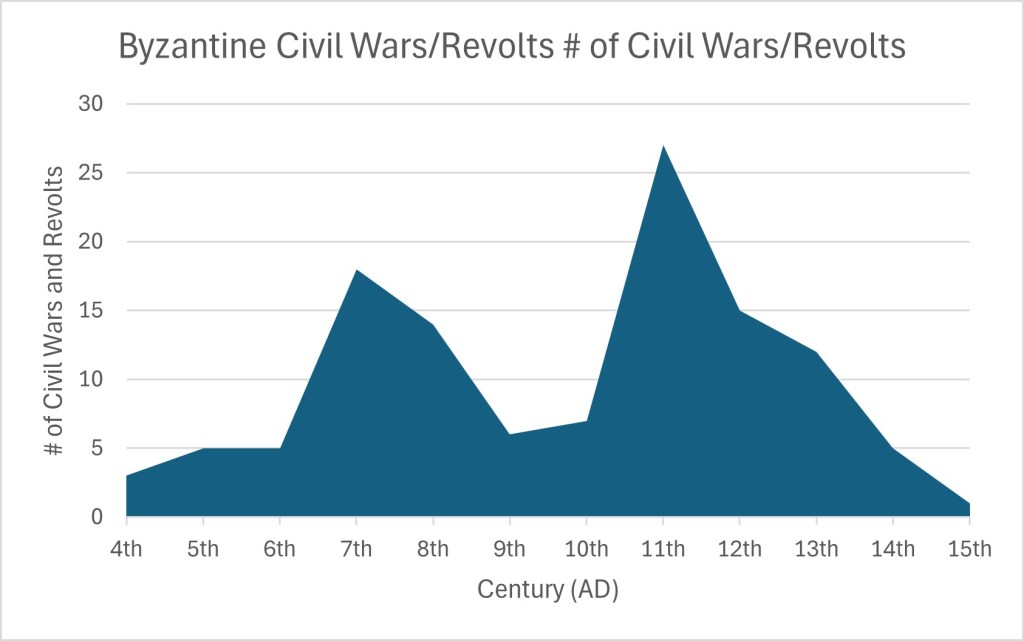
As you can see here, there two peaks of chaos in the empire. In the 7th Century, the Empire became a lot less Latin and urban and became more Greek and rural in its character. This was a time of war and massive changes as Islam overtook both the Byzantine Empire and the Sassanids. After a period of reforms, the empire would have many convulsions of Emperors overthrowing each other in the Twenty’s Years Anarchy (695-715).
The next era is in the 11th Century, when the Empire reached its territorial peak past Justinian. However, as soon as Basil II was no longer emperor, the empire would enter a state of slow decline in this age. Revolts would start popping up in Bulgaria and Serbia. The old thematic system would be under strain as the Byzantines attempted to revive the imperial culture.
The chart in some sense hides the many civil wars that formally occurred in the 14th century. While these wars were not huge in scale, they did ravage through Byzantium. It was these wars that would allow the Ottomans to eventually take control of Anatolia and Greece.
However, a question remains.
Why did the Byzantine Empire have so many civil wars?
7 Reasons why the Byzantine Empire had so many civil wars.
- The Empire did not have the tradition of primogeniture. This succession tradition meant that the oldest son often took control of their father’s lands or kingdom. The Byzantine Empire approached this tradition with more chaos. They preferred to choose someone as a successor over keeping it within their own Imperial clan. Adoption, much like in the Pagan Roman era, was still a very important ideal in the Empire. Not until the Kommenoi, would a succession process be more formal in in choosing rulers.
- The Centralized Nature of the State: The Byzantines had a highly autocratic government. Unlike the other European Kingdoms, the Byzantine crown was worth much prestige for nobility. This meant that there was much at stake for rebellion to succeed in comparison with other states.
- The size of the armies: The Byzantine Army was based on a professional system along with some levies. This meant that the military had many generals who had the resources at their disposal to start a civil war. Unlike in say the Medieval Kingdom of France, where the army was largely mercenaries and peasant levies.
- The Power of Generals in the Byzantine Armies: Generally speaking, the strategos (Greek word for Generals in armies) was an important aspect of the Byzantine hiearchy. The power of the regime was predicated heavily upon military power and control.
- The diverse groups in the empire: The Byzantine Empire has an increase in revolts starting in the 11th Century as it is struggling to transition from a state which was mostly about being a rump state of the Eastern Roman Empire to being an Empire that had imperial ambitions. The conquest of the Bulgarians meant bring in many people who were different from the integrated populations of Greece and Anatolia. This led to lots of instability as there were more interest groups in the empire.
- The Byzantine Empire was in a state of decline in the 14th Century: When the Byzantine was restored in the 13th Century, it was no longer an Empire but back to being a rump state. It was going to remain that way and compete as a regional power with the Ottoman Empire.
- The Elites and Merchant class came head-to-head in the 14th Century: In this era of decline, the Byzantine system began breaking down and central authority was largely falling away. It is in this era that you see despotes taking over places such as Mystras and Eprius. In the core Imperial region that remained under Byzantine control, the merchant classes of Thessaloniki were in conflict with the land holding classes of the empire. This unresolvable conflict led to the rise in formal civil wars rather than just rebellions which were caused by generals. Now it was between the power groups fighting over a small rump state.
The Byzantine Empire had many civil wars due to these important reasons. Overall, one can say that the Imperial system of the Roman Empire was always unstable. Under the Republic, civil wars or rebellions were uncommon. Nevertheless, in the Late Republic and continuing into the Empire, the changing nature of power and influx of money into the political system was causing chaos. In such chaos, there was less of a need for emphasizing civic virtues.
Continuing into the Byzantine era, the militarized nature of the state also helped to continue such secular trends in the Christian state. In spite of such violence, the Byzantines were remarkably a resilient and powerful state. They were great at adapting to circumstances and making their state stronger after each calamity that struck the empire.
Even with the civil wars, the Byzantine had a reputation that preceded them, and they were well known as the powerhouse of Europe before the Crusades.
 Byzantine-Empire.com