


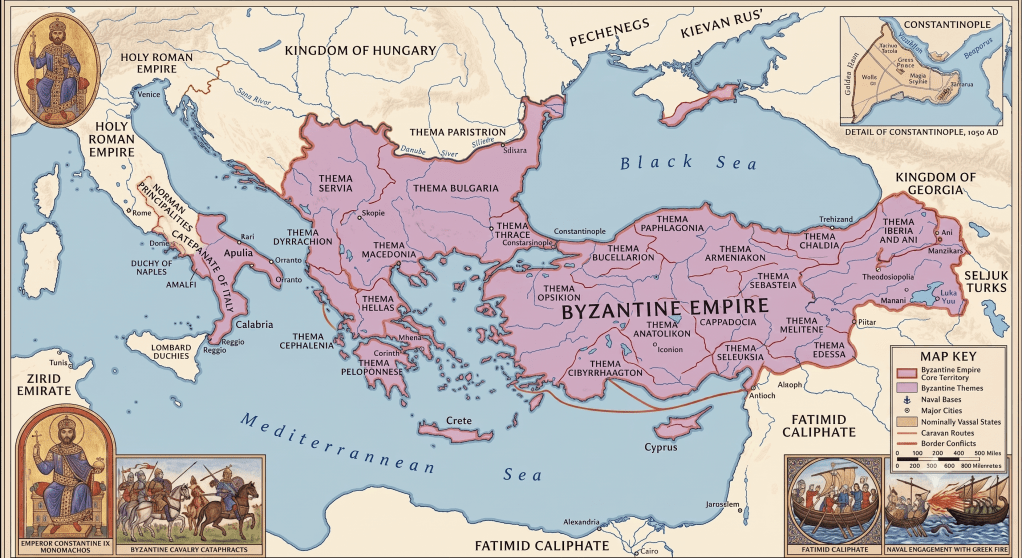
The Byzantine Empire was an empire that endured for more than a millennium. However, when was the empire truly the strongest and most influential in Europe?
The Byzantine Empire was at its height in the Macedonian and Komnenian eras
That era had to be in the time of the Macedonian Emperors to the Komnenian Emperors. Starting from the reign of Basil I in 867 AD to Manuel I in 1180, the Byzantine Empire went from crisis to crisis, but it remained the beating heart of Christendom and revitalization of European civilization.
The previous height of the Byzantine was shortly before the Sassanid and Arab Wars. The empire was bigger in those years, including the provinces of Egypt and Syria as well as holdings in Southern Spain, Italy and North Africa. However, the empire was stretched thin, economically, militarily and spiritually.
Justinian had simply stretched the empire too much and under the weight of this strain, the Lombards would invade Italy under his successor, Justin II. This is why on the historical maps of Italy after Justinian; the peninsula has Roman control mostly in the center around Rome and coasts while the Lombards controlled the inland areas excluding the ancient capital and some areas in the North and South. Sicily would remain a Byzantine Stronghold until it was conquered by the Muslims in the 9th Century.
With this context, one can see that Justinian’s empire was big on the map, but it was a fragile empire which would prove to be an issue with the Sassanids invading the empire after the overthrow of Emperor Maurice by the usurper, Phocas.
It is only after the Muslim Conquests that I consider the transition from Eastern Rome to Byzantine complete. It has shed its old Latin administrative legacy and become a fully Greek and Orthodox Empire.
The 300 year long march to success
The Byzantine Empire, in my study of its history, shows remarkable resilience. Even with so many competitive states such as the Bulgarians or the Serbians later in the 14th century, it had some way of surviving their armies and their political machinations.
The Byzantine Empire would continue to have the grip on periphery territories weaken; Sicily, once an outpost after the 7th Century, was taken by the Muslims. Sardinia, taken by the Muslims. Italy was slowly taken by the Lombards and Rome became the Papal States, independent of Constantinople’s control. Carthage, which the Emperor Constans II retook in the 660s was conquered by the Muslims again and would not again be in the hands of the Romans.
The Bulgarians before Christianization would give the empire a hard time, capturing Emperor Nikephoros I and turning his head into a drinking cup. The Rus would also be a competitor before the Byzantines managed to change their whole world view and turn a rival into an ambiguous ally.
It was really at that moment, when Vladmir the Great transformed himself and his society towards the Byzantine Christian religion, the Byzantine Empire truly became a superpower again. It was at this same time that Basil II would basically bring the empire to its greatest heights by conquering their archrival of the Bulgarians.
The height of the empire was in the mid 1150s
While the empire under Basil II was strong, it was really under Emperor Manuel I, that the empire was at its peak in influence in Europe.
It was the age of the Crusades and everyone was was trying to get through Constantinople to get to the Holy Land. So many important leaders were going through the Empire, causing havoc but still having to play by the rules of the Emperor or bending them for an advantage.
The Empire, economically, after surviving the dislocations of the Seijuk Turks and their conquests of Anatolia after the Battle of Manzikert, were able to bounce back even more. After giving concessions to the Venetians and Genoans, the capital became more consistently involved in trade. The growth of Medieval Europe from its rural feudalism to become a more economically productive region. It was now even starting to compete with the Byzantines, but it had not yet surpassed them. There was a growing market for goods and services of various kinds in the empire. While this may have hurt the empire’s independence when it grew weaker, when Emperor Manuel I was the emperor, this system of growing competition and imperial resilience helped create a superpower in Europe.
The empire may have not as been as big as under Emperor Basil II but it was probably at the height of its respect and ability to extend its power to other areas in Europe and Asia.
Bigger isn’t necessarily stronger in Geopolitics
It is important to remember that the Byzantine Empire was at greatest extent under Emperor Justinian. The army was at its biggest, the capital was at its biggest and it seemed that the old Roman system was going to continue.
However, size is not the most important thing here. It’s is a stable system and ability to innovate.
 Byzantine-Empire.com